
Arthurs Lake rewards a plan that is small enough to change. For a November or December visit, choose one accessible stretch of bank, carry tackle you can fish accurately, and leave enough daylight to find your way back. Early summer is a useful planning window, not a promise of settled weather, a particular insect hatch or a catch. This guide sets out a conservative first session for wild brown trout, using rules checked on 23 October 2026.
The Inland Fisheries Service identifies Arthurs as a naturally recruiting brown-trout fishery in Tasmania’s Central Highlands. Its western and southern shores offer bank possibilities, although some approach tracks require a suitable vehicle. The lake is also used for hydroelectric generation. Those facts make access and the water level part of the fishing decision: a familiar-looking shoreline photograph cannot tell you whether today’s footing, vehicle route or casting position is suitable.
Check the lake-specific rules before packing
The current IFS Arthurs Lake entry gives an open season of 1 August 2026 to 2 May 2027, a 300 mm minimum size and a bag limit of 12. It permits bait, artificial lures and flies. These are legal ceilings and permissions, not a suggested harvest target. The inflowing waters are closed, together with the lake water within a 50 m radius of their entrances. Do not treat an attractive creek mouth as a permitted fishing spot.
An inland angling licence is required from age 14; junior licences for ages 14–17 are free but still required. Choose the licence that covers your dates and number of rods. This plan uses one rod, which keeps the session simple. IFS allows no more than two lures on one line, but one is enough here. Fish products, freshwater crayfish and groundbait are not permitted inland baits. Leave them out of the kit even if you normally use them elsewhere.
Recheck the IFS water entry and notices shortly before travel. A licence does not settle parking, camping or access across land. Use the current access information and signs to choose a lawful approach, keep gates as found, and avoid driving a deteriorating track simply because a map shows it. This guide does not certify a particular track or campsite as open.
Find a bank you can fish and leave safely
Start with shelter, footing and a return route. A promising-looking bank is a poor choice if waves are washing the only path back. Check whether a change in wind could put rough water directly onto the shore. Look for a dry place to organise tackle, a gentle water edge for landing a fish, and enough space behind you to cast without approaching other visitors.
Treat the first ten minutes as observation time. From the bank, look for a visible transition between shallow and darker water, the outer edge of weed, a gap between submerged branches or a patch of broken surface. These are places to test, not proof that trout are present. Keep the first casts short; walking straight to the edge and casting as far as possible can overlook the water closest to you.
The IFS notes submerged timber around the Morass as trout cover. That is useful habitat context, but it is not an instruction to walk into flooded timber or fish through a closed inflow. From a lawful, stable bank, select an open lane beside cover rather than aiming into a tangle. If you cannot imagine landing a fish there, move before making the cast.
A manageable spinning outfit
A practical starting outfit is a 2.1–2.4 m light or medium-light spinning rod matched to roughly 3–12 g lures and a 2000–2500 size reel. These are editorial starting ranges, not regulations or a claim that one specification suits every shore. A beginner can use 6–8 lb monofilament throughout. An experienced braid user might choose 6–10 lb braid with about 1–1.5 m of 6–10 lb leader, increasing abrasion resistance near rough cover.
Carry a small selection rather than a large box: 3–7 g spoons, compact spinners and 45–70 mm shallow-running minnows cover several presentation choices. Check actual lure weight against the rod rating. A light lure that cannot be controlled in the wind is not automatically the subtle option. It may be better to find a sheltered bank than to keep increasing weight.
Fit hooks that suit the lure without spoiling its action. Where practical, a single barbless replacement makes unhooking more straightforward; this is a handling recommendation, not a statement that IFS requires every lure to be barbless. Bring forceps, line cutters, spare leader and a landing net with a fish-friendly mesh. Put the net somewhere reachable before fishing.
Search in a sequence you can understand
Begin with a shallow presentation that travels above the visible weed or timber. Cast along the bank at a safe angle, then gradually fan into open water. Retrieve steadily enough to keep the lure working, pausing only where it will not immediately sink into a snag. Watch the line and lure together when visibility allows.
If there is no response, change depth before changing every part of the outfit. Count a short, repeatable sink interval on the next cast, then retrieve through the same lane. A countdown is a comparison between casts, not a depth measurement: lure shape, wind and line all alter the sinking path. Stop the count earlier if the lure collects weed or repeatedly touches timber.
After covering the near water, middle distance and one deeper lane, move a short distance along safe, permitted ground. Resist changing colour after every empty cast. A useful session tests a few clear questions: can the lure travel cleanly, is the retrieve controlled, and does a different depth or angle produce any interest? Record the answer even when it is no.
If a trout follows without taking, avoid repeatedly whipping the same lure past its nose. Pause, change the casting angle or try a smaller profile that still casts safely. Do not pursue a visible fish into a closed area. One follow is evidence of a fish at that moment, not proof of a reliable spot for the next visitor.
A fly option for anglers already comfortable casting
For an experienced fly angler, a 9 ft five- or six-weight outfit, floating line and approximately 9–12 ft leader provide a reasonable starting point from an open bank. A single size 10–14 nymph or wet fly is easier to control than a complicated team in unfamiliar wind. Match tippet strength to hook size and cover rather than choosing the finest material by habit.
Only move to a dry fly when you can see repeatable surface feeding and make a controlled presentation. A size 12–16 pattern is a starting range, not a forecast of the insects present. Watch where the rise occurs, allow the fish space, and deliver a cast that can drift or sit without immediate drag. Avoid casting across people, paths or livestock. If the wind defeats safe control, use a sheltered position or stop.
Weather matters more than the calendar
IFS warns that cold water, submerged hazards and rapidly changing weather can affect inland fishing. Waterproof clothing and spare insulation belong in an early-summer kit. Keep a dry layer in a sealed bag, take drinking water and sun protection, and tell someone the shore you intend to visit and when you expect to return.
For a first visit, stay on the bank rather than making wading part of the plan. Uneven bottom, soft margins and hidden timber can turn a short step into a fall. Wear suitable footwear, work with a companion where possible, and choose a position that allows you to retreat before conditions deteriorate. A boat opens different water but brings separate equipment, operating and safety requirements; it is not a shortcut around an unsuitable bank.
This is a freshwater lake session, so tide tables are not the organising tool. Wind direction, lake level, visibility and local access are the useful checks. Review the forecast again on the morning of travel and set a firm stopping point if gusts, rain or cold make accurate casting or the return walk doubtful.
Land, release and learn
Keep the fish in the water while preparing to remove the hook. Wet hands before contact, support the body if lifting is necessary, and avoid squeezing or touching the gills. Do not carry a trout up the bank to arrange a photograph. A quick photograph is optional; an uncomplicated return to the water is the priority when releasing.
Check the leader after contact with branches or rocks and replace any damaged section. Carry out discarded line, hooks and packaging. Clean and dry footwear and tackle before moving to another water, following any local biosecurity directions. Do not transfer lake water, fish or aquatic material to a second destination.
A useful half-day plan is simple: arrive in daylight, inspect access and weather, fish one manageable shore with a consistent search sequence, then allow time to pack and leave before fatigue changes your decisions. Keep a short record of wind, water level, lure weight, retrieve depth and the positions you could fish safely. That record will improve the next visit even if this one produces no trout.
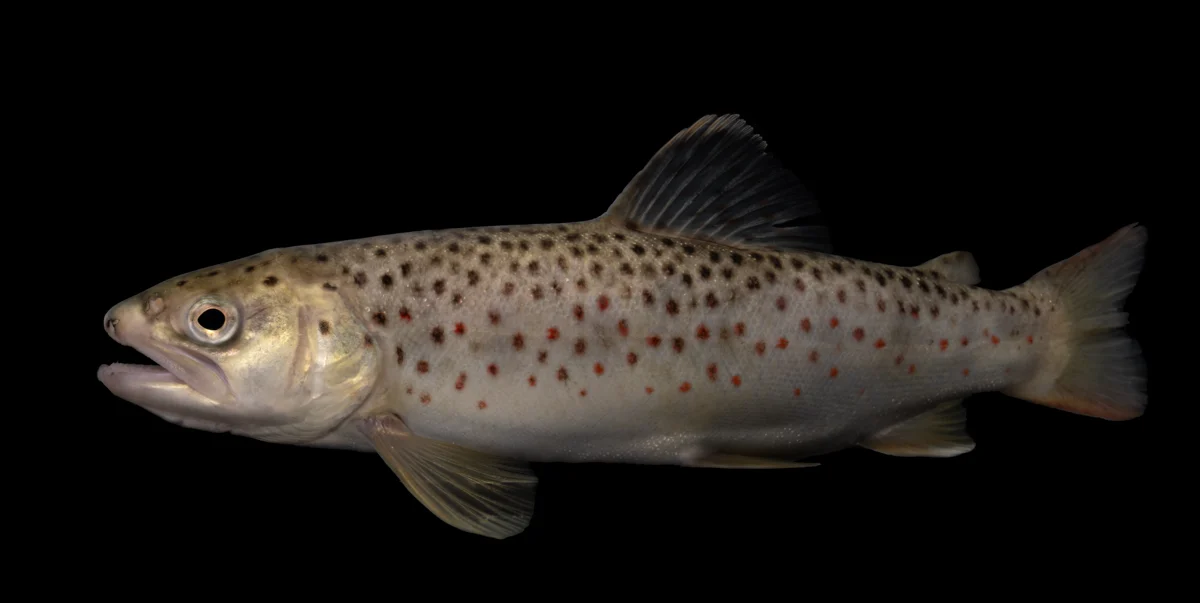
The cover is a representative photograph of brown trout, not evidence of an Arthurs Lake catch. This guide was prepared with AI assistance from the official sources listed below; it does not claim firsthand fishing experience or guaranteed seasonal results.