
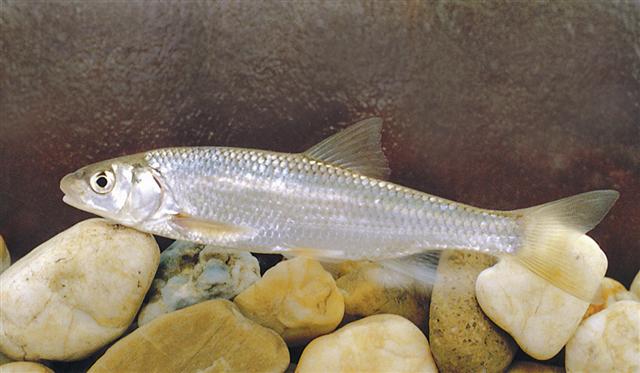
A dace float should travel through a chosen lane, not simply disappear downstream. On the River Barrow at Athy, the useful skill is controlling the relationship between moving water, loose feed and hookbait. A short, repeatable drift with little slack makes the next bite easier to interpret than a long cast that immediately pulls the float off course.
This guide concentrates on the town river pegs by Pettits SuperValu and the opposite bank near the castle. It does not recommend the downstream Maganey–Graiguecullen reach for autumn or winter float fishing. The distinction matters because that reach has a seasonal legal restriction. The tackle sizes and timed experiments below are practical starting suggestions, not measured prescriptions for every Athy swim.
Recognise the fish and its food
Dace, Leuciscus leuciscus, are slender silver fish with a yellowish eye and inward-curving edges to the dorsal and anal fins. Roach generally have a redder eye and a deeper profile. Use the combination of features; a brief flash of silver is not enough to identify a fish in a mixed Barrow catch.
Dace occur across much of Europe and into Siberia. They were introduced to Ireland and are established in several river systems, including the Barrow. They favour flowing water and may school high in the water column. Their food includes insects and small crustaceans, alongside plant material. These are broad biological facts, not a claim that every local shoal eats the same prey at the same depth.
For the angler, that creates a useful comparison: a small bait descending naturally through the water versus one travelling close to the bed. Maggots or casters let you test both with the same float outfit. You do not need to reproduce an exact local insect species before making a controlled presentation.
Start at a documented access point
Athy & District Anglers maintains approximately eighteen permanent town pegs. Its current river information says membership is not required for those river pegs, although club matches can restrict their availability. Check the club’s notices before travelling and use an unoccupied, stable position with room for other towpath users.
The river generally has slow to moderate flow here, but rainfall can change both level and speed. Depth can increase rapidly away from the bank. Neither a photograph of a peg nor the town’s year-round fishing reputation establishes today’s depth, safety or fish location.
Start by looking at the nearest controllable water. Follow bubbles or floating fragments to see whether one lane travels evenly while another accelerates or turns. A seam beside stronger flow is a candidate because you can deliver bait through it repeatedly. An eddy is a different test: the float may circle back, and loose feed may accumulate somewhere other than beneath it.
Where safely visible, note weed, a shelf or a change from shallow margin to deeper water. Treat these as features to measure, not proof that dace are present. Avoid privately controlled game-fishing water around weirs. Permission to use a public approach does not confer access across adjoining private fields.
Plumb before feeding
Attach a suitable plummet to the hook and lower it rather than throwing it hard. Adjust the float until you can identify the depth at the beginning, middle and end of the intended drift. Compare a near lane with one a little farther out.
If the plummet is too heavy for the fine hooklength, use a stronger temporary plumbing arrangement. Remove it completely before fishing. Do not repeatedly drag a hooked rig through unknown bottom debris.
Begin with the hookbait just clear of the bed, then test shallower presentations. A float that dips at the same downstream point on every run probably signals a depth change or obstruction. A bite may occur there too, but the repeated pattern is a reason to investigate rather than strike harder.
Build a light river-float outfit
A 13–14 ft float rod gives useful reach for lifting line away from the surface. Pair it with a small 2000–3000 fixed-spool reel and approximately 4 lb nylon main line. A 30–45 cm hooklength around 2.5–3 lb and a size 18 single barbless hook are starting choices for one maggot. Increase strength where the actual obstacles demand it; avoid choosing a swim that requires fine tackle to pull fish through heavy snags.
For a reachable, steady lane, choose a top-and-bottom attached river float, perhaps carrying roughly 1–2 g. Thread the line through its attachment and secure the stem with suitable silicone sleeves according to the float design. Slide it along the line to set depth, without trapping or damaging the line.
Add shot gradually until only the visible tip remains above water. Start with most weight in a small group approximately 45–60 cm above the hook, then place two or three much smaller droppers below it. Keep the lowest shot clear of the hook and check the entire rig for tangles.
This arrangement takes the bait through the upper water reasonably promptly while leaving the final descent less abrupt. To test fish feeding higher, spread the shot farther apart. To overcome a quicker flow, concentrate more weight higher on the rig and choose a float with adequate carrying capacity. Use the lightest arrangement you can control, not the smallest float in the box regardless of conditions.
Make the drift work
Cast a little upstream of the feeding lane, feathering the line before the rig lands so it straightens. Lift excess line away from crosscurrents and let the float settle. Feed line smoothly enough that the reel does not stop the drift in short jerks.
First allow a free run. On the next few drifts, briefly check the float with light line tension. Checking can lift or slow the bait; it is a comparison to observe, not a rule that dace always prefer a slower offering. If the float leans, skates toward you or drags across the seam, you are holding too firmly or controlling too much line at once.
End the drift while you can still see the tip and make a controlled strike. Letting it travel another twenty metres often reduces both bite detection and repeatability. Retrieve without sweeping through another angler’s water.
When the tip decisively submerges or stops differently from its normal travel, close the bail if necessary, recover slack and make a short upward lift. A small hook and light line need little force. Keep the rod bent while guiding the fish toward a waiting net.
Feed for a lane, not a large area
Start with a small pinch of locally sourced maggots, perhaps four to eight per drift. Adjust the landing point upstream so the loose bait can sink toward the part of the lane you are fishing. The correct point depends on current and depth; throwing beside the float may put feed downstream of the hook by the time both settle.
Try a single maggot first, lightly nicked through the blunt end so the hook point remains exposed. Two maggots add bulk and can be compared if tiny fish repeatedly take the first offering. A caster on a suitably matched hook provides another compact option. Use fresh bait that stays on during the cast.
If bites develop higher in the water, shorten the depth and spread the shot before increasing feed heavily. If there are no bites, adding more food is not automatically helpful. Check the hookbait, the drift and the depth first.
Bread is another small-bait experiment, but it must survive the cast and drift. Pinch a modest piece around the shank with the point clear. Avoid moving live fish or leftover bait between waters; buy bait locally and dispose of leftovers responsibly.
Choose an alternative when the drift is wrong
A bottom-attached waggler can suit a lane farther out where surface wind makes top-and-bottom float control awkward. As a starting arrangement, use a float around 2–3 g, with most loading near its base and light droppers toward the hook. Set its depth by plumbing, cast beyond the lane if space permits, then settle into position.
Sink the line carefully to reduce wind drag. Keep checking that the sunken line itself is not towing the float unnaturally through faster water. A waggler offers reach, but it does not solve every deep or turbulent swim.
| Observation | Starting choice | What the change tests | Main caution |
|---|---|---|---|
| Even near-bank flow | Top-and-bottom river float | Repeatable moving bait | Avoid pulling the float across the seam |
| Fish taking bait on the descent | More spread-out shot | A slower final fall | Tangled droppers can mimic missed bites |
| Deeper, quicker lane | More carrying capacity and grouped shot | Reaching depth earlier | Stop if the swim cannot be controlled safely |
| Crosswind on an outer lane | Bottom-attached waggler | Reduced surface-line drag | Recheck depth and underwater line bow |
| Repeated dips at one point | Shorter depth or adjacent lane | Bottom contact versus a bite | Do not keep striking into a snag |
A feeder is a further alternative for stationary bottom presentation, but it answers a different question. For this dace session, compare two float lanes first. Switching immediately to a heavy feeder can abandon the moving-bait test before you have established whether fish are higher in the water.
Work through a two-hour session
Spend the first fifteen minutes checking access, selecting a stable peg and plumbing two lanes. Assemble the river float with one maggot and begin just clear of the bed. Make several unbaited practice drifts to learn the float’s normal path.
For the next twenty minutes, feed a small pinch consistently and fish the same line. Record where a bite occurs within the drift. If bites begin before the bait reaches full depth, test a shallower setting. If the rig returns tangled, fix that before changing the bait.
After another quiet period, alter one thing: depth, shot distribution or the adjacent lane. Try a caster only after the rig is presenting reliably. There is no requirement to remain on an unresponsive peg for the entire session, but moving without first testing depth teaches little.
In colder weather, use the safest manageable flow and modest feed. The middle of the day may be a convenient comparison with an early session, but no verified Athy evidence establishes a universal winter bite hour. Rising water, colour and debris can matter more than the clock. Stop when conditions deteriorate rather than treating a flood as a tactical opportunity.
Local rules and brief handling note
Checked 29 October 2026: Inland Fisheries Ireland limits freshwater fishing to rod and line, with no more than two rods, and prohibits live fish as bait. This plan uses one single barbless hook, no worms and prompt release. Confirm current local salmon-water restrictions even when targeting dace. Bye-law 1011, 2024 restricts angling from Maganey Bridge to Graiguecullen Bridge from 1 October through 31 January, with a dead-bait exception; do not extend this float plan into that reach. The town pegs described above are a separate location.
Use wet hands and a small suitable landing net, unhook promptly and release without placing fish on the bank. Leave unstable or flooded approaches, keep the towpath clear and clean tackle before moving to another water.