
Aysén is a large destination, so a useful first trout itinerary should be deliberately small. Base the trip around one river reach whose access and current conditions you can confirm, leave room for weather changes, and make cleaning equipment part of every move. November and December offer different legal conditions for river fishing; they should not be treated as interchangeable dates on a booking calendar.
This guide is for a conservative freshwater trout session, with brown trout as the cover species and rainbow trout included in the tackle plan. It does not identify a guaranteed public bank or promise fish in a named pool. Rules were checked on 23 October 2026 against Sernapesca’s announcement for the new season. Practical tackle ranges below are editorial starting points rather than official recommendations or firsthand catch reports.
Read the season by water type
Sernapesca announced that Aysén’s freshwater season began on 12 October 2026. Its regional river schedule requires release through 30 November. From 1 December 2026 through 28 February 2027, the announced river allowance is up to three fish or 15 kg, whichever is reached first, per angler per day. Mandatory release resumes from 1 March through 6 May 2027. This guide recommends a release-focused trout trip; the allowance is not a target.
The lake timetable differs: mandatory release runs through 9 November, with the announced retention period from 10 November 2026 through 1 April 2027, followed by mandatory release to 6 May. Do not transfer a lake rule to a river. Chinook salmon have a separate schedule and are outside this trout plan.
Before choosing a reach, confirm any water-specific restrictions, protected-area conditions and land access with the relevant authority or an operator who can identify the applicable rule. A regional announcement does not prove that every gate, trail, reserve or bank is open to you. If a local restriction is unclear, choose a confirmed alternative rather than interpreting silence as permission.
Arrange the licence before travelling to the river
The current announcement requires a valid recreational licence, artificial lures and one rod per person. Exemptions depend on age, residency and other qualifying circumstances; a visiting foreign angler should not assume that a resident exemption applies. Use Sernapesca’s official licensing service and carry the issued licence in a form you can show during a check.
The licence portal warns that payment confirmation can take up to 48 hours and advises against paying twice simply because the licence has not yet arrived. Build that possible delay into the itinerary. A payment receipt is not something this guide can certify as a substitute for an issued licence. Resolve any problem before fishing.
Keep the first day geographically simple. Choose accommodation and an access arrangement that do not require a long drive after an unfamiliar river session. Ask an operator or land manager to confirm where you may park, where the permitted approach begins, whether a locked gate or fee is involved, and how you should leave the property. Do not equate a road crossing with unrestricted access to both banks.
Select a reach for control, not distance
From safe ground, look for a modest piece of water you can cover without crossing the river. A slow edge alongside faster flow, a pool tail with a clear bank, or an open lane beside structure can provide a manageable first test. These are habitat features to assess, not claims that trout occupy every such place.
Observe before wading. Watch the surface for drifting material, changes in flow and places where a snagged line would be difficult to recover. Decide where a fish could be landed and where you could retreat if the level rises. If the only plausible landing position lies beyond a deep channel or unstable bank, the reach is unsuitable for this plan.
Stay out of water you cannot confidently assess. A wading staff, belt and appropriate footwear are useful equipment, but they do not make fast or opaque water safe. A first visit with a competent local guide can help with access and decisions; it does not remove your responsibility to stop when conditions exceed your ability.
One spinning outfit and a small lure box
For bank fishing on a moderate river, a 2.1–2.4 m light or medium-light spinning rod rated around 3–15 g is a practical starting point. Pair it with a 2000–2500 size reel. A beginner can use 6–10 lb monofilament; a more experienced angler might use 8–12 lb braid and approximately 1–1.5 m of 8–12 lb leader. Choose the stronger end near rough cover or where a fish needs prompt control.
Carry a few 3–10 g spoons or spinners and 50–80 mm minnow lures that can be worked at different depths. Use artificial offerings only. Avoid a complicated multi-lure rig: one lure makes casting, snag avoidance and unhooking easier to manage. A suitable single barbless hook is a practical release recommendation, not a claim that the regional announcement mandates that hook on every lure.
Match lure weight to both current and rod rating. A heavy spoon dragged along the bottom can snag before it reaches the intended lane. A very light lure that is swept away before you gain control may be equally ineffective. Test a short cast where you can see the lure work, then adjust weight or angle before fishing farther away.
Work the water in a repeatable sequence
Begin with the nearest plausible holding water. Cast slightly upstream or across the flow where the bank and other users allow, recover slack, and keep enough contact to know when the lure changes direction. Allow the current to influence the presentation without letting the line form an uncontrolled loop around rocks or branches.
Use several casts to cover a narrow lane, then alter the angle. A trout may see a lure differently when it arrives from upstream rather than swinging broadly across the current. That is a reason to vary presentation methodically, not a guarantee that a reluctant fish will take. If the lure repeatedly catches bottom, retrieve sooner or choose a shallower path.
Move only after you have tested the accessible near water and one or two farther lanes. Do not cross the river simply to reach the opposite bank. A follow or missed take can justify a pause and a change in profile; it does not justify trampling a fragile edge or entering an area whose access is unconfirmed.
If you hook a fish, guide it towards the landing position already selected. Keep steady pressure and avoid lifting it by the line. Strong enough tackle and a prepared net usually offer a better release process than attempting to tire a fish completely before deciding how to land it.
A fly-fishing alternative
For anglers already comfortable with fly casting, a 9 ft five- or six-weight rod and floating line offer a manageable starting point on modest water. Begin with a leader around 9 ft and tippet suited to the fly and current. A single size 10–16 nymph or dry fly is easier to control than a complicated rig while learning a reach.
Choose a dry fly when observable surface feeding gives you a reason to try it. Without that evidence, a carefully controlled subsurface presentation may be a more informative test. Do not announce a particular hatch or an exact emergence time from the season alone. Wind, water condition and the insects actually present should guide the choice.
Check the entire casting space, including the bank behind you. If wind prevents safe control, shorten the cast, move to a sheltered lawful position or stop. Changing to spinning tackle can be an option if that method is permitted for the exact water, but it is not a reason to fish conditions you cannot manage safely.
Make biosecurity part of the itinerary
Sernapesca’s didymo guidance calls for removing visible material, washing equipment and drying it before reuse. Pack the cleaning kit before the first fishing day: a bucket, brush, suitable detergent and bags to separate wet equipment from clean gear. Avoid absorbent felt soles when choosing footwear.
The agency specifies soaking fishing equipment for one to two minutes in a mixture of 500 ml dishwashing detergent and 10 litres of water, and says not to return the wash water to the river. It also advises allowing equipment to dry and waiting at least 48 hours before using it again. Follow current local instructions and any cleaning station directions, particularly when moving between catchments.
Do not schedule a rapid sequence of different rivers that your equipment cannot support responsibly. A spare clean, dry set or a longer stay at one destination can make the plan more realistic. Clean nets, boot seams and other easily overlooked surfaces, not just the visible outside of the waders. Keep contaminated wash water and loose material out of another water body.
Plan the day around the return journey
Check the forecast and local river condition before setting out. Pack waterproof layers, dry clothing, food, water, a first-aid kit and a way to communicate appropriate to the area. Leave your route and expected return with someone who can act if you do not return. Do not assume mobile reception at an unfamiliar bank.
A useful first day has a modest structure: confirm access and the rule for that reach, inspect it in daylight, fish a short section with one repeatable method, then stop with time left for cleaning equipment and travelling back. If rising water, worsening visibility or fatigue changes the risk, shorten the session. There is no catch target that makes an uncertain crossing necessary.
Keep released trout in the water as much as possible, wet hands before contact and avoid handling gills or squeezing the body. A photograph is optional. Note the conditions and presentation in your journal without presenting one session as a reliable forecast for the whole region.
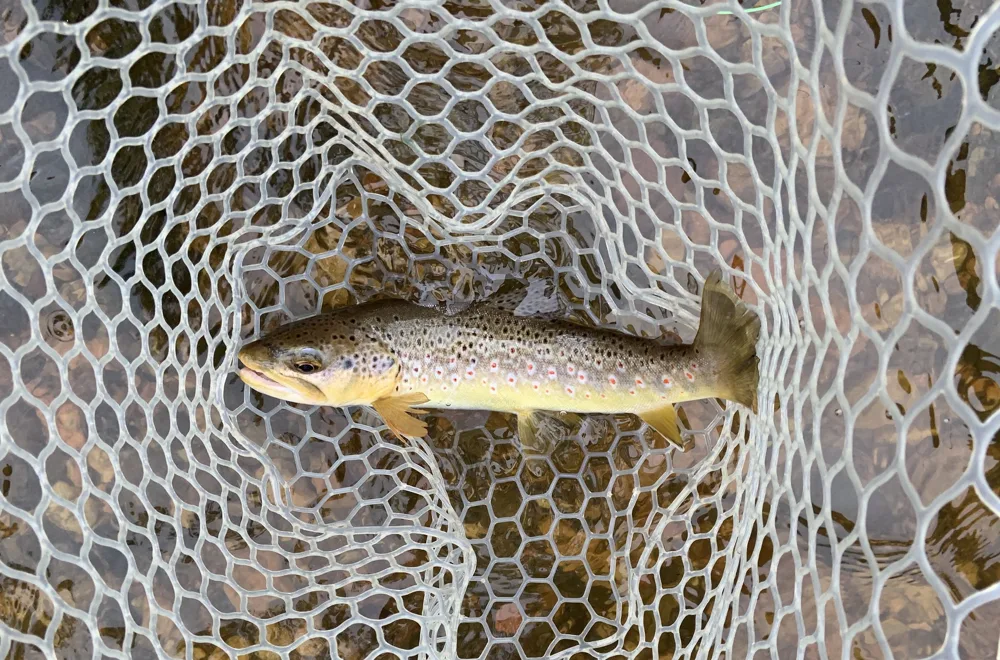
The cover shows brown trout for species context; its source does not establish an Aysén location. This AI-assisted guide draws on the official sources below and makes no claim of firsthand reporting, guaranteed seasonal success or unrestricted access.