
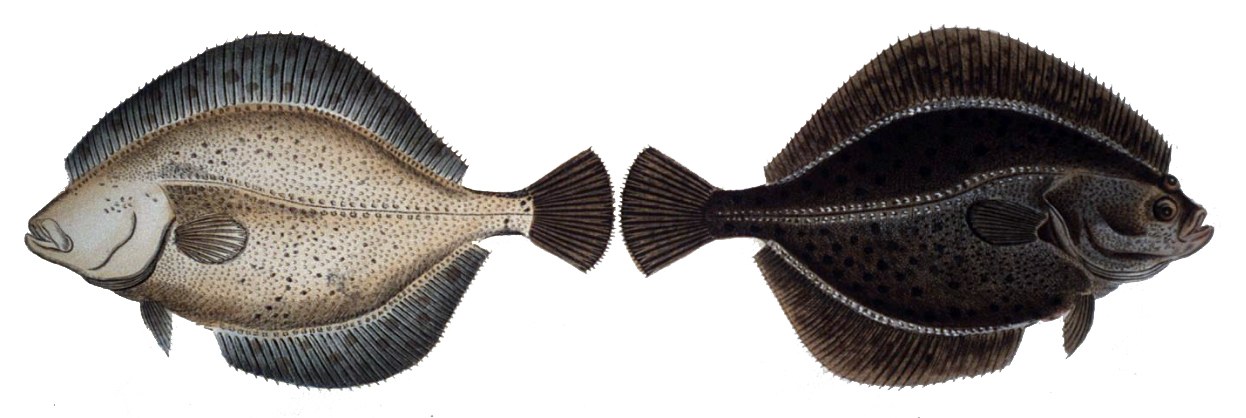
Flounder fishing becomes easier to understand when you stop treating the farthest cast as the best one. A bait on a clean strip of sand beside a tidal channel can be more useful than a distant bait rolling through weed. Around Ballyteigue in County Wexford, the beach and estuary entrance offer different kinds of water; choose one that you can fish from firm ground with a safe retreat.
The plan below is for a measured autumn or early-winter shore session. It uses published location information, not a claim of recent catches. Mobile sand, tide strength, weed and access conditions can change what is practical on the day. A named mark is a starting area to inspect, never permission to cross private land or wade into a channel.
Recognise the fish and its feeding level
European flounder, Platichthys flesus, are native to Ireland and European coastal waters. They live close to the bed, with both eyes on the upper side of a flattened body. The upper surface is variable brownish or greenish-grey and may have orange markings; colour alone should not be used to separate them from every other flatfish.
Plaice and dab are different species. Use a reliable identification guide to check the complete fish rather than relying on an orange spot or assuming that every estuary flatfish is a flounder. The unusual flat body is an adaptation to life on the bottom, so a bait held well above it can miss the feeding zone.
Young flounder eat small invertebrates and plankton, while adults take worms, molluscs, crustaceans and small fish. They can travel well into brackish and fresh water; mature fish move into deeper coastal water to spawn in winter. That movement makes a winter estuary session uncertain rather than guaranteeing that fish will remain in a particular hole.
Choose the beach or the estuary edge deliberately
Ballyteigue Strand extends west of Kilmore Quay. The published coastal guide also describes the estuary behind Ballyteigue Burrow and the entrance approached from Cullenstown on its western side. It identifies flounder as a local target and crab, lugworm and bottom-fished fish baits among useful options.
The outer beach gives room to cast but can collect substantial floating weed, particularly with spring tides and onshore conditions. The entrance concentrates water movement and may be unsuitable when flow is strong. A historic deep-hole description is not a current depth measurement, nor an invitation to fish beside moored boats.
Inspect at a modest tide in daylight. Identify a firm bank above the water, the nearest clean sandy lane and the complete route back. Stay off soft mud and isolated sandbars; do not cross the channel. If the only way to reach a supposed hotspot requires wading into moving water, choose the beach or another location.
On the beach, look for a shallow trough or a break in the shoreward wash. At the estuary edge, look for a slower strip beside faster flow. These are candidate feeding routes, not proof of fish. Start short and work outward so that you do not repeatedly cast across fish in the near margin.
Match tackle to the lead you can control
For sheltered, short-range work, a 9–11-foot rod rated for roughly 1–3 ounces and a 4000-class spinning reel offer a manageable starting outfit. More exposed beach work may require a proper surf rod and heavier terminal tackle. Match the rod to the complete cast weight, including bait.
A 12–18-pound nylon mainline can be a useful starting range on clean ground. When casting a lead, use a suitable shock leader of adequate length and strength for the weight and casting style; a common conservative starting calculation is about 10 pounds of leader strength per ounce of lead, with several turns on the spool. Check knots and never power-cast around other people.
Carry 1–3-ounce leads in a few shapes, size 4–1 single bait hooks, swivels and 12–20-pound snood material. These are practical ranges for small baits, not universal specifications. If the tide needs so much weight that the outfit or bank position becomes unsuitable, wait for easier flow or move.
Rig one: a running ledger along clean sand
Slide a lead-running link onto the shock leader, then add a bead and tie to a swivel. Attach 45–75 centimetres of snood to the other end and finish with a single size 4–1 hook. Clip the lead to the running link. The hooklength should lie near the bed without wrapping around the lead.
Thread a compact lugworm bait along the shank, leaving the point clear and a little tail movement. A small piece of legally obtained crab can be secured lightly with bait elastic, keeping the hook gape open. A narrow fish strip is an alternative to test; a large dangling bait makes small taps harder to interpret.
Cast slightly across the current rather than automatically straight into its strongest part. Allow the lead to settle, then take up slack until the rod tip has a light bend. Watch whether the rig holds or travels. A little controlled movement over clean sand can search water, but a lead that races around the corner is not presenting a bait predictably.
When the current slackens, a rounded lead can allow a gentle sweep. In stronger flow, use a lead that grips sufficiently without exceeding the rod rating. Change angle or shorten distance before repeatedly increasing weight. The running arrangement works best when the line can move freely and the hooklength is not buried in weed.
Rig two: a short paternoster for a stable presentation
Build a strong rig body approximately 70–100 centimetres long, with a swivel at the top and a secure lead link at the bottom. Attach one short 20–35-centimetre snood above the lead, positioned so the bait can fish close to the seabed. Use appropriately rated rig components and tested knots.
A one-hook version is simple and reduces tangles on mixed ground. On known clean sand, a second short snood can compare two small baits, but it also adds drag and hooks. Ensure the snoods cannot reach each other. More hooks are not automatically more useful than one bait placed accurately.
Cast smoothly and gently tighten as the rig settles. A short snood is less likely to wrap around the trace in moving water, though it gives the bait less freedom than a long running-ledger trace. Choose it when turbulence or tangles repeatedly spoil the simpler rig.
Keep an eye on the tip throughout. Flounder can produce small taps, a steady pull or a slackening line. With a conventional bait hook, reel to contact and lift positively but without a violent strike. Do not deliberately wait through repeated bites to encourage swallowing; these fish can become deeply hooked.
Work with changing flow
A bait cast into one position does not remain at the same depth as the tide rises. Move the casting target shoreward when newly covered sand provides an accessible clean lane, or toward the nearest channel edge as water recedes. Reassess the return route at the same time.
Try the slower part of the tide when the entrance is otherwise difficult to hold. That is a control decision, not a claim that slack water is always the best feeding period. Likewise, lower light may suit feeding fish but does not justify an unfamiliar first visit after dark.
A tiny soft plastic on a light jig can be an occasional active alternative over clean, sheltered ground. Use a compact worm-shaped body, very short lifts and pauses near the bottom. It is a search experiment rather than a replacement for the better-established local bait approach. Avoid using tackle so light that it cannot maintain contact in the flow.
| Water or problem | First choice | What to watch | Next adjustment |
|---|---|---|---|
| Clean sand with gentle flow | Running ledger and compact worm | Slow sweep and readable taps | Change cast angle |
| Turbulence and repeated tangles | Short paternoster snood | Bait returning straight and clean | Reduce to one hook |
| Weed accumulating on line | Shorter cast on a cleaner lane | Tip loading without genuine bites | Move or end the session |
| Bait untouched after several casts | Different nearby depth or distance | Repeatable response | Test another small bait |
| Baits stripped rapidly | Smaller, firmer presentation | Hook point and gape still clear | Shorten inspection interval |
A worked two-hour session
Arrive before your chosen manageable tide stage and spend the first quarter-hour walking the safe bank. Pick two lanes: one close to shore and one farther out, both free of moorings and obvious obstacles. Assemble the running ledger with a modest lead and small worm bait.
Fish the near lane first for roughly ten minutes, then inspect the bait and trace. If it is clean, repeat slightly farther out. If it returns weeded, move rather than extending the soak. The aim is to compare fishable presentations, not time spent with a hidden hook.
After several quiet casts, try the shorter paternoster with a different small bait. Keep distance similar so the comparison means something. A bite on crab at the farther lane suggests a combination worth repeating; it does not establish that crab will always win.
During the final hour, follow the changing edge only from safe ground. Reduce the number of changes once bites become repeatable. Write down tide stage, distance, lead weight and bait condition. These observations will make the next visit more useful than relying on an old record fish or a broad claim about winter.
Brief rules and fish care
Check Inland Fisheries Ireland's current regulations, local access and any protected-area conditions before fishing or collecting bait. Bass and sea trout can occur in these waters and have separate rules; do not apply a flounder plan to them automatically. The linked 2026 bass rules specify a 42-centimetre minimum and seasonal retention conditions. Release unintended catches promptly when you are not certain of the applicable requirements.
Use wet hands, support the fish and carry a disgorger. If a hook is deeply embedded, avoid damaging probing. Leave when weed, current, waves or darkness make the position unsuitable. A clean bait on a short, controlled cast from a safe bank is the central lesson of this session.