An early-summer framework
Kahawai are found around New Zealand, and the Bay of Islands offers beaches, rocky points and tidal channels where shore anglers can build a sensible early-summer plan. December does not guarantee surface feeding or easy access. Wind, swell, boat traffic, bait movement and local closures change what is possible. The reliable method is to pick a safe legal shoreline, cover water with modest lures and keep a second, sheltered option.
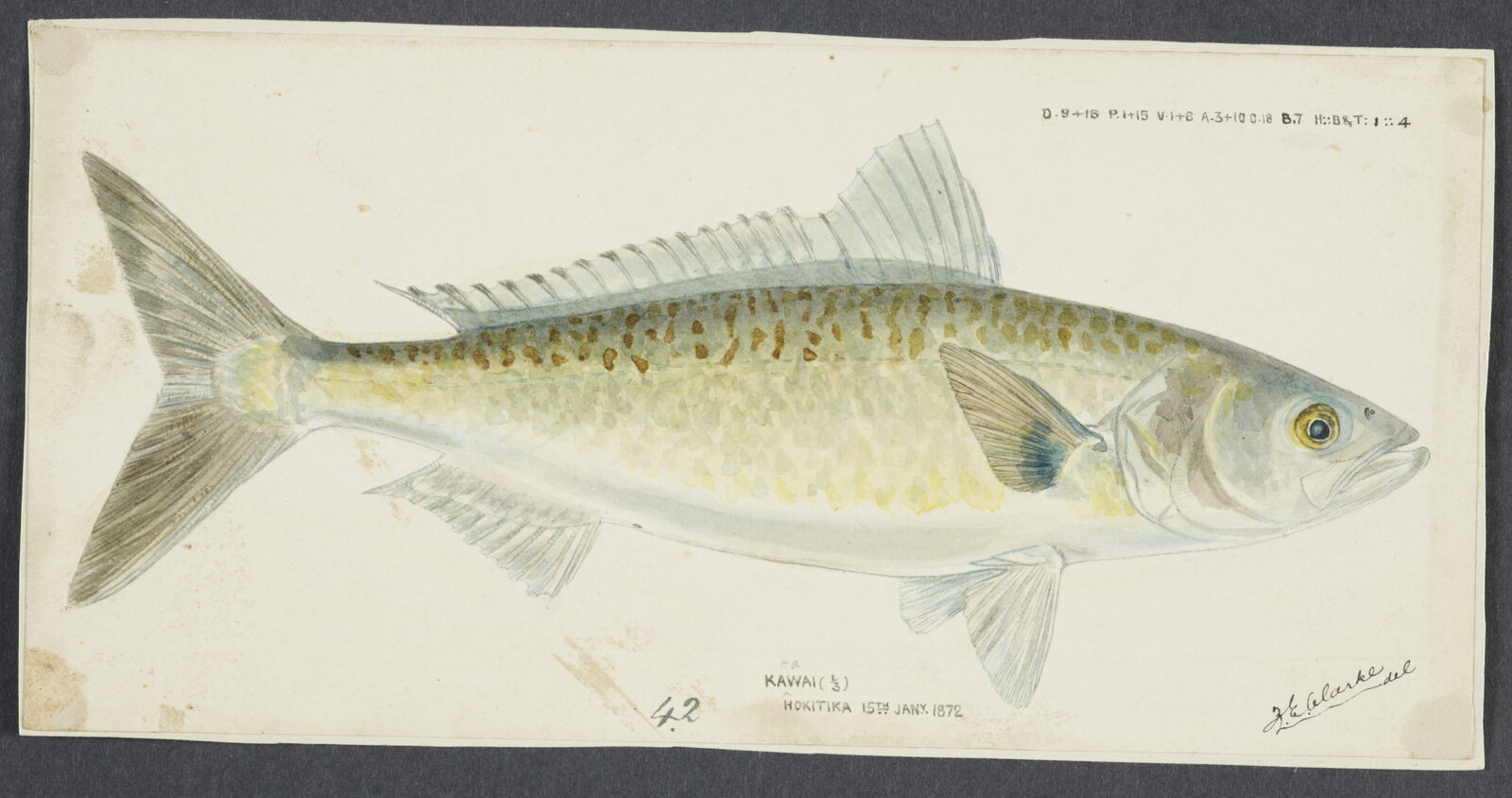
The cover is a public-domain 1872 scientific illustration of Arripis trutta by Frank Edward Clarke, held by Te Papa. It shows the whole fish clearly but is labelled as a historic illustration, not a modern field-identification photograph or a Bay of Islands catch.
Rules before rods
Fisheries New Zealand says recreational fishers are legally required to follow current rules, which can change and differ by area. Use the NZ Fishing Rules app or the live Auckland and Kermadec area page for the exact location. Check daily limits, size rules, closed areas, customary management areas and method restrictions before keeping any fish.
Do not copy a number from an old screenshot into a trip plan. MPI’s pages were updated in October 2026 and specifically recommend live rule checks. If a mātaitai, taiāpure, marine reserve or temporary closure applies, its conditions can differ from the general area. When unsure about a boundary, fish somewhere clearly outside it or seek official clarification.
Shore selection and access
Choose a beach corner, public wharf where fishing is allowed, or low rock platform with a dry retreat. Confirm land access and parking; a public-looking track may cross private property. On rock, identify the highest wet line and watch several wave sets before carrying gear down. A lifejacket designed for rock fishing, grippy footwear and fishing with a companion add meaningful safety.
Kahawai often pass current seams, channel edges and the down-current side of points. On beaches, look for terns, nervous bait or a colour change, but do not chase birds into unsafe surf. At a wharf, keep hooks away from people and boat lanes. Move if a position cannot be fished without conflict.
Tackle and lure sizes
A 2.4–3.0 metre rod rated around 10–40 grams offers casting reach while retaining sport. Pair it with a 3000–4000 reel, 15–20 lb braid and a 15–25 lb leader. On rock, a longer abrasion leader is useful; on open beach, a slimmer connection improves casting.
Carry metal lures around 15–35 grams, 9–14 centimetre minnows and a few surface lures. Replace trebles with strong singles when appropriate to simplify release, but balance the lure so it still swims. Pliers, cutters, a rubber net or safe landing plan, a damp mat and a legal measuring tool should be ready before the first cast.
Reading the water
At a beach, start by casting across the edge of a rip or channel rather than straight to the horizon. Count a metal lure down briefly, retrieve briskly, then repeat at a slower speed. Kahawai can feed near the surface, mid-water or behind deeper bait; a complete search covers all three.
On a point, cast up-current and retrieve across the seam. Keep enough tension to control the lure without dragging it unnaturally. If birds are working, approach without entering their feeding zone by boat or foot and avoid casting into densely packed wildlife. A surface splash is information, not permission to ignore waves.
Retrieve options
For a metal lure, use a quick steady retrieve with occasional half-second pauses. If fish follow but turn away, reduce speed or change to a slimmer bait. A minnow can be swept and paused in calmer water. A surface lure works best when the sea allows visual control and birds are not at risk.
When a fish strikes, keep winding until the rod loads, then lift smoothly. Kahawai often jump and change direction; a high, rigid rod can throw hooks. Lower the tip during a jump, maintain pressure and let the drag absorb the first run.
Wind, swell and boating weather
MetService publishes recreational marine forecasts by region, including warnings, wind, sea and swell information. Check the Bay of Islands page immediately before the trip and compare it with the exact exposure of the chosen shore. A “good” boating index is not a guarantee that a particular rock ledge is safe.
Onshore swell can make landing impossible even when casting remains easy. Offshore wind can improve surface appearance while increasing the consequence of a fall or gear loss. Cancel if waves reach the stance, wind disrupts balance, visibility deteriorates or a safe landing route cannot be maintained. Sun protection and drinking water matter in early summer even under cloud.
Landing and fish care
Plan the landing before hooking a fish. From beach, use the wash only when it can be done without stepping into a strong backwash. On a low platform, guide the fish into a rubber net. Do not high-stick the rod or swing a kahawai by the leader onto rock.
For release, wet hands, support the body and remove the hook quickly. Kahawai are powerful but can still be damaged by dry rock and prolonged air exposure. Hold the fish upright in clean water and release when it swims strongly. If lawfully retaining one, dispatch it promptly, chill it immediately and record it against the current personal limit.
Food quality without over-harvest
Kahawai quality depends heavily on care. Bleeding and rapid chilling are common practices where retention is lawful, but carry them out cleanly and away from public congestion. Take only what will be used. A legal maximum is not a trip target.
MPI describes kahawai as a widespread species important to recreational, customary and commercial sectors. That shared importance supports restraint, accurate reporting where requested and respect for local customary management.
Common mistakes
The most serious mistake is relying on a remembered bag limit without checking the current area. Others include crossing private land, fishing inside a closure, standing below the wet line, and casting near swimmers or birds.
Tackle mistakes include a leader too light for rock, hooks too weak for fast fish, and no landing tool. Technique mistakes include retrieving every lure at maximum speed and chasing visible schools so aggressively that safe footing is lost. Stop, observe and let the fish come through the lane.
A half-day plan
The evening before, open the NZ Fishing Rules app, select the exact area and save the relevant rules. Check access and the MetService marine forecast. Pack one rod, three lure types, pliers, cutters, water, sun protection and a rubbish bag.
Arrive near first light and watch for ten minutes. Spend 30 minutes searching the near channel, 30 minutes covering mid-water and 20 minutes with a surface option if conditions suit. Move once to the sheltered backup. Finish before heat, crowds or rising wind reduce the quality of decisions. Log tide stage, current direction, bait signs and retrieve speed without claiming a single session predicts the whole summer.
Final check
This guide was reviewed on 24 October 2026 against Fisheries New Zealand’s Auckland-area rules, MPI’s kahawai information and MetService’s Bay of Islands marine forecast. Recheck all three on the day. The rules app and official signs outrank this guide, and safety outranks a visible school.