
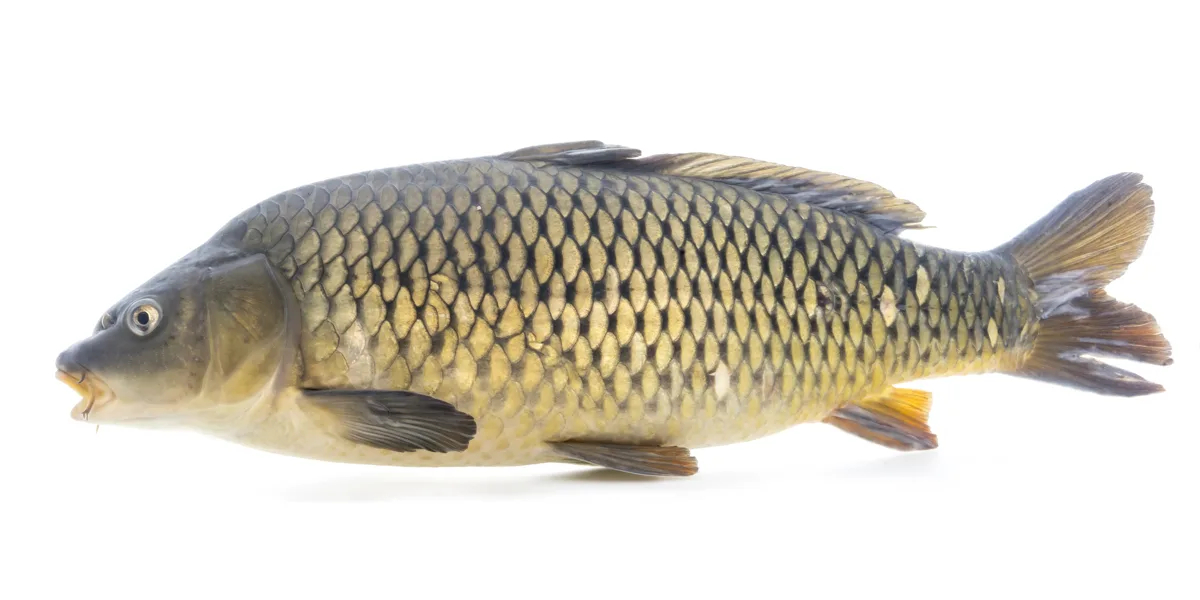
A small farm-dam carp session is a useful place to learn presentation, but it is not improved by covering the water with bait or putting out as many rods as possible. At BietjieDam near Caledon, begin with one accessible lane, one modest feeding patch and a rig you can see or feel clearly.
The operator explicitly lists common and mirror carp fishing at this working-farm retreat. That establishes the fishing opportunity, not a guaranteed catch or a mapped stock of large fish. This guide offers practical late-spring and summer starting setups; dimensions, bait quantities and timings should be adjusted to the actual swim and the operator's current instructions.
Common and mirror carp are the same species
The target is Cyprinus carpio. Fully scaled common carp and sparsely scaled mirror carp are varieties of the same species, not fish requiring completely different bait systems. Look for a long dorsal fin, a thick-lipped protrusible mouth and two pairs of barbels.
Tilapia and other deep-bodied fish can be mistaken for small carp at a glance. Their mouth and dorsal-fin structure differ; do not identify a catch from bronze colour alone. If you cannot see the barbels clearly, use a reliable illustrated reference rather than forcing an uncertain identification.
Carp often feed on bottom-dwelling invertebrates and can disturb sediment while foraging. Worm is therefore a food-based presentation; sweetcorn is a convenient angling bait rather than a claim about the fish's natural diet. Neither requires a large bed of feed to make a useful first test.
Arrange the visit and the fishing space
BietjieDam is a private working-farm accommodation and camping venue near Caledon. Use its booking and contact information to confirm access; do not assume the public can arrive for unrestricted day fishing or walk through the farm from the road.
Ask which bank is available, whether baiting and the proposed hooks are acceptable, and how fishing should share space with swimming, kayaking or other activities. A booking does not mean you can occupy every edge or cast across a recreation lane.
Choose a level place with room for a net and a clear route to the water. Do not enter the farmyard or drive through unmarked areas. These are practical boundaries that make a simple guest session work without turning it into an access problem.
Watch before feeding
Look for a visible cruising fish, a carefully moving patch of sediment or a repeated disturbance near the same feature. Bubbles can come from the bottom without a fish being present, so treat them as a clue rather than proof.
Compare the near margin with the first reachable depth change. Any weed edge, firm patch or cover should be confirmed at the swim rather than assumed from a photograph. A short cast beside a useful feature can be more productive than the middle of the dam.
In warmer weather, shallow water can change quickly through the day. Compare shaded or slightly deeper water with the margin when conditions change. Do not claim that carp always feed on the windward bank: wind can concentrate food, but it can also make presentation and landing unnecessarily difficult.
| Swim evidence | Starting approach | Why it helps | Change after trouble |
|---|---|---|---|
| Fish visible close to a clean margin | Balanced float | Precise bait placement and clear indication | Approach more quietly |
| Clean bottom beyond easy float control | Running ledger | Keeps a bait on one small patch | Reduce casting distance |
| Soft sediment coating the hookbait | Suspended float bait | Keeps bait visible above bottom | Raise bait slightly |
| Weed on every retrieve | Clear edge beside vegetation | Avoids burying the hook | Change cast direction |
| Bites without hooked fish | Smaller bait with exposed point | Improves hook access | Check depth and tangles |
One manageable outfit
A 10–12 ft light carp or medium float/ledger rod, a 3000–4000 reel and roughly 8–12 lb main line are useful starting choices for a modest open-water setup. Use stronger tackle if the actual obstacles or expected fish require it, but do not use heavy line as an excuse to fish close to unavoidable snags.
A hooklength around 15–25 cm long and 6–10 lb breaking strain can suit the running rig, while the float setup may use a somewhat longer hooklength. Match all knots and line strengths, and set the drag to yield smoothly before the weakest connection fails.
Carry size 8–12 single hooks, a small float, stops, shot, swivels, beads and light running leads. These hook sizes suit small corn or worm baits; larger baits may require another choice. A landing net and a wet unhooking surface should be ready before the first cast.
Rig one: the close float
Use a 2–4 g float suited to the distance and wind, attached according to its design. A fixed waggler is simplest where the depth allows comfortable casting. Secure it with suitable stops or shot, add smaller balancing shot below, then attach the hooklength and hook.
Plumb the swim with a small plummet. Start with the bait close to bottom or just clear of soft sediment, then make small measured adjustments. A float that lies flat or repeatedly drags under without a bite may be set too deep or catching vegetation.
Put one or two kernels of sweetcorn on the hook, keeping the point exposed, or use a short worm section. Cast slightly beyond the intended lane and draw the rig into position. Sink surface line where possible so wind does not tow the bait away.
A slow lift, sideways movement or steady disappearance can be a take. Wind down and make a controlled sideways lift once the movement is positive. Striking at every ripple can disturb the feeding patch and teaches little about the real bite.
Rig two: the running ledger
Thread the main line through a running lead or lead carrier, add a bead to protect the knot and tie to a swivel. Attach the short hooklength and one hook. Check that the lead can move freely and that the rig does not become a fixed tether when pulled from the hook end.
Start with a light 15–30 g weight where that holds the chosen lane, keeping the complete casting load within the rod rating. More weight is not automatically more sensitive. If the lead digs into soft bottom, shorten the cast or change its shape.
Bait neatly with corn or worm and cast to a fixed landmark. Let the lead settle, then tighten gently rather than pulling it toward the bank. Use a suitable tip or line indicator and keep the rod attended.
With a J-hook, remove slack and lift smoothly into a sustained take. A fish moving toward you can create a drop-back rather than a dramatic pull. Do not wait for a deeply swallowed bait merely because the indication was subtle.
A hair-rig option for corn
A small hair can hold corn clear of the hook, leaving the point and gape unobstructed. Form a short hair with a loop and bait stop, then tie the hook using an appropriate knotless-knot arrangement or a well-made ready-tied rig. Match a size 8–10 carp hook to the bait and line.
Thread a few kernels onto the hair and secure them with the stop. Leave only a small gap between bait and hook bend so the bait can move without wrapping around the hook. Check the finished presentation in the margin before casting.
Use it on the same free-running ledger rather than adding an unnecessarily heavy fixed bolt system. When a fish takes, tighten steadily and let the hook engage before lifting. If you are unfamiliar with tying or checking the rig, the direct-hooked corn setup is a perfectly useful starting method.
Feed a patch, not the whole swim
First confirm that feeding is permitted by the operator. If it is, begin with a few kernels or a small amount of suitable feed near the hookbait. Observe the response before adding more.
If fish arrive but stop taking the bait after feeding, pause the feed and continue fishing a small hookbait. If they remain elsewhere, improve placement rather than throwing food across several distances. Excess feed can spread fish away from the rig and leave you unable to tell where they are responding.
Worms, corn and simple small baits are enough for this comparison. Coloured additives and large mixed bait balls are not a substitute for finding a clean route to bottom.
A worked guest session
An illustrative afternoon starts with access and bank use confirmed. Watch the water from a little distance, choose one near lane and one clean alternative, then plumb before feeding.
Start with the float and one or two corn kernels. Keep the distance and bait size constant while you test a bottom-level setting and one slightly higher. If bites are missed, check the point and reduce bait rather than immediately choosing a much smaller hooklength.
If wind prevents control or fish show beyond the close lane, compare the running ledger. If bait returns coated in sediment, return to the float above it. Move only after giving two sound presentations a fair trial.
Record depth, bait height and the nature of the indication. A quiet session can still produce a useful lesson about wind drag or soft bottom. It cannot justify claims that the dam has no fish or that only one proprietary bait works.
Brief local rules and care
Checked 28 October 2026: CapeNature distinguishes public-water angling permits from privately owned farm dams, where the owner's permission governs access and a freshwater licence is not required under the stated exemption. Confirm that your BietjieDam booking and fishing arrangements fall within that private-dam permission; the exemption does not extend to nearby public waters. Follow current venue bait, fish-retention and site instructions, and never move live fish between waters.
Keep children supervised, share the bank with other guests and avoid entering the dam to free tackle. Use wet hands, support fish and release unwanted catches promptly under the venue's instructions. A small patch, a straight rig and careful bite reading give the session its purpose.