
A winter plan for the Derbyshire Derwent
November and December are useful months to plan a grayling trip on the Derbyshire Derwent, provided the river is safely fishable and the particular beat permits winter access. This guide is a planning framework, not a claim about today's catches. A cold, settled afternoon and a flood-coloured morning are different fishing situations even when they fall on the same weekend. Choose a short, manageable stretch where you can inspect the current from the bank before committing to a method.
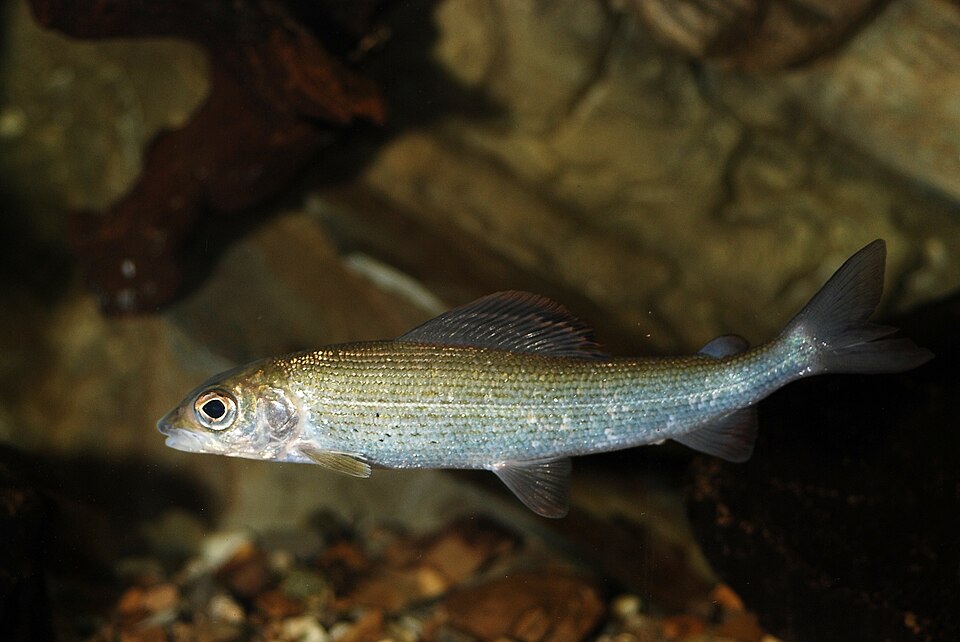
European grayling are the intended quarry. Do not turn a winter grayling outing into deliberate fishing for out-of-season trout. The cover is an illustrative photograph by Gilles San Martin showing a complete European grayling; it does not document a Derbyshire catch. Research and editorial preparation were AI-assisted, with the official rules and specialist sources below checked on 23 October 2026.
Settle permission before choosing tackle
A riverside footpath does not confer fishing rights. The Grayling Society's England directory identifies the Derwent and nearby Dove catchments as grayling waters, while explaining that much fishing belongs to clubs and syndicates. Its Matlock Bath entry describes bait fishing with no fly fishing because of close public access. Other listed stretches have different arrangements. Treat that directory as an introduction to the rights holder, not a live ticket reservation or permission to cross somebody's land.
Before travel, obtain confirmation of the exact upstream and downstream boundaries, permitted dates, methods, baits, hooks and access route. Ask whether wading is allowed and whether there are spawning areas to avoid. If a ticket cannot be confirmed, choose another verified venue or postpone. Do not arrive with a fly rod assuming that every grayling beat accepts it. Similarly, a fly-only permission cannot be stretched to include float fishing because conditions look more suitable for bait.
Prepare a map with the permitted bank marked. Save the ticket and rules offline, and keep a second exit route in mind. Winter daylight gives little margin for discovering that the only legal route back is substantially longer than the walk in.
Current rules: separate licence, season and fishery conditions
The Environment Agency's Midlands byelaws cover the Trent catchment, including the Derbyshire Derwent and Dove. They state that the river trout close season runs from 8 October through 17 March, while the national coarse-fish river close season runs from 15 March through 15 June. Dates are inclusive. A November or December plan therefore needs to remain a lawful grayling trip on an open, permitted beat; it does not reopen trout fishing.
Check the national rod-licence requirement for your age and circumstances before fishing. GOV.UK says children under 13 do not need a licence and those aged 13 to 16 require a free junior licence. A rod licence and the fishery's permission are separate requirements. Carry the applicable documents.
National tackle rules also matter. GOV.UK restricts lead weights to 0.06 grams or less or more than 28.35 grams, and prohibits knotted or metallic landing-net mesh. For the small shot used in the float rig below, a clearly labelled non-lead alternative avoids relying on an uncertain weight or material. Recheck current official guidance and the beat's additional conditions before each trip. This guide recommends releasing grayling; it does not offer a retention entitlement.
Read a run before entering it
From a safe bank position, divide the water into the main fast tongue, the smoother seam beside it and the slower margin. Look for a practical feeding lane that can be covered without standing in the strongest current. A small change in surface texture may show a change in depth or an obstruction. Use that as a hypothesis to test with a light presentation, not as proof of a fish's position.
Begin close. Walking straight into the near margin can disturb the most accessible water before the first cast. Cover the near seam, then extend gradually toward the main run. Avoid trampling shallow clean gravel, especially where spawning activity or a fishery restriction is apparent. Do not wade across a productive-looking area simply to reach a more dramatic piece of current.
If the river is rising, carrying substantial debris, or hiding the bed completely, change the plan. A bank-only session may still be possible where permitted and safe; otherwise leave. Repeatedly adding weight does not make dangerous water suitable.
A simple float outfit where bait fishing is permitted
A practical starting outfit is a 12–14-foot float rod, a smooth fixed-spool reel or familiar centrepin, and roughly 4–6-pound main line. Choose strength according to snags and flow rather than attempting the finest possible setup. A hooklength around 3–4 pounds and a size 16–18 barbless hook are useful starting suggestions for small permitted baits, subject to the beat's own rules.
Use a buoyant river float carrying enough non-lead shot to maintain control. Begin with most weight above the lower part of the rig and smaller droppers toward the hooklength. The objective is a readable float that transports the bait through the chosen lane without repeatedly anchoring it to the bed. Plumb the depth from a secure position, then adjust in small steps.
Keep the first trot short. Follow the float with the rod rather than feeding a large belly of line into the faster water. If it drags sideways, shorten the distance or mend gently. If it disappears at the same place on every pass without other indication, suspect an obstruction before assuming a bite. A clean, repeatable drift is more informative than a long uncontrolled one.
Feed modestly only where bait and loose feeding are permitted. Avoid emptying leftover bait into the river at the end. Change one variable at a time—depth, lane or feeding frequency—so that the next pass tells you something useful.
A compact fly approach on suitable beats
Where fly fishing is explicitly allowed and there is room to cast safely, a 9–10-foot rod rated around a 3–4-weight is a reasonable starting point. A simple floating line, tapered leader and approximately 4X–5X tippet can cover modest dry-fly or light nymph presentations. These are suggested ranges, not a claim that a particular tackle specification is compulsory or optimal everywhere.
Begin with one barbless nymph, perhaps size 14–18, rather than a complicated multi-fly arrangement. Select bead weight to suit the depth and current. A small fly that reaches the feeding level under control is more useful than a heavy one that constantly snags. Where the rules permit an indicator, keep it small enough to show subtle changes without pulling the rig across the surface.
Cast a short distance upstream or across the chosen seam and remove surplus slack without dragging the fly. Watch for a stop or deviation, then lift firmly but gently. Once the drift passes beyond useful control, retrieve and reposition. Long casts are unnecessary if they conceal the difference between a natural drift and a dragging fly.
If fish rise, pause and observe before changing tackle. A smaller dry fly and a better drift may matter more than finding an exact pattern name. Never cast across a footpath or close to other visitors. Choose a different position when a safe casting corridor is unavailable.
Weather, daylight and a sensible session length
There is no tidal timetable to follow on this inland stretch. River level, clarity, wind and daylight are more relevant. Check rainfall upstream as well as the forecast at the parking place: a locally dry morning does not guarantee a stable river. Keep a waterproof outer layer, spare warm gloves and a dry layer accessible rather than buried beneath tackle.
Plan to finish with enough light for the return walk. Short sessions can be more effective than staying until cold hands make knot tying and safe fish handling difficult. If using waders, wear a properly fastened belt and use a wading staff where appropriate. Neither compensates for uncertain depth, powerful flow or a poor exit.
A companion should know the intended reach and return time. Keep a phone protected from water and do not rely on reception at the river. A decision to leave early is a successful safety decision, regardless of the fishing.
Land, release and move on
The Grayling Society's angling code recommends barbless hooks, fish-friendly nets, prompt unhooking and minimizing air exposure. Apply that advice before the first cast: have the net and forceps within reach and arrange photographs only if they can be taken quickly without delaying release. Wet hands before contact, support the fish and keep it in the water as much as possible.
Choose gentle flowing water for recovery and let the fish regain control before release. Do not move it back and forth through the current. If a fish shows distress or repeated trout bycatch occurs, reassess the method and location rather than treating every capture as a reason to continue unchanged.
A workable half-day itinerary
Spend the first twenty minutes confirming boundaries, exits and water conditions. Then fish one short run systematically, beginning nearby and extending outward. After several controlled passes through each lane, adjust depth or weight once before moving. Keep the midday break useful: inspect knots, warm your hands and record which presentations actually stayed under control.
Use the final part of the session on the most promising safe water rather than exploring a distant beat in fading light. Note the level trend, clarity, method and any access problem in a personal log. Avoid recording assumptions as catches. Clean and dry equipment before another waterbody, remove discarded line and leave gates as instructed. The best winter plan is one that remains lawful, repeatable and easy to abandon when conditions deteriorate.