
Work a small section of rock thoroughly
A ballan wrasse is often close to the rock and weed you can already see. The challenge is to place a bait beside that cover, recognise the take and guide the fish away before it reaches a crevice. Distance is secondary. A short float drift along a kelp edge can be more controlled than a long cast into unknown rough ground.
On the Dingle Peninsula, compare two methods: a bait suspended just above the weed and a weedless soft plastic worked through open gaps. Both allow you to alter depth without repeatedly leaving sinkers on the bottom. The numerical sizes, weights and timings below are practical starting suggestions. They are not claims of a guaranteed local pattern, and the worked session is illustrative rather than firsthand reporting.
Identify ballan wrasse
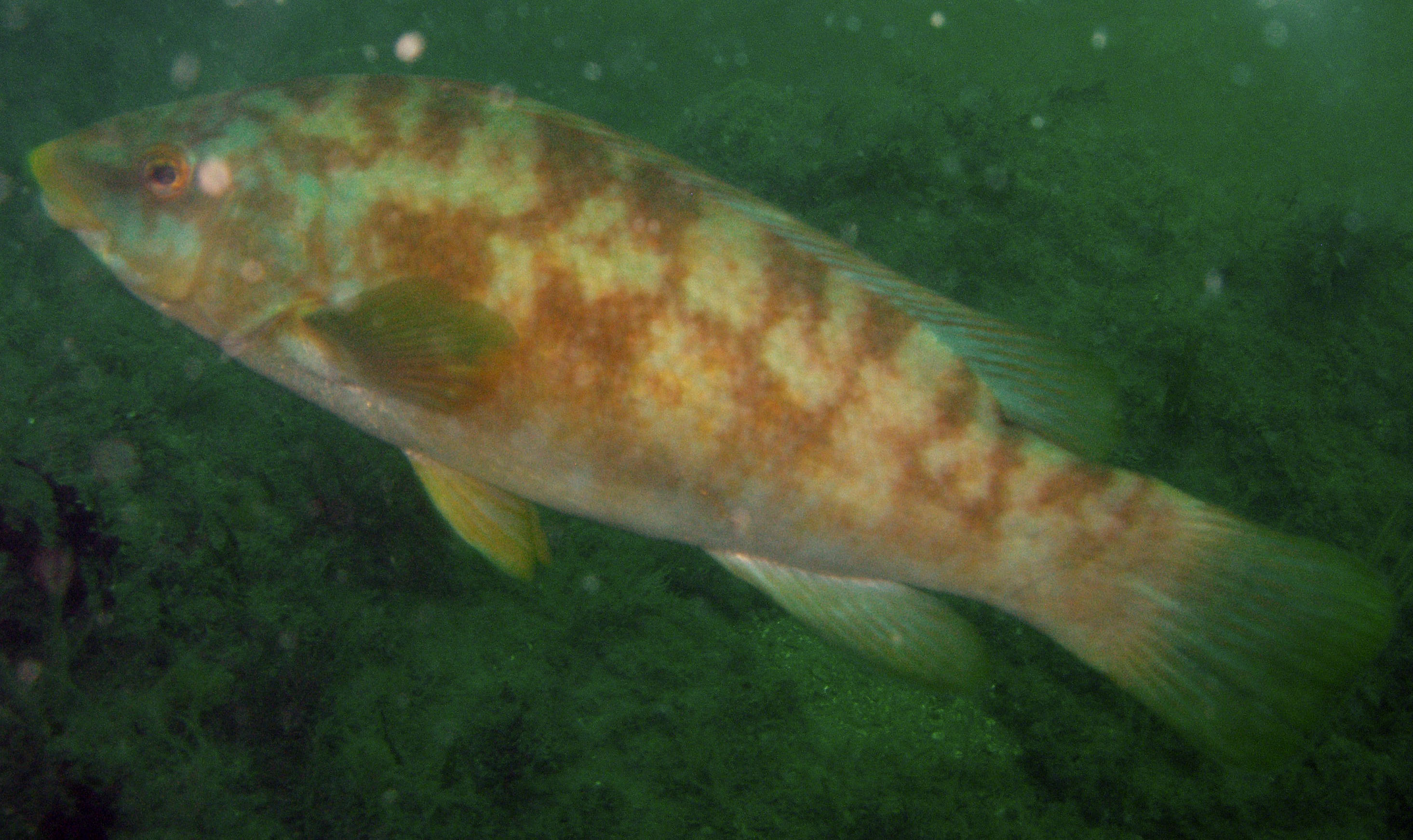
Ballan wrasse, Labrus bergylta, have a heavy body, broad head, thick lips and a long dorsal fin. Colour is highly variable: brown, green, reddish and spotted fish can all be ballans. Colour alone does not establish species or sex. Their eastern Atlantic range extends from Norway to Morocco, with widespread records around Ireland.
Cuckoo wrasse are more slender and have distinctive colour patterns, including blue and orange in males and dark patches near the rear dorsal region in females. Small corkwing wrasse have a dark spot near the middle of the tail base. Check those features before calling every small mottled wrasse a ballan. Seasearch's identification guide is useful alongside a clear side view.
Rock faces, boulder slopes and kelp provide shelter and feeding surfaces. Crabs, other crustaceans and molluscs form important parts of the diet; a crab or worm bait is therefore a reasonable practical starting point. A soft plastic need not be an exact prey copy to offer a small moving target. The relevant question is whether it reaches the fish's feeding space without becoming trapped.
Choose a named area, then assess the actual stance
Inland Fisheries Ireland lists Dún an Óir, on the western side of Smerwick Harbour, for float fishing for wrasse. It also identifies wrasse fishing around Clogher Head, Dunquin and Slea Head, while explicitly warning that some access is difficult in wet or windy conditions. These are venue references, not a recommendation to climb onto an exposed ledge.
For a first session, use a local access check to select a stable, permitted stance with a straightforward route back. Do not interpret an old venue description as proof that a gate, path or rock shelf is currently accessible. Dún an Óir is a useful planning area, but the final position depends on the day's sea and the landing route available.
Before casting, decide where the net can reach the water. If the only landing method would be to swing a fish up a cliff on the line, choose another position. A rock that is dry between waves may still be in the wash zone. Watch complete sets from a safe distance and allow for the rising tide.
Let daylight and depth guide the session
Ballan wrasse are principally daytime fish, using crevices and weed as shelter at night. Plan around useful daylight rather than assuming dusk is essential. Late autumn can still offer a session in suitable conditions, but cooling water and winter swell make activity and access less predictable. Do not transfer a warm summer pattern unchanged to December.
A flooding tide can cover a fresh strip of rock and bring the float within reach of a different edge. Test that change rather than treating every flood tide as a guaranteed bite window. A modest movement of water may carry a bait naturally; strong surge can make the same rig uncontrollable and the position unsafe.
Begin by checking the near-side kelp top and the clean space outside it. A working depth of roughly 1.5–4 m is an initial float-setting range where the ground permits, not the full habitat depth of the species. The key measurement is the gap between bait and weed, which changes with tide and the angle of the underwater slope.
Tackle that can turn a fish
Start with a 2.7–3.3 m rod capable of casting a float rig around 15–40 g, a 3000–4000 reel and 15–20 lb mono or 20–30 lb braid. With braid, add about 1.5 m of 20–30 lb abrasion leader. This gives contact and enough reserve for a short, forceful dive without making every small bite invisible.
The rod should have backbone in its lower section but enough tip movement to cast gently and cushion a fish close to shore. Set the drag firmly enough to steer a fish, yet with some release under a strong pull. A completely locked drag and a high rod angle can break tackle when the fish is directly below you.
Carry a long-handled net suited to the stance, pliers and spare hooklengths. Inspect the final metre of line frequently. A leader that feels rough after brushing rock should be replaced before the next cast, even if it has not yet broken.
Rig one: sliding float with crab or worm
Thread a float stop and bead onto the line, followed by a sliding sea float. Add the float's appropriate weight, a protective bead and swivel. Tie on a 45–75 cm hooklength of 15–25 lb abrasion-resistant mono and a strong size 1 to 1/0 J hook. Match the hook to the bait and mouth size being encountered; larger numbers are not automatically stronger.
Use a compact, lawfully obtained crab bait or a small section of ragworm, leaving the hook point clear. A small hard-backed crab can be hooked securely through an appropriate leg socket without burying the point in shell. Do not collect bait where local restrictions or habitat protection prohibit it. Bring enough prepared bait to avoid dismantling the shore during the session.
Start shallow and deepen the rig in small steps until you find the weed or bottom, then raise the bait about 30–60 cm. If the float repeatedly sinks at the same place without a fish, it may be dragging the bait into weed. Shorten the depth before striking harder. Use only enough weight to cock the float and control the bait.
Lower the rig or make a short underarm cast along the edge. Feed a little line as it drifts, but prevent a large belly from forming. The bait should travel at the pace of the water, not be towed by wind across the surface. At the end of the useful drift, retrieve and start again rather than allowing it to disappear behind a rock.
Detect the take and control the first dive
Small dips can be a fish inspecting the bait or the rig brushing weed. A deliberate submergence or sideways pull is more useful. Recover slack, lift firmly and immediately apply controlled side pressure away from the nearest crevice. Do not give a hooked wrasse several metres of loose line to reach cover.
Keep the rod at an angle that allows it to absorb movement. If a fish stops in weed, maintain steady pressure and try a modest change of angle from your safe stance. Do not climb down or lean over the edge to pull vertically. If the line is solidly snagged, protect yourself from a recoiling hook and avoid loading the rod to breaking point.
A fish that comes free should be guided into the prepared net, not lifted with the leader. Support the body during unhooking and keep the time out of water short.
Rig two: a weedless soft plastic
For a mobile search, use a 2.1–2.4 m rod rated around 7–28 g, a 2500–3000 reel, 15–20 lb braid and a 60–100 cm 20–25 lb leader. Rig a 6–9 cm worm, small craw or slender paddle-tail on a 1/0–2/0 offset hook. Thread the nose onto the offset shoulder, rotate the bait and lightly conceal the point in its back, leaving enough gap for the body to collapse.
Slide a 3.5–7 g bullet weight ahead of the hook, choosing the lightest load that reaches the open pocket. In very shallow water an unweighted bait may be sufficient. Test it at close range: a lure that spirals or lies bent on the hook needs re-rigging before it is fished.
Cast obliquely across an open gap, let the bait settle under control and move it with short lifts rather than a fast swim across the whole mark. Begin with a lift of 10–30 cm, a pause and another small movement. Keep the lure near the rock edge without repeatedly wedging the weight between stones.
On a take, wind into the weight and make a firm sweep to expose the concealed hook. If there are repeated bites without a hookup, check whether the lure is too thick for the hook gap or whether small fish are only taking the tail. A shorter bait may solve that more effectively than a harder strike.
A brown, olive or muted red-brown lure is a reasonable first test. A brighter contrast can help you monitor the lure in murky water, but there is no established universal colour rule for Dingle wrasse. Depth, hook exposure and the ability to work beside cover come first.
| Feature or response | Likely reason to test it | Method | Presentation | Next change |
|---|---|---|---|---|
| Kelp edge beside clear water | Shelter meets a feeding lane | Sliding float | Bait just above weed, short controlled drift | Adjust stop depth as tide rises |
| Small open gap between rocks | A target can be held near cover | Weedless soft plastic | Short lift, settle and pause | Reduce weight if it wedges |
| Repeated float dips at one point | Bait may touch weed | Float, set shallower | Repeat the same drift | Move outside the obstruction |
| Nipped lure tails | Small fish or poor hook exposure | Shorter soft bait | Keep hook gap clear | Change pocket if no solid takes |
A worked daylight session
Choose a manageable tide and two nearby safe positions before committing to a longer walk. At the first, begin with an 18 g float system, a 60 cm hooklength and a size 1 hook carrying a compact worm bait. Set the bait shallow, make a short drift and deepen it gradually until the top of the weed is located.
Fish several drifts at the resulting depth, then compare a crab bait without changing the lane. If the float works cleanly but no fish responds, test the adjacent pocket with a 5 g weedless soft bait. This changes presentation while keeping the location understandable.
After a thorough twenty-to-thirty-minute comparison without interest, move to the second safe position. If a fish bites quickly there, repeat the depth and cover type before walking farther. If you catch several small wrasse, change the pocket or finish rather than repeatedly handling them. The purpose is to learn which edge is being used, not to turn every patch of cover into a prolonged disturbance.
Rules and a short rock-fishing note
Inland Fisheries Ireland's current guidance says most sea species can be fished without a state licence; salmon and sea trout are exceptions. Check current species restrictions and local access before the trip, and do not apply the historical bass-season wording on older venue pages to present-day fishing. This plan targets wrasse with rod and line.
Wear suitable flotation and footwear, fish with a companion and leave exposed rocks when conditions deteriorate. Keep handling brief, use wet hands and release wrasse carefully near the capture point. No possible bite makes a washed ledge or an unsafe landing route worthwhile.