
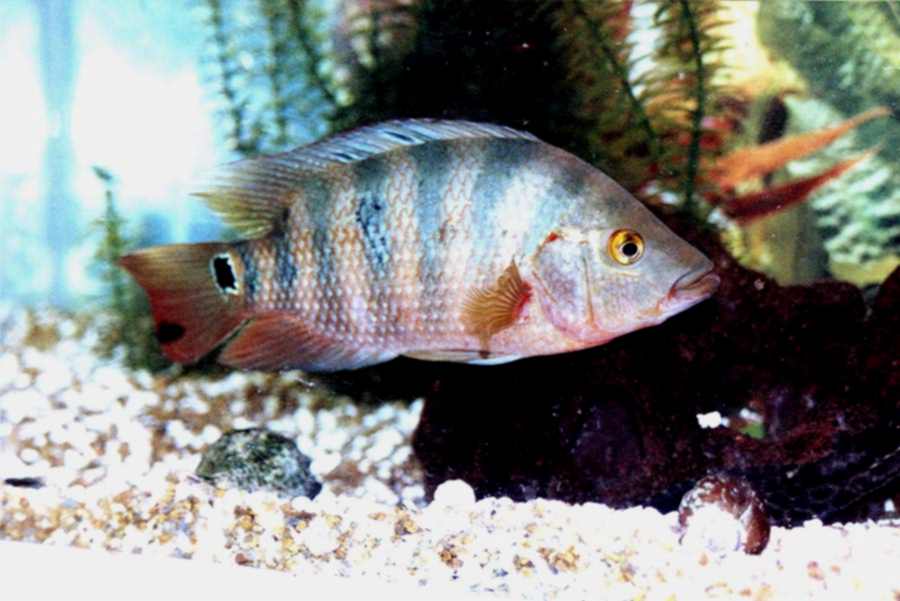
A canal full of vegetation can look uniformly promising, yet the useful fishing may occupy only a few small openings. For Mayan cichlids, begin with the outside of the plants, a pocket where a bait can fall unobstructed, and the first change in depth. A light float rig lets you hold food above the stems; a small jig lets you search the next opening without rebuilding the tackle.
This is a bank-fishing plan for the Everglades Water Conservation Area canal network in southern Florida. The species, access framework and feeding ecology below come from the linked sources. Tackle dimensions, trial depths, cast sequences and time allocations are practical starting suggestions, not measurements from a surveyed swim or promises about the next bite.
Identify the fish before choosing the method
The Mayan cichlid is Mayaheros urophthalmus, an introduced Central American cichlid established in southern Florida. Look for an oval, compressed body, several dark vertical bars, a rounded tail and a dark tail-base eyespot with a conspicuous coloured rim. The bars and reddish throat can vary with condition; a brightly coloured fish is not automatically a different species.
A tail eyespot alone is insufficient identification. Other introduced cichlids also have striking markings. Butterfly peacock typically has three broad body bars and a more bass-like outline; Mayan cichlids usually show more bars. Compare the whole fish with the identification references rather than applying a peacock limit to every cichlid. Do not assume that an unfamiliar fish is an unregulated nonnative.
Mayan cichlids eat small fish, grass shrimp, snails and insects. That mixed diet supports a choice between small natural baits and compact artificials. A worm section or little shrimp presents an easily taken mouthful; a short jig imitates moving prey without requiring the fish to chase a large bass lure. Their broad salinity tolerance does not mean every brackish canal contains them.
Where to begin and what winter changes
The Water Conservation Areas occupy western Palm Beach, Broward and Miami-Dade counties. Documented fishing access includes the Tamiami Canal bank corridor and boat access through Holiday Park to the WCA-3 canal network. For this shore plan, choose an established, legally accessible Tamiami Trail canal stopping place with safe parking and a firm landing position. The regional access description is not permission to park on a road shoulder, cross a fence or enter a water-control structure.
Water level matters more than a calendar label. As marsh levels fall, fish can become concentrated in the bordering canals; high water allows them to disperse. That makes the approaching winter and spring drawdown worth watching, but a sudden cold spell can reduce cichlid activity. November through January is therefore a period for checking actual level and temperature trends, not a guaranteed peak season.
Walk the accessible section before unpacking. Find three different features: an open plant edge, a deeper-looking gap and a quieter pocket beside moving water. Observe whether floating debris travels steadily, circles or remains still. A fresh flow can reposition the bait; it does not prove that fish are present. Avoid trying to fish through a solid mat simply because it looks like cover.
Start close. A bait delivered a rod length from the bank may reach the fish without dragging line across the plants. Fish the near edge before casting across the canal, because retrieving a distant fish through nearer cover complicates both the presentation and landing. Where visibility permits, look for small prey and fish movement without leaning over the bank.
A manageable light outfit
A 6–7 ft light or medium-light spinning rod, a 1000–2500 reel and 6–8 lb monofilament make a useful starting outfit for open margins. Monofilament is straightforward for small floats and gives some cushioning with light hooks. Near abrasive stems or rough edges, use an 8–10 lb leader about 45–75 cm long, joined with a properly tied line-to-line knot.
Choose a rod that can place a light bait accurately, rather than the shortest rod available. Extra reach helps keep line off vegetation and guides a hooked fish around the last clump. Conversely, a long rod becomes awkward beneath branches. Select the fishing position and landing route before deciding which outfit to carry.
Keep a small landing net ready. These are modest-sized targets, but lifting a fish up a bank by a fine leader is an avoidable failure. Carry spare hooks, two jig weights, a few floats and pliers in a compact bag so moving between openings remains easy.
Build and fish a small float rig
Thread on a small fixed float suitable for approximately 1–3 g of shot, then attach the leader and a size 8–12 single hook. Spread most of the balancing shot below the float and leave the final 15–25 cm above the hook relatively free. Add shot gradually until only the visible tip remains above water; an oversized, underweighted float resists a tentative bite.
Use a short worm section or a small legally obtained shrimp, leaving the hook point clear. A bulky bunch that hides the bend often produces pulls without a secure hook-up. Match the hook to the bait: the gape must remain open enough to take hold, even when the bait folds during a cast.
Start with the bait roughly 30–60 cm below the surface in a shallow visible pocket, then deepen in small steps if the opening allows. In a deeper gap, measure or probe the depth and suspend the bait just above the plants or bottom. These are search settings, not a claim that Mayans always feed at one level.
Cast gently past the outside edge and draw the float into position. In slight current, cast a little upstream and follow its travel with the rod, mending loose line before it drags the float sideways. Let the bait pause beside cover; then move it a few centimetres and allow it to settle again. A float sliding purposefully away or submerging steadily calls for taking up slack and a small, firm lift with this conventional single hook.
Search with a swimming jig
For open water beside vegetation, begin with a 1/32–1/16 oz jighead and a 2–4 cm soft tail or compact feather dressing. A size 6–10 hook is a reasonable starting range, provided it suits the lure body. Thread a plastic straight, bringing the point out centrally so the lure swims without rolling. Tie directly to the leader; unnecessary hardware can overwhelm such a small lure.
Cast parallel to the plant edge or diagonally across an opening. Let the jig sink briefly, close the bail and retrieve just fast enough to keep it above the stems. Add a short lift followed by a pause. Watch the line during the pause: a twitch, sideways movement or unexpected stop can indicate a take before the rod registers it.
Calibrate the countdown in visible water. A two-second sink in one pocket may put the same jig on the bottom in another; current, line angle and dressing all change the fall. If it repeatedly catches vegetation, shorten the sink or lighten the head before increasing retrieve speed. If it never reaches the intended layer, add a little weight or shorten the cast.
Natural brown or olive and pale pearl provide contrasting starting options. In stained water, try a brighter tail to improve your ability to follow the lure, then compare responses with the same depth and retrieve. There is no established universal colour rule here. A straight-running lure at the right level is a better controlled experiment than changing colour, weight and speed together.
Choose the presentation for the opening
| Observed feature | Likely opportunity | Starting method | Presentation | Adjustment |
|---|---|---|---|---|
| Clear gap inside vegetation | Small prey accessible without a chase | Small float and worm section | Hold just above stems | Shorten depth if the hook catches |
| Open outside edge | Fish can intercept moving prey | Light swimming jig | Cast along the edge and pause | Slow the fall before downsizing |
| Gentle moving water beside a pocket | Food passes a quieter holding place | Float and small shrimp | Drift into the pocket without towing | Reposition upstream if line drags |
| Deeper unobstructed margin | Fish may sit below the visible edge | Slightly heavier jig | Count down and swim through one layer | Increase depth one step at a time |
The table describes places to test, not proof of fish presence. A barren-looking opening may be more workable than dense cover when it permits a clean presentation and a clear landing route.
A worked two-hour bank session
For an illustrative mild-weather session, take the 7 ft outfit with 8 lb line, a small float and a size 10 hook. Begin at a safe open pocket with a worm section suspended above visible vegetation. Make several placements at the near side, middle and outer edge. If the float repeatedly tilts from contact with plants, shallow it rather than interpreting every movement as a bite.
After roughly fifteen minutes without a response, change depth before bait. If a second depth and a fresh bait also produce nothing, move to the next distinct opening. Keep a note of depth setting, water movement and any observed fish; this makes a later return more useful than simply remembering that one spot felt promising.
At an open edge, change to a 1/32 oz jig and work three cast angles. Increase to 1/16 oz only if the lighter head cannot hold the intended depth. After a fish or credible take, repeat the successful angle before exploring elsewhere. If only small fish nip the tail, shorten the dressing while retaining enough hook gape.
Finish by revisiting the best opening with the method that gave the clearest response. A blank session is still informative if it separates access problems, vegetation contact and genuinely bite-free presentations. Do not spend the final hour repeating a rig that was never fishing cleanly.
Brief rules and handling note
Checked 2 November 2026: FWC lists no Mayan-cichlid bag or size limit, but licensing, access and site-specific restrictions still apply. Use the linked current rules and licence guidance; other fish caught alongside them have different protections. Check local fish-consumption advice before retaining a meal. Stay back from steep banks and alligators, avoid obstructing roads, and handle fish with wet hands and control of the spiny dorsal fin. Keep wildlife and hooks clear of companions before making the next cast.