
Boat-supported spearfishing combines a moving vessel, people below the surface, sharp equipment, changing current and a fishery rule set. The surface crew is not a taxi waiting for divers to return. It is an active safety system responsible for position, lookout, recovery readiness, diver accounting and a lawful divers-down display.
This guide uses Florida saltwater rules as a concrete example. It is not a certification course and cannot make an unsafe dive safe. Divers need training appropriate to scuba or breath-hold diving, medical fitness, equipment competence and local knowledge. Spearing rules, species rules and boating rules can all change, so reopen the official pages on the trip date.
Separate three decisions
First ask whether diving is safe. Then ask whether spearing is permitted at that place. Only then ask whether a particular fish can be taken.
Those questions are easy to collapse underwater. Clear water and visible fish do not establish that the site is outside a prohibited zone, the species is open, the size is legal or the diver can complete a controlled ascent. The surface plan must remove those decisions from the moment of pursuit.
Florida defines spearing broadly to include devices that take fish by piercing. FWC’s current page prohibits spearfishing in freshwater and lists saltwater places where spearing is prohibited, including within 100 yards of a public swimming beach, a commercial or public fishing pier, and parts of bridges from which public fishing is allowed. It also restricts areas near above-water jetties, with a stated exception for the last portion of sufficiently long jetties. Read the full current wording rather than planning from this summary.
Build a site card
For every site, record charted position, water type, depth range, bottom or structure, normal current direction, forecast wind and sea state, nearby channels, ferry or ramp traffic, emergency exit points and communication coverage. Mark the no-go boundary around beaches, piers, bridges and jetties using the current rule text.
Structure changes both fish behavior and diver risk. Reef ledges and wreck edges can hold fish because they break current and concentrate forage, but they can also create line entanglement, overhead spaces and separation from the boat. Open sand provides easier tracking but fewer visual references. A current seam along a reef edge may concentrate bait and predators on the slower side; it can also carry a diver away faster than the boat crew expects. Thermoclines reduce visibility and change fish depth, but they are not a reason to exceed training.
A practical starting rule is to reject a site when the crew cannot describe where a surfaced diver will drift during the next five minutes. That is not an official distance or formula; it is a planning test.
Assign roles before anyone enters
The minimum workable crew depends on conditions and diving mode, but duties must be explicit:
- Vessel operator: remains capable of maneuvering, watches traffic and never assumes another person has the helm.
- Dedicated lookout: tracks bubbles, floats, diver positions, current and approaching vessels without fishing or using a phone.
- Dive supervisor or roster keeper: logs names, entry time, planned return, gas or breath-hold mode, and actual exit.
- Diver buddy: provides the in-water support required by training. For breath-hold diving, a person on the boat is not a substitute for a trained one-up, one-down buddy close enough to protect an airway.
- Recovery lead: prepares a clear ladder or lift point, first-aid and oxygen equipment when trained and appropriate, and a plan for an unresponsive diver.
On a small boat one person may hold more than one compatible role, but operator and lookout tasks cannot simply disappear. If staffing makes continuous tracking impossible, reduce the number of divers or cancel.
Divers-down device and traffic control
Florida’s boating guidance says the divers-down symbol displayed from the water must be at least 12 by 12 inches, while a vessel display must be at least 20 by 24 inches and placed at the vessel’s highest unobstructed point. A flag needs a stiffener so it remains unfurled. A buoy must show the symbol on its flat sides.
Boaters must make reasonable efforts to remain at least 300 feet from the device in open water and 100 feet away in rivers, inlets or navigation channels; inside those distances they must slow to idle speed. Divers must make reasonable efforts to stay within 300 feet in open water and 100 feet in the other named waters. The warning device must come down when divers are out of the water.
Treat those as legal boundaries, not as a safety bubble that other vessels will respect. The lookout should expect traffic to miss or misunderstand the flag. Use a clearly visible float when appropriate, keep the vessel positioned to warn without blocking navigation, and recall divers early when traffic increases.
Scuba and breath-hold are different risk systems
A scuba diver manages gas supply, buoyancy, ascent rate, decompression exposure and equipment failure. A breath-hold diver manages hypoxia with no reserve gas. Divers Alert Network explains that hypoxic blackout often occurs near the surface and that direct buddy supervision is critical. Hyperventilation can suppress the urge to breathe without creating a safe oxygen reserve; it is not a performance tool to build into a fishing plan.
For breath-hold teams, use trained one-up, one-down supervision and watch the returning diver through the surface interval. Do not send two divers down together while the “buddy” watches from a distant float. For scuba teams, follow training-agency gas, ascent and buddy procedures and do not let the desire to recover a fish override them.
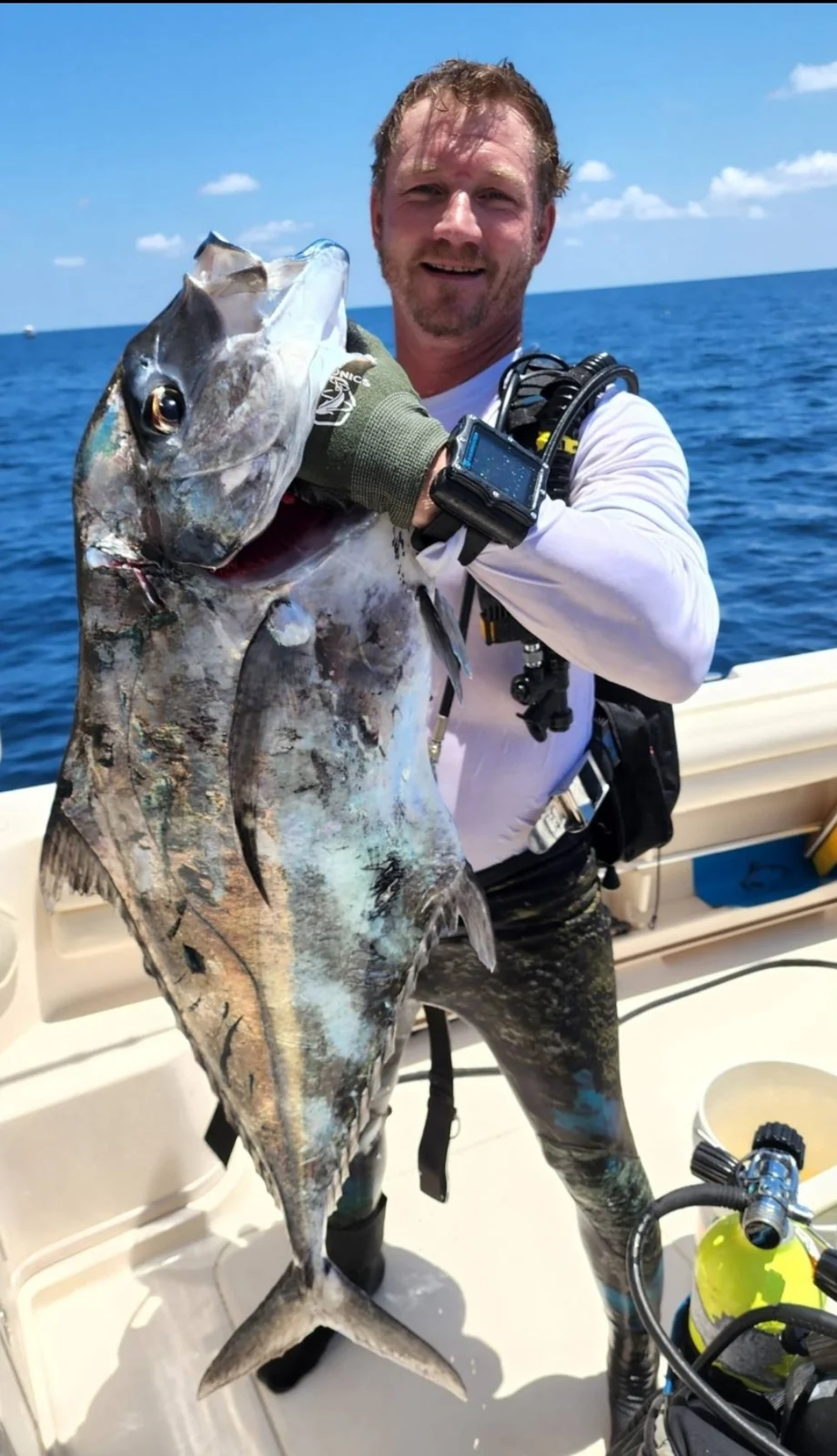
The photograph used with this article shows diving equipment and a retained fish aboard a boat. It does not establish which diving mode was used, where the catch occurred, which species it is or that the pictured handling is a model to copy.
Equipment zones on the boat
Create three physical zones:
- Clean entry zone: masks, fins and exposure equipment ready without loose hooks, knives or shooting lines underfoot.
- Weapon-safe zone: spearguns unloaded before boarding, pointed away from people and secured so the trigger cannot be pressed accidentally. Load only in the water under trained practice and unload before approach.
- Recovery zone: ladder or gunwale path clear, engine status understood, propeller hazard controlled and a place ready for a diver who cannot climb unassisted.
Keep fish, lines and sharp equipment out of the recovery path. A large retained fish may create thrashing, spine, tooth or shark-attraction hazards. The crew should decide before the dive how a fish is secured, cooled and recorded without turning the swim platform into an obstacle.
A conservative drift sequence
1. At the ramp, file a float plan with a responsible person. Include vessel description, crew, sites, route, return time and what to do when overdue. 2. At the site, make a current test using a visible marker only when lawful and environmentally responsible. Compare observed drift with the forecast. 3. Motor through the recovery path before the dive. Identify propeller, ladder, anchor, current and traffic conflicts. 4. Display the legal divers-down device and brief the recall signal. 5. Put one team in at a time. The lookout states where every diver or float is and updates that statement continuously. 6. On each recovery, unload weapons before boarding, count every person by name and log the exit. 7. Pause when wind, current, visibility, traffic or crew fatigue changes. Recalculate the next drift rather than repeating the previous one automatically.
Suggested drift length, depth and bottom time must come from training, conditions and the least-capable qualified diver, not from a generic article.
Fish selection under pressure
Before descent, the target list should include exact species names, look-alikes, minimum or maximum sizes, season, bag and vessel limits, prohibited gear, area closures and whether federal waters apply. Carry a waterproof reference. If a fish cannot be identified before the shot, do not shoot.
Use a measuring device appropriate to the current rule. Underwater size estimates are distorted by visibility and distance. A “looks legal” standard is not defensible. Do not assume that a species legal on hook and line may be speared; method restrictions can differ.
Abort points
Cancel or end the dive when the lookout loses reliable tracking, the device cannot remain visible, boat traffic enters the working area repeatedly, current exceeds the team’s planned recovery ability, visibility prevents buddy contact, a diver misses a check-in, weather deteriorates, equipment fails, or anyone feels pressured to exceed training. A missed fish is not an emergency. A separated diver is.
After any near miss, end the fishing sequence long enough to reconstruct what happened. Preserve time, position and equipment details. If emergency services are needed, use the prepared communication plan rather than improvising numbers after the event.
Common mistakes
A flag is not a substitute for a lookout. A surface person watching multiple breath-hold divers is not automatically an effective buddy. Anchoring the boat does not stop divers from drifting. Chasing a fish into a wreck or ledge changes the dive plan even if depth does not change. Loading on deck creates an unnecessary projectile hazard. Leaving the device up after all divers exit gives other boaters false information and is contrary to Florida guidance.
Another error is mixing the legal site boundary with the diver-distance rule. Being within 300 feet of a flag in open water does not make spearing lawful near a prohibited beach or pier. All conditions must be satisfied.
Prepublication checklist
- Geography: pass — Florida saltwater is explicit; no national or global rule claim is made.
- Habitat and structure: pass — reef edge, wreck, sand, current seam and thermocline implications are explained.
- Forage: not applicable — the article is a surface-team safety and legal workflow, not a fish-feeding guide.
- Methods: pass — scuba and breath-hold systems are distinguished and roles are ordered.
- Lures and presentation: not applicable — spearfishing uses no lure presentation; shot selection is limited to verified legal targets.
- Examples and table: pass — role, zone, drift and abort decision structures are concrete; prose is clearer than a comparison table here.
- Sources: pass — current FWC, USCG and DAN pages were checked on 26 October 2026.
- Local rules: pass — Florida spearing places and divers-down dimensions/distances are attributed to current FWC pages.
- Image match: pass — the distinct registered owner photo visibly shows a diver with equipment and a retained fish aboard a boat; species, place and method are unclaimed.
- Ethical handling: pass — the plan prioritizes identification before a shot, lawful harvest and immediate cooling.