
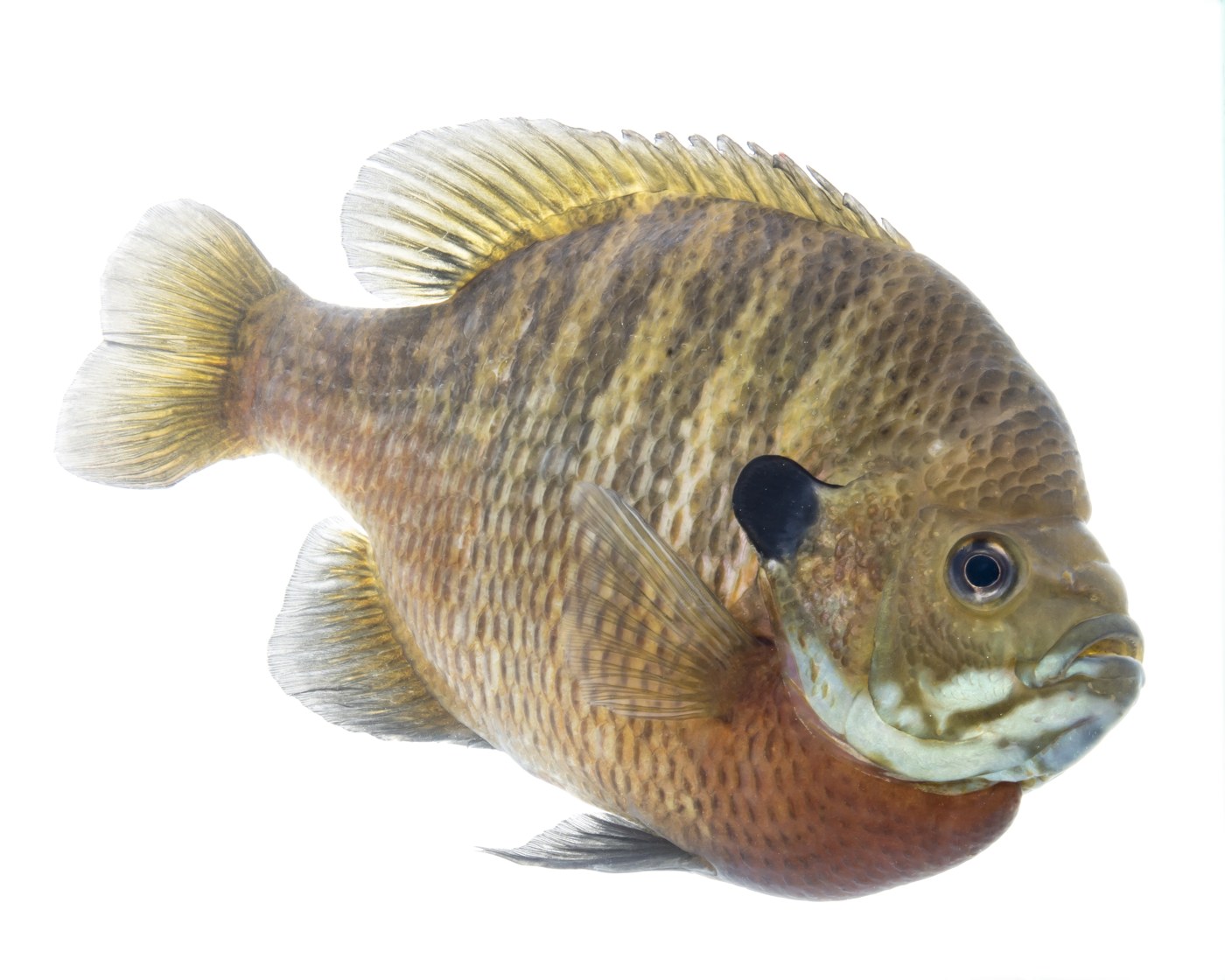
Groenvlei's reeds can make the lake look as though every useful fish is out of reach. The better approach is to find a legal opening, a jetty position or a permitted boat route that lets you fish along the vegetation rather than through it. Bluegill offer a small-lure target where an accurate cast matters more than brute strength.
This is a late-spring and early-summer learning plan for the lake near Sedgefield, not a current catch report. The local tourism information confirms bluegill and small spinning-lure opportunities; the detailed tackle settings below are practical suggestions. The fish's North American origin and general biology do not establish a South African spawning date or a guaranteed summer bite.
Identify bluegill rather than relying on a local nickname
Bluegill, Lepomis macrochirus, are small-mouthed sunfish with a deep body, vertical bars and a dark mark toward the rear base of the dorsal fin. Colour varies with condition and breeding state. A blue or green sheen alone is not enough for identification.
They are not Mozambique tilapia, sometimes called blue kurper, and they are not juvenile largemouth bass. All occur in the wider local fishing discussion, but their mouths, body proportions and feeding behaviour differ. Check the whole fish against a reliable species reference before describing a catch or deciding what may be retained.
Bluegill were introduced to Groenvlei; they are not an indigenous Garden Route fish. General life-history evidence describes young fish feeding on plankton, with larger fish taking aquatic insects and larvae. That makes a small suspended artificial prey item a reasonable presentation to test. It does not mean a particular reed bed has been sampled or that its bluegill eat exactly the same proportions of food as a North American population.
Start with access, then select a reed edge
Groenvlei, also called Lake Pleasant, is near the N2 between Sedgefield and Knysna. Local information describes extensive reeds, grass patches and limited shore access. Use established, permitted access; do not cut reeds, create a fishing platform or assume a gap beside a private property is public.
CapeNature's current Goukamma page says Groenvlei jetty boat permits are obtained from the reserve office during weekday office hours, and only electrically driven boats are allowed. Arrange the relevant permission before arriving for a weekend outing. A fishing licence and a boat-launch permit serve different purposes.
From an authorised jetty or boat, seek an outside reed line with open water beside it. A small indentation creates a short casting lane; an isolated grass clump lets you cover both its shallow and deeper sides. A straight wall of stems may hold fish but is difficult to present through and harder to land beside.
Avoid equating visible reeds with fish at every metre. Begin at an edge where the lure can travel freely, then compare a shaded opening and an open patch. A gentle breeze may improve a lure's movement, while a stronger wind can make a small boat impossible to hold accurately. Choose control over distance travelled.
Build tackle around a small mouth and a clean landing route
A 1.8–2.1-metre light spinning rod, a 1000–2000 reel and 4–6-pound nylon are a practical starting combination. If you prefer fine braid, add about 1–1½ metres of 4–8-pound leader. Use the stronger end around abrasive jetty fittings, while keeping the lure small enough for the target.
Carry a small landing net, forceps and a few replacement leaders. A soft rod tip helps cast very light lures and cushions a hooked fish. A heavy bass outfit may cast the same lure poorly and make delicate bite detection unnecessarily difficult.
For the active method, start with a compact spinner around 1–3 grams, choosing a model whose hook and blade are proportionate to a bluegill. For the stationary method, carry 1/64–1/32-ounce jigheads with roughly size 10–6 hooks and 15–30-millimetre artificial tails. Actual hook dimensions vary by maker, so inspect them rather than buying on the number alone.
These are initial ranges for sheltered, relatively open edges. The outfit is not intended to pull fish through dense reeds. If you repeatedly lose control near vegetation, fish farther outside it or use a stronger compatible outfit and a clear lane.
Method one: a small spinner parallel to cover
Tie the spinner to the leader with a sound, tested knot, or use a tiny quality clip if it does not spoil the action. Check the blade beside the bank or boat. It should rotate at the slowest retrieve you intend to use without the entire lure spinning the line.
Cast beyond the edge you want to cover, not directly onto a visible fish. Begin retrieving soon enough to keep the hook clear of the grass. The first retrieve should run high, so you learn whether the lane is open before allowing a deeper count on later casts.
Keep the rod low enough to see the line, and wind smoothly. A tiny pulse can restart a reluctant blade, but repeated sharp jerks often send the lure out of the narrow lane. When the lure nears the boat, continue working it instead of lifting it out abruptly; fish may follow before committing.
A modest silver blade is a useful visibility comparison in clear water, while gold or copper can be tested under different light. Do not treat those choices as fixed local colour rules. If fish follow without taking, try a smaller profile or slower workable speed before changing every colour in the box.
Use a gentle sweep into a definite take. Keep the fish moving toward open water with steady pressure and net it without lifting by the line. If a larger bass takes the lure, allow the drag to work; do not try to compensate for light line by raising the rod vertically.
Method two: suspend a tiny jig beside the reeds
Attach a small fixed float to the mainline and tie a tiny jighead below it. Thread a short artificial worm or insect-like tail straight onto the hook, leaving the point exposed. Set the initial distance from float to jig at roughly 40–80 centimetres, then adjust to the actual vegetation height and water depth.
Choose a float only large enough to cast and support the jig while retaining a visible tip. Add a small shot well above the jig only if the float needs it, and check the rig in the water. An over-buoyant float can hide a tentative pull; an overloaded one can imitate a bite by sinking on its own.
Cast just outside a gap and allow the jig to settle. Hold still, then give the float a small twitch and pause again. The aim is a tiny prey item hanging within reach, not a plug dragged along the surface. Let a light ripple provide some movement where possible.
Start above the weed and lower the jig in small increments only if it remains clean. A float that tips, draws sideways or disappears deserves a gentle lift after slack is removed. If the jig repeatedly returns with vegetation, raise it rather than assuming the fish require a heavier lure.
A darker olive or brown artificial body provides one starting profile; a lighter one gives a comparison. Keep the same depth while testing colour, and the same colour while testing depth. This simple discipline makes a short session much more informative.
Match the method to what you can observe
| Feature or response | First method | Reason | Adjustment |
|---|---|---|---|
| Long clean reed edge | Small spinner parallel to cover | Searches several openings efficiently | Count slightly deeper on the second pass |
| Small opening with visible fish | Float-suspended artificial jig | Holds a tiny lure in one place | Change depth before moving |
| Fish follow but turn away | Smaller spinner or stationary jig | Reduces speed and profile | Pause longer |
| Weed on every retrieve | Higher running lure outside the edge | Keeps the hook available | Change the casting lane |
| Boat drifts too quickly | Sheltered permitted position | Restores line control | End the drift if control is lost |
A worked session from a permitted position
After arranging the correct access, begin on a calm morning with a short section of reed edge you can fish safely. Spend the first ten minutes observing openings and testing the lure beside you. Check the route back before travelling away from the launch, especially if the wind may rise.
Cover the first edge with the spinner, making a small fan of casts that travel beside the stems. Give each lane several clean passes before moving. When a fish follows or taps, stop advancing and repeat the route with a slightly smaller lure or a shorter sink count.
Next, place the suspended jig at the most promising opening. Allow it to settle for several seconds between small twitches. If the float remains quiet, raise or lower the jig by about 15–20 centimetres and repeat. An occasional small fish is not evidence that larger bluegill occupy the deepest water, so test rather than assume.
For the final part of the session, revisit whichever edge produced the clearest response. If neither method worked, try one new opening with the same rigs. Keep a note of shade, depth setting and retrieve rather than changing five tackle variables at once.
Permissions, introduced fish and brief care
CapeNature requires an inland angling licence for freshwater fishing in the Western Cape. Confirm Groenvlei access, permitted methods and current instructions for handling alien fish with the reserve. Indigenous and introduced species have different management considerations; do not apply a blanket release or removal rule to every fish. Never transfer fish or live bait to another water. This plan uses artificial lures and does not depend on collecting bait organisms.
Handle fish with wet hands and support their bodies, keeping fingers away from dorsal spines. Use forceps for small hooks. On a boat, wear appropriate flotation and retain enough battery capacity for the return; wind can remove the advantage of an electric motor quickly. A modest, repeatable reed-edge session is more useful than reaching distant water you cannot fish or leave comfortably.