
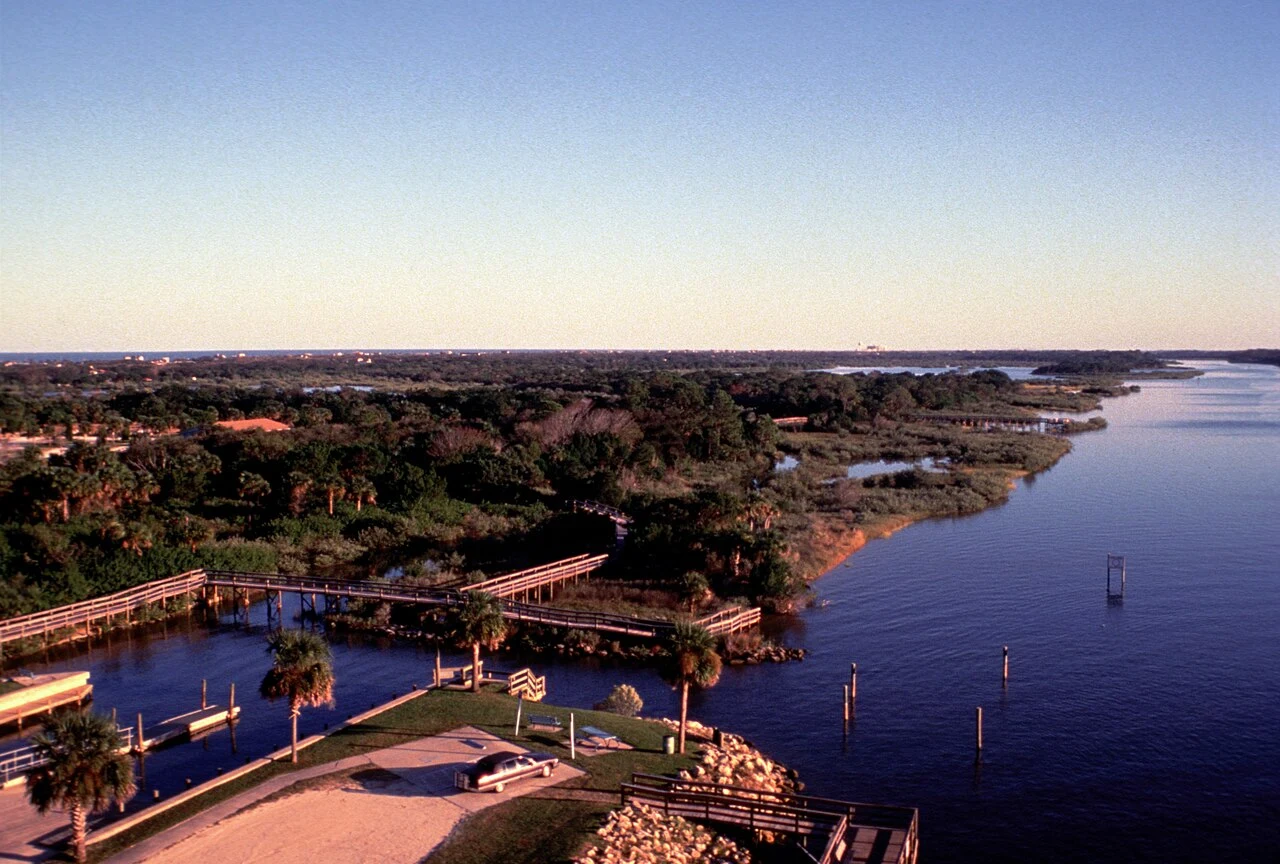
A harbor presents an angler with two overlapping maps. One shows access, boats and the places where fishing is permitted. The other shows moving water, shelter and feeding opportunities. Productive shore fishing begins where those maps overlap. A promising piling behind a locked gate is not a fishing station, and an accessible seawall is not automatically holding fish.
This is a practical search method for legal public shorelines in sheltered North American saltwater harbors, with Florida examples. It does not identify a particular harbor as open or recommend casting inside a working marina. The cover is a historical view of Florida's Flagship Harbor area; it illustrates shoreline access and habitat, not today's permissions or conditions.
Choose three stations before unpacking
Start with the responsible park, port or marina authority. Confirm the exact bank or pier where fishing is allowed, opening hours, closures, parking and any restrictions on casting or landing fish. Check the relevant recreational fishing licence and species rules separately. Florida FWC's shoreline-licence guidance distinguishes shoreline fishing from other situations; do not assume that being on public ground removes every licensing requirement.
Walk the available section without carrying an exposed hook. Select three stations with room for a controlled cast and an attainable landing position. Useful candidates are a public seawall corner, an open edge beside a permitted pier, and a reachable transition between vegetation and sand. Reject a station if retrieving a fish would require climbing a fence, leaning over a dangerous edge or entering a berth.
Leave room for pedestrians and other anglers. Boat traffic can change the available casting lane within seconds. A long cast across a channel may look productive but creates a conflict with navigation and rapidly moving hulls. Fish a shorter, manageable lane when necessary, or choose another location. Access and landing control are part of the method, not administrative details to consider after a bite.
Separate tide height from current
Tide height affects which shelves, rocks and banks are covered. Current affects the route of a drifting bait or swimming lure. NOAA publishes tide and tidal-current predictions separately because the timing relationship varies by location. High water does not reliably mean slack current, and a nearby station may not describe the flow beside your chosen corner.
Read the appropriate predictions, note their station and time zone, then observe the water. Watch naturally occurring foam or floating leaves, where present, and the way the surface passes a fixed piling. Do not throw material into the harbor. Wind may move the surface differently from deeper water, so treat what you see as a clue rather than a full current measurement.
Record an easy description: water moving left past the public wall, quiet pocket behind the corner, visible baitfish outside the shade. This is more useful than writing incoming tide without checking what the water is actually doing. When flow changes, your successful casting position may also need to change.
Understand why structure can hold fish
A hard edge can provide shelter, concealment, attached organisms or a boundary that guides prey. These are different advantages. A crustacean-feeding fish close to a piling may respond to a small bait held accurately, while a predator intercepting passing fish may respond better to a swimming lure worked along an edge.
Forage is the natural food available. In Florida, FWC describes common snook as feeding on fish and large crustaceans and orienting toward moving water. Its sheepshead profile describes structure such as seawalls and oyster bars and a diet dominated by crustaceans with other food. Those examples explain different presentations; they do not mean both species inhabit every North American harbor.
Use a local identification guide or fishery species list before selecting a target. A harbor in Maine has a different fish community from a Florida inlet. Even within Florida, water temperature, salinity, season and habitat affect which fish are plausible. Do not interpret a familiar-looking shoreline as proof that a particular species is present.
Turn a harbor feature into a fishing decision
The table gives editorial starting hypotheses for places where fishing is expressly allowed and the example fish occur. It is not a location-specific catch forecast. Choose a presentation you can control without contacting boats, lines or private equipment.
| Feature | Possible fish example | Food or shelter advantage | Starting presentation | Adjustment to test |
|---|---|---|---|---|
| Public seawall corner with a current seam | Snook in suitable Florida waters | Passing small fish or crustaceans beside a quieter holding edge | Swim a small soft plastic along the seam, beginning with short casts | Move your safe standing position so the lure follows the edge longer |
| Permitted piling edge | Sheepshead in its range | Structure associated with crustacean feeding | Lower a suitably sized legal shrimp or crab bait close to, but clear of, the piling | Reduce excess sinker weight if it pins the bait awkwardly; maintain contact |
| Open sand beside vegetation | Locally present inshore predators | A boundary between prey shelter and open water | Retrieve a paddle-tail above the plants and across the clean edge | Shorten the sink count if the lure repeatedly returns with grass |
| Shade line beside a legal open casting lane | Local small-fish predators | Concealment beside an illuminated feeding lane | Compare a steady minnow-profile lure with a brief pause at the boundary | Change depth or angle before changing several lure colors |
| Riprap beside a public bank | Structure-associated fish confirmed locally | Gaps and edges may concentrate prey and shelter | Fish the outer edge with a controlled swimming lure | Keep the lure above snag-prone cracks; do not drag blindly through rocks |
| Slack pocket beside faster flow | Species depends on the harbor | A resting place close to food moving past | Drift a permitted bait or guide a lure through the pocket entrance | Test the exit separately; the center of the pocket may be less informative |
The strongest station combines appropriate habitat with an observable feeding opportunity. Small fish repeatedly scattering along an edge are more informative than a large empty expanse. A patch of attached growth does not establish permission to scrape bait from structures; obtain any required authorization and check collection rules before taking organisms.
Start with two presentations
For open shoreline and modest cover, a medium spinning outfit capable of casting approximately 7–21 grams can be a useful illustrative starting point. A rod around 7 feet and a balanced reel are convenient, but the printed lure rating, expected fish size and abrasion risk matter more than a model number. Heavy pilings or powerful fish can demand stronger equipment and more experience; do not compensate for an unsuitable outfit by locking the drag.
A 7–10 centimetre paddle-tail on a light jighead offers a simple search presentation. Select the head weight for depth, current and the rod rating, starting light enough to keep the lure swimming through the useful lane. Thread the plastic straight. Test its movement in visible water before making a longer cast; a lure rolling sideways or covered in grass is not fairly testing the station.
A small bait on a single appropriate hook provides a different question: will a fish take a slower offering close to structure? Match hook gape to the bait rather than burying the point in a bulky piece. Use the lightest practical sinker that allows control. Hook requirements vary by species and jurisdiction; check them before choosing a rig, and avoid deliberately delaying a bite response so a fish swallows deeply.
A shallow-running hard minnow offers another comparison in a clear lane: use a steady retrieve or short pulls with pauses, checking the lure's stated running depth. Its fixed shape and buoyancy behave differently from a weighted soft plastic. A compact spoon can search open water with a fluttering fall, but needs room to stay clear of pilings and mooring lines. Start with the plastic for adjustable depth, then test one alternative for a specific reason. More lure types help only when their action or running depth addresses the water in front of you.
Control the route, not just the retrieve
Imagine current moving from your left to your right along a legal public wall. Casting slightly left may give a lure time to reach the intended layer before it passes the chosen corner. Recover excess slack, keep track of where the line enters the water and retrieve so the lure works without racing away from the edge. This is an example to test, not a fixed casting rule.
A cast straight out can cross the productive strip quickly. A shorter cast more parallel to the bank may spend longer near it. If the lure repeatedly touches the same obstruction, reduce the settling time or change position instead of pulling through the snag on every attempt. Broken tackle and disturbed habitat are not evidence of persistence paying off.
With bait, maintain enough contact to detect an unusual movement without dragging it constantly away from the holding area. Watch whether the rig stays in the chosen lane or sweeps behind a piling. If a stronger current makes the presentation uncontrollable, select a more sheltered station rather than automatically adding a very heavy sinker.
Work a deliberate ninety-minute session
Use the first fifteen minutes to confirm access, observe traffic and choose three stations. Spend about fifteen minutes at each with one basic search presentation, making near, middle and farther casts only where each is safe. Note depth control, follows, taps, baitfish and repeated snags. These timings are an editorial practice exercise, not a biological timetable.
For the next twenty minutes, revisit the most informative station. Change one variable: a more parallel angle, slightly slower retrieve or different layer. If the lure drew follows but no takes, a smaller profile or a controlled pause may be worth comparing. If there was no visible activity and poor presentation control, another station is usually a better test than an endless sequence of colors.
Use the remaining time to pack away hooks, collect line fragments and record the actual flow direction and water level. Keep useful observations separate from guesses. Two bites beside the wall corner is an observation; all fish feed there on outgoing water is an unsupported conclusion from one visit.
Make the next visit more informative
Return with the same core tackle and test a different stage of water movement while retaining a safe exit and legal access. Compare the same features before drawing conclusions. A busy harbor, dirty water, changing wind or temporarily absent baitfish can make yesterday's route unhelpful.
Have a net and release tools ready before fishing. Avoid dragging fish over rough surfaces, handle them only as necessary, and follow current local rules for protected species, retention and consumption advice. Keep wildlife away from bait and hooks. A good harbor session leaves both a usable record and a shoreline that other people can continue to enjoy.