November and December can fit a Hawaiʻi bonefish trip, but they are not a promise of easy wading or a statewide peak bite. The useful seasonal question is which lawful flat remains fishable when winter swell, wind and cloud change the plan. Build the trip around safe access, enough visibility to see fish and a presentation you can control.
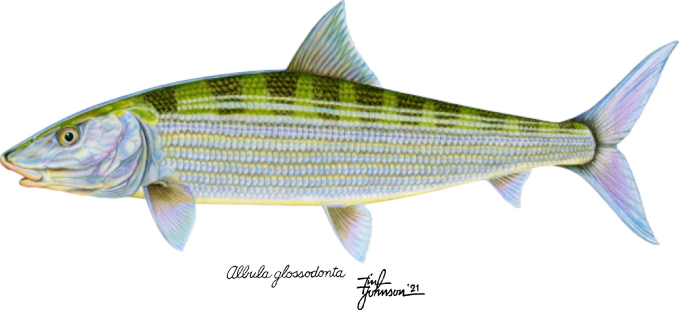
The cover is Timothy P. Johnson’s scientific illustration of an adult roundjaw bonefish (Albula glossodonta), reproduced from Figure 1 of Pickett et al. (2022), Gigabyte, under CC BY 4.0. It is not a catch photograph or a record of a particular Hawaiʻi flat. Use the official identification material linked below when distinguishing fish.
Choose the island first, then the conditions
For a first visit, concentrate on one island rather than turning several short sessions into an inter-island itinerary. Oʻahu offers a useful planning framework because DAR publishes detailed managed-area information and the University of Hawaiʻi provides an island-specific surf climatology. That does not make every shallow Oʻahu shoreline legal or safe to fish. A flat visible from a hotel may be inside a conservation district, across a deep channel or reached only through restricted property.
Hawaiian bonefishes are known as ʻōʻio. NOAA’s habitat material describes a life cycle using multiple connected habitats; the fishery should not be imagined as an isolated patch of sand. For an initial sight-fishing search, look for clean sandy lanes, shallow feeding areas and transitions toward deeper water. Treat those features as places to investigate, not evidence that fish are present today.
A knowledgeable local guide can turn a first session into a lesson in species recognition, safe wading and boundary interpretation. Before booking, ask whether the outing is primarily wading or boat based, what happens when visibility disappears, whether tackle is included and how cancellation decisions are made. Pay for an appropriate plan, rather than an implied catch guarantee.
Winter changes which shore is sensible
University of Hawaiʻi surf climatology identifies winter as the strongest season for the North Shore’s North Pacific swell sources. South-facing exposures have a different annual cycle, but winter westerly swell and Kona weather can still affect them. “South side” therefore is a starting point for comparing exposures, never a declaration of safety.
Use the National Weather Service Honolulu marine page for the current surf forecast, coastal forecast, warnings and buoy links. Compare swell direction and period as well as height. A sunny, lightly windy morning does not cancel swell arriving from a distant storm. A small-looking set while you unpack does not establish the largest waves that will reach a reef.
Do not wade an unfamiliar outer reef, cross a channel or continue beyond a safe return route for a casting angle. Choose a guide or shore-based alternative when exposure is uncertain. Stop for thunder, rising water, increasing surge, poor footing or an exit that no longer looks straightforward. Keep a companion informed of the route and return time; protective footwear and a flotation aid are sensible additions where appropriate, not permission to enter hazardous water.
Resolve the legal map before rigging
Rules below were checked on 20 October 2026. Recheck DAR immediately before the trip and again for the chosen location. A statewide species rule, marine licence and legal shoreline access answer different questions.
- DAR requires a Nonresident Recreational Marine Fishing License for nonresidents aged 15 or older fishing recreationally in the ocean, including from shore and charter boats. Its current page lists exemptions for active-duty military and their minor children. Purchase the appropriate licence and carry the required identification; a guide booking does not automatically replace it.
- DAR’s statewide marine-species table lists a 14-inch minimum for ʻōʻio. HAR 13-95-10 prohibits taking, possessing or selling smaller fish. The chapter defines the measurement along a straight line from the snout to the middle of the tail’s trailing edge. Do not assume another state’s total-length method applies.
- Managed-area rules can prohibit fishing, restrict gear or impose additional conditions. Read the exact district map and text. Catch-and-release intentions do not override a fishing prohibition.
- Legal fishing water does not authorize crossing private land, entering a fishpond or ignoring park access restrictions. Arrange lawful entry separately and respect community and cultural sites.
A concrete example prevents a common Waikīkī mistake: the Waikīkī Marine Life Conservation District at the Diamond Head end has defined boundaries and prohibits fishing. DAR also restricts taking gear into its waters, subject to the stated exceptions. Do not mistake that district for the entire Waikīkī coastline or transfer its rules to another managed area. Save the official map and ask DAR about an ambiguous boundary before fishing it.
This guide recommends releasing bonefish. That recommendation is not a claim that all legal harvest is banned, and the statewide minimum does not establish a permission to retain fish in every location.
A practical fly outfit
An 8-weight saltwater fly rod, floating tropical line and a reel with a smooth drag form a sensible baseline. Orvis’s bonefish instruction uses an 8-weight as its general starting point, with a 9-weight an option for wind and heavier work. Ask the guide which outfit suits the expected flat before buying a second rod.
Use adequate backing—Orvis recommends 150 yards in its general lesson—and check that the line-to-backing and backing-to-reel connections are sound. A fish reaching backing should find clean line, not a forgotten weak knot. Practise clearing loose line through the guides without wrapping it around a hand or stepping on it.
Begin with a tapered leader around 9 feet and a 12–16-pound terminal section. Lengthening toward 12 feet can separate the fly from the thicker line in calm, clear water, but only if you can turn the leader over accurately. A shorter controlled leader is more useful than a long collapsing one. Inspect the last section after contact with rough bottom and replace damaged material.
Carry a compact selection of shrimp- and crab-style flies in sizes roughly 4–8, with light and heavier eyes. These are editorial starting ranges, not a regulation or a guarantee of the local prey size. Choose weight to reach the feeding level without striking the bottom so hard that every cast hangs up. Neutral tan and pale patterns give a manageable starting selection; ask a local operator what size and weight to add.
A light spinning alternative
A medium-light to medium saltwater spinning rod around 7 feet, a 2500–4000-size reel and approximately 10–15-pound braid offer a practical starting outfit for controlled casts. Reel numbering varies by maker. Balance the actual rod and reel, and use tackle strong enough to land fish promptly without locking the drag.
Connect roughly 3–5 feet of 12–20-pound leader with a knot you can tie consistently. A small shrimp imitation on a single jighead can cover sandy lanes; begin around 1/16–1/8 ounce in sheltered shallows and change weight when depth or current demands it. Those weights are suggestions for testing presentation. If the lure ploughs, reduce weight or retrieve more deliberately; if it never reaches the intended layer, increase weight gradually.
Where bait fishing is lawful and appropriate, ask a local guide about a small shrimp bait on a barbless, non-offset circle hook, approximately size 2–1/0 according to bait and actual hook dimensions. Leave the hook’s gap clear. Follow the circle hook’s intended method: wind steadily into pressure instead of delivering a hard strike. Do not collect bait, introduce live organisms or assume bait methods are allowed until the site’s rules are checked. DAR encourages barbless circle hooks to reduce harm to fish and protected wildlife.
See first, cast second
Polarized glasses, a brimmed hat and a position with useful light can matter more than another lure. Stop often and search a short section of water systematically. Look for a moving outline, a shadow that changes position independently of the bottom or a tailing disturbance. Waves, mullet and drifting debris can mislead an inexperienced observer; identify a likely target before casting.
Walk slowly on safe sandy routes, avoiding live coral. Do not chase fish across the flat. When you spot one, determine its direction and place the offering ahead of its likely route without dropping heavy line across it. The needed lead changes with fish speed, current, water clarity and sinking time; a fixed number of feet would be misleading.
Let a weighted fly settle enough to enter the feeding zone. Begin with small controlled movements and watch the fish’s response. If it turns toward the offering, avoid an automatic long strip that drags it out of reach. If it bolts on landing, improve the approach, reduce impact or lead farther rather than immediately changing colour.
On fly tackle, establish contact with a controlled strip strike when the fish takes, then clear line safely. With a jig, wind and lift smoothly into contact. Keep the rod angled to apply pressure without pointing a sharply bent tip behind your head. Once a fish runs, protect fingers from line and let a properly set drag work.
Tides help structure observation
Use NOAA predictions for a relevant local station and compare them with what you actually see. Predicted water level does not describe every current flowing across a reef or through a channel. Wind and swell can also change the practical experience of a flat.
Plan an initial visit around a manageable access window and good visibility, with time to leave before the return route deteriorates. Note where shallow feeding water connects with deeper refuge, and observe whether fish move onto or off it as the level changes. Do not conclude that a missed tide window means the entire island is unfishable. A sheltered legal alternative—or a cancelled session—can be the better decision.
Release, wildlife and shared space
Have pliers or a dehooker ready before casting. Bonefish & Tarpon Trust recommends minimizing handling and keeping the fish in the water for dehooking where possible. Use clean wet hands if support is necessary; avoid dry sand, hard surfaces, gill contact and hanging a fish by its jaw. Prepare any photograph beforehand and keep air exposure minimal. An in-water photograph avoids the pressure to lift a fish for repeated attempts.
Allow recovery without dragging the fish back and forth. Watch for predators before release; repeatedly feeding vulnerable fish to predators is a reason to move or stop. Do not prolong a fight with unnecessarily light tackle for the sake of sport.
Avoid casting near turtles, seals, swimmers or other people. Hawaiʻi’s protected species have state and federal protections; DAR’s guidance explains how fishing practices can reduce entanglement and hooking risk. If protected wildlife enters the casting area, bring the line in and give it space. Follow official reporting guidance for any accidental hooking rather than attempting an improvised capture. Pack out line, clipped leaders and hooks, and leave cultural features and access paths undisturbed.
Build a useful first outing
The evening before, confirm the licence, legal boundary, access permission, forecast, guide contact and cancellation plan. Assemble one outfit, test the knots and pack water, sun protection, glasses, footwear, dehooking tools, a charged phone and a small first-aid kit.
On arrival, watch the water before entering. Identify a conservative exit, assess the largest sets and compare the conditions with the forecast. Spend the opening portion learning to see fish and control a short accurate cast. If cloud removes visibility, wind defeats safe casting or swell reaches the access route, change the plan rather than forcing the original booking into unsuitable water.
Afterward, record light, wind, water level, safe access timing, fish behaviour and presentation changes. A quiet session can still reveal where you should stand, which weight fouls less and what conditions justify returning. Those observations are a more reliable foundation for a second Hawaiʻi bonefish trip than a promise attached to November or December.