A tench session often improves before the first bait enters the water. Finding a clean strip beside cover, measuring its depth and arranging a reliable landing route are more useful than immediately throwing a large quantity of feed at the prettiest patch of reeds.
Hollygrove Lake, in the River Suck system near Ballygar and Athleague, is a documented tench venue. This guide explains how to build a measured session there. It is not a claim that late autumn is its peak season: colder weather can make a tench-only visit slow, and the same plan may be more useful when warmer conditions return. Suggested tackle sizes and feeding quantities are starting points, not locally measured optima.
Identify the target and understand its food
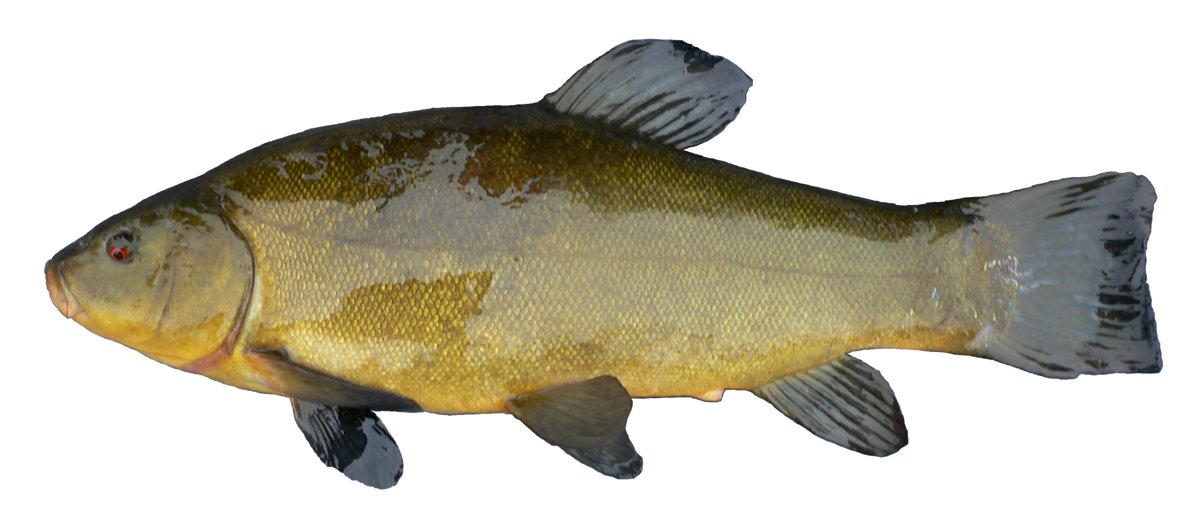
Tench, Tinca tinca, are stocky, greenish fish with small scales, red eyes and rounded-looking fins. They differ from the deeper, laterally flattened profile of bream and the larger-scaled appearance of carp. If a catch is unfamiliar, identify it before deciding what to do with it.
Native across much of Europe and northern Asia, tench are introduced in Ireland and distributed unevenly among suitable waters. They use lakes, canals and slower rivers, feeding near the bottom among aquatic plants. Their food includes invertebrates, molluscs, zooplankton and algae. Worms and small particle baits are practical offerings, but they should not be described as a complete reproduction of the natural diet.
Vegetation provides both cover and a place for food organisms. The useful fishing position is often a clean lane beside that habitat, where a bait remains available and the rig can be retrieved. Surface bubbles can indicate feeding, but they do not prove the species or even that fish caused every bubble.
What is known about Hollygrove
The fishery description places Hollygrove close to the main River Suck and describes much of it as shallow, around five feet, with two deeper channels or veins. It identifies tench and pike as important species. These are broad venue characteristics; water level and the exact depth at a selected stand still need checking.
Facilities described by IFI include an access road, parking, a footbridge to the island and angling space on the road shore. Inspect the current entrance information and any closure or maintenance notice. Do not assume that a mapped facility is usable during flooding or that neighbouring land is open for access.
The local guide notes night fishing for tench, but that is not a requirement to begin in darkness. For a first visit, learning the swim and exit route in daylight is more useful. A dusk extension can be considered only when access, footing and equipment are suitable.
Select a clean lane before feeding
Use a plummet with the float outfit to establish the depth at several nearby positions. A firm contact and a clean retrieve suggest a different bottom from a soft, burying weight or a rig returning with weed. Avoid tearing vegetation out to manufacture a swim.
Choose one close line and, if space permits, a slightly farther alternative. Keep them far enough apart to compare them, but close enough that casts remain accurate. The point is to learn which depth and bottom type is usable rather than scatter feed across the lake.
| Feature found in the swim | Reason to test it | Suitable rig | Adjustment |
|---|---|---|---|
| Clean strip beside plants | Bottom food beside cover | Light float with bait just on the bed | Recheck depth if the float drifts |
| Slightly deeper clean channel | Alternative feeding route | Running ledger | Reduce weight if it buries |
| Soft silty bottom | Bait can become hidden | Float with minimal bottom weight | Shorten the amount of line lying down |
| Dense vegetation across the retrieve | High risk of fouling and lost fish | Choose another lane | Do not rake out a new path |
Tench can pull hard for cover. Select a lane with room to steer a hooked fish before considering thinner hooklengths or an especially delicate float.
Rig one: a properly balanced float
A practical close-range outfit is a 12–13-foot float rod, a 2500–3000 reel and 6–8 lb monofilament. Match a 4–6 lb hooklength to clean water, or use a stronger one where cover demands it and the rod can protect it. Very light line beside heavy weed creates avoidable problems.
Attach a small waggler or suitable fixed float using its intended connector. Place most of the required shot near the float, with smaller shot spaced down the line. Finish with roughly 30–45 cm of hooklength and a size 12–16 hook chosen to suit the bait. Leave the hook point clear.
Set the float so the bait just reaches the bed or lies only slightly overdepth. Use a tiny lower shot as a depth reference rather than piling weight beside the hook. Test the rig in front of you: the float should show a readable tip, not lie flat or sink from its own loading.
Cast beyond the feeding point and draw the rig gently into place. Sink the surface line when appropriate to reduce wind drag, without pulling the float away. Watch for a sustained slide, lift or disappearance. A brief tremble may be a fish brushing line; respond to positive movement with a smooth lift rather than an explosive strike.
Rig two: a free-running ledger
When surface drift makes a float difficult to hold, use a light ledger. Thread a running ring carrying a 10–25 g weight onto the main line, add a protective bead, and tie to a swivel. Attach a 40–60 cm hooklength and the baited hook. The weight must slide freely; do not lock it between stops.
Use only enough weight to maintain the chosen position. On soft bottom, reduce weight or select a shape less likely to bury. A heavy lead may make a neat quivertip bend while hiding the bait in sediment.
Cast gently to the same measured line, let the weight settle and tighten until the tip is just responsive. Keep the rod positioned so a fish cannot pull it into the water. Strike smoothly on a positive pull or sustained drop-back after recovering slack. Do not leave a legered bait unattended.
This rig is an alternative for presentation control, not a reason to fish farther. If a close swim is producing, changing from float to ledger should preserve the location long enough to make a useful comparison.
Bait and feeding without excess
Begin with a modest hookbait: part of a worm, a few maggots or one grain of sweetcorn where local conditions permit. Increase the hook size if the bait masks the point. A large bunch of bait on a tiny hook can produce missed bites and unnecessary swallowing.
For a cold-weather trial, introduce only a small pinch of loose offerings near the hookbait, then wait for evidence before adding more. In warmer, active conditions, measured small additions may hold interest. The feed is there to focus fish, not to fill them.
If small fish remove soft bait repeatedly, a firmer grain of corn or a smaller, tidier worm section is worth testing. If bubbles appear without bites, check depth, hook exposure and line crossing the feeding patch. Do not assume the answer is always a larger bait pile.
Artificial maggots or buoyant imitations change the bait's behaviour and may lift it above the bed. They are optional experiments, not a necessary tench method or a substitute for understanding the rig. Check their buoyancy in shallow water before using them.
A worked half-day session
Arrive in daylight, confirm access and choose an available stand with a clean landing route. Spend the first part of the session measuring two nearby lines. Suppose the close one is weedy but a slightly farther patch gives clean bottom contact: start there with the float and a single small hookbait.
Feed sparingly and watch the float. If wind gradually tows it out of position, first adjust line control; if that fails, put the running ledger on the same line. This changes the delivery while preserving the test area.
After a sustained quiet period, inspect the bait and compare the second clean line rather than feeding more into the first. If a fish is hooked, steer it away from cover with steady side pressure, keep the rod cushioned and use a sufficiently large landing net. Record what preceded the bite and whether the rig remained clean.
Permits and care
Checked 31 October 2026: Hollygrove is included in the IFI Midland Fisheries Group controlled waters and requires the relevant permit. Carry the electronic or printed permit and check current conditions. Ireland's coarse-fishing rules include a two-rod maximum and a ban on live fish as freshwater bait; this plan uses one rod and releases tench.
Avoid flooded access and unstable edges. Keep fish supported and wet, minimise handling and return them promptly. Never move live fish to another water. A careful, quiet session can be worthwhile even when the season makes bites scarce.