Why the canal suits a winter plan
The Royal Canal offers long, accessible reaches, varied cover and established angling use. Waterways Ireland identifies pike among the species present, but that does not make every bridge, lock or towpath equally safe or productive. In November and December, short days, leaf debris, cold water and rapidly changing weather reward a compact, mobile plan.
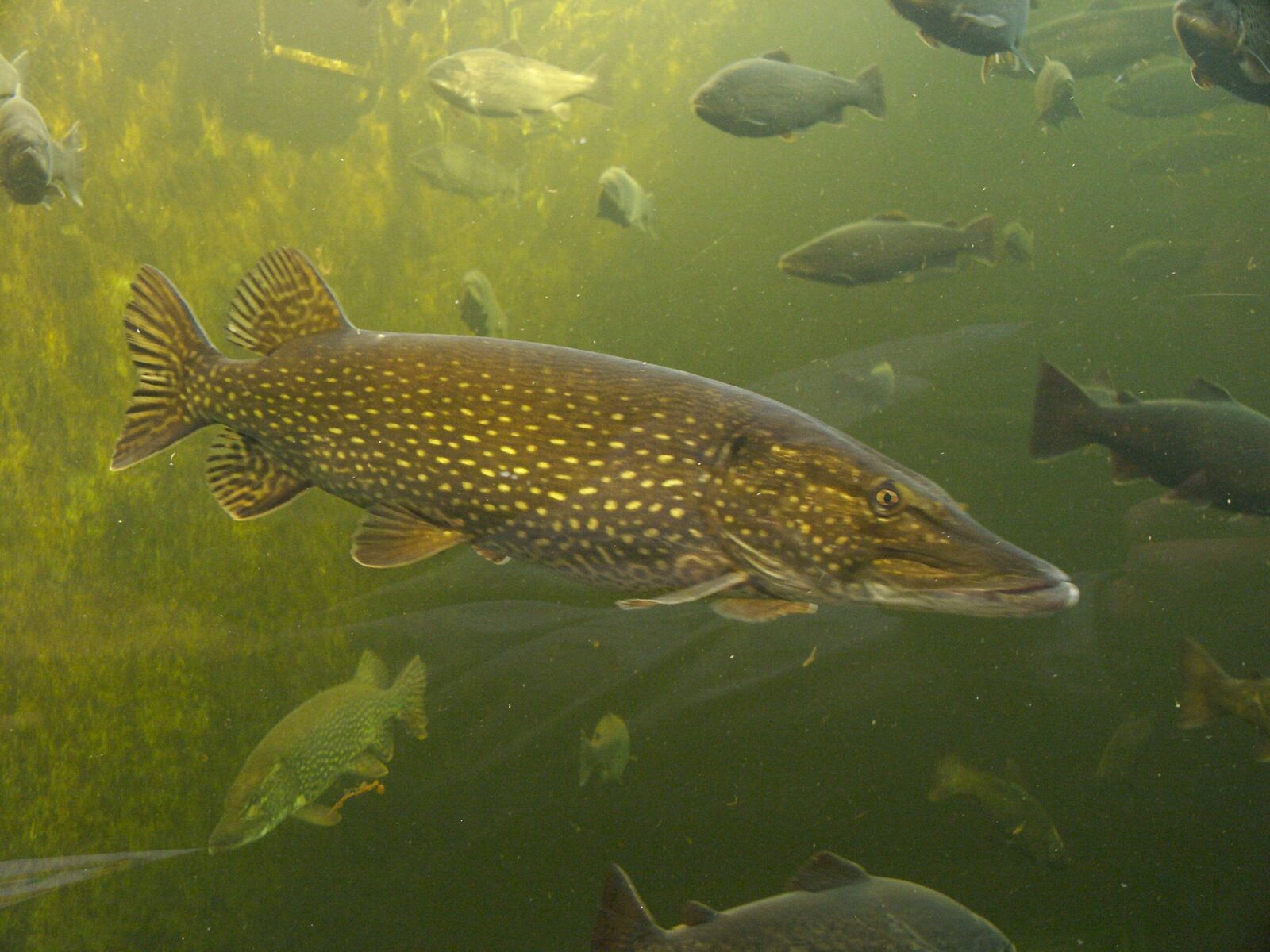
This is not a claim that pike feed better on a particular date. The aim is to fish a small number of legal, well-chosen reaches carefully, protect the fish and leave before darkness or weather makes the towpath awkward. The cover shows two verified Esox lucius in an aquarium; it is representative, not an Irish canal catch.
Access and permissions
Start with Waterways Ireland’s Royal Canal pages and local access information. The canal has many public access points, but anglers still need to respect signs, private boundaries, navigation operations, works and temporary restrictions. Park without blocking gates, keep the towpath open and give way to walkers and cyclists.
Confirm whether any local club permission is needed for the precise reach and whether construction, dredging or bank repair changes access. Lock chambers, weirs and moving gates are not fishing platforms. Never climb fencing or step onto a wet balance beam for a better angle. A long-handled net allows safe landing from a stable bank.
National pike rules to carry into the plan
Inland Fisheries Ireland’s current public reminder cites the national Pike Bye Law No. 809/2006: an angler may retain no more than one pike in a day, and pike longer than 50 centimetres may not be killed. Other pike must be returned safely to the same waterbody. This guide recommends releasing all pike unless there is a lawful, considered reason to retain one.
IFI enforcement material also confirms that using live fish as bait in fresh water is prohibited. For this lure-fishing plan, that is simple: carry only artificial lures and do not transport live baitfish. Check IFI’s current bye-law guide before each trip because consultations or later legal changes must not be confused with rules already in force.
Tackle for confined, snaggy water
A 2.1–2.4 metre spinning rod rated around 20–60 grams covers compact jerkbaits, paddletails and spoons without becoming unwieldy on a narrow towpath. Match it with a 3000–4000 reel, 20–30 lb braid and a bite-proof trace. Use either suitable multi-strand wire or a purpose-designed heavy fluorocarbon system of adequate strength, understanding that ordinary light leader is not protection from pike teeth.
Carry lures from roughly 10 to 18 centimetres rather than only large baits. A shallow jerkbait searches the shelf; a weighted paddletail explores the central track; a spinnerbait or single-hook weedless bait can work around remaining vegetation. Strong split rings, reliable snaps, long-nose pliers, side cutters, a large rubber net and a damp unhooking mat are essential.
Finding canal features
Walk first. Look for bridge shadows, lock approaches where fishing is permitted, reed points, moored-boat edges that can be fished without interfering, changes in canal width and the mouths of legal feeder sections. Pike often use the first depth change outside cover rather than sitting in the thickest snag.
Begin with a cast parallel to the near shelf. Then cover the outer edge and central line. Move after 10–15 minutes if there is no follow, strike or prey activity. In cold water, a slow retrieve with deliberate pauses often keeps the lure in the useful zone; “slow” still means maintaining hook control and avoiding the bottom.
A three-lure rotation
Use a suspending jerkbait first where depth permits. Two gentle pulls followed by a long pause can reveal following fish. Next, count down a soft plastic and retrieve just above the bottom with occasional lifts. Finish with a spoon or spinnerbait to cover a wider section when debris is light.
If a pike follows without taking, do not immediately repeat the same fast cast. Change angle, pause length or lure profile. At the end of every retrieve, make a controlled turn beside the bank so a following fish sees a stable target. Keep feet back from the edge during this manoeuvre.
Weather, visibility and canal hazards
Check Met Éireann’s current local forecast and warnings for the chosen section. A live warning observed on 24 October 2026 showed how quickly heavy rain and damaging gusts can make outdoor plans unsuitable; that transient warning is not a forecast for a later trip. Cancel when strong winds, flooding, lightning or poor visibility compromise safe casting or travel.
Canal edges can be undercut, greasy or obscured by leaves. Wear footwear with dependable grip and avoid standing on lock masonry. Carry a headtorch as backup, not as permission to extend an unfamiliar session into darkness. Cold hands slow unhooking, so pack dry gloves for walking and keep fishing tools accessible.
Playing and unhooking pike
Set the drag before fishing and use tackle strong enough to avoid an exhausted fight. Lead the fish into the net without stabbing at it. Once netted, keep the pike in the water while the mat and tools are positioned.
On the mat, keep the fish straight and supported. Long pliers remove exposed hooks; cutters are for hooks that cannot be backed out safely. Do not put fingers into the mouth. An experienced, careful chin grip can control the head, but it must be combined with full body support and should not be attempted without understanding the gill anatomy. Weigh in a sling only if necessary and return the fish promptly to the same water.
Release in cold water
Cold water can reduce some thermal stress, but it does not excuse prolonged photography. Keep the pike low, wet and supported. In the margin, face it into gentle flow or hold it upright in still water without pumping it. Release when it maintains balance and pushes away. Do not throw it or move it to another reach.
Clean and dry net, mat and boots before visiting another water. This reduces the chance of moving invasive organisms or disease. Remove discarded line encountered on the bank where it can be done safely.
Common mistakes
The first legal mistake is using live bait or retaining a fish contrary to the bye-law. The first practical mistake is carrying so much tackle that safe movement on the towpath becomes difficult. Other problems include a weak leader, no cutters, fishing from lock infrastructure and casting when a cyclist or walker is approaching from behind.
Technique errors include racing through likely cover, fishing only the central channel, and striking repeatedly at a following fish. Slow down, change angle and make every cast purposeful.
A short-day itinerary
Choose two adjacent legal reaches and one parking point. Check access, daylight and weather the evening before. Arrive after first light, inspect the towpath and rig away from the edge. Spend 45 minutes covering the first reach with three depths, then walk for 15 minutes while observing prey and cover.
Fish a second reach for another hour, take a warm break and decide whether conditions justify one final pass. Finish with at least 45 minutes of daylight remaining. Record water colour, debris, lure depth, follows and fish-care time. A blank log is still valuable.
Final verification
This guide was reviewed on 24 October 2026 against Inland Fisheries Ireland’s pike-rule material, its live-bait enforcement notice, Waterways Ireland access information and Met Éireann forecasts. Check the exact reach, current bye-laws and live warnings again before leaving home. If access, weather or fish-care preparation is incomplete, postpone the trip.