Find a wash lane you can fish from dry ground
The useful part of rock wash is often the edge where moving water spreads away from cover. A small bait can travel beside the ledge there without falling straight into a crack. The best-looking patch is of little use if the float keeps disappearing behind rock or if a hooked fish cannot be guided to a landing place.
This is a shore plan for eastern rock blackfish on the Kiama coast of New South Wales. Start from a legal, stable position with a clear exit and a dry landing area. The suggested tackle, depths and timing are practical starting points. They describe ways to test a lane in suitable conditions, not a recent catch report or a promise that any exposed ledge is fishable.
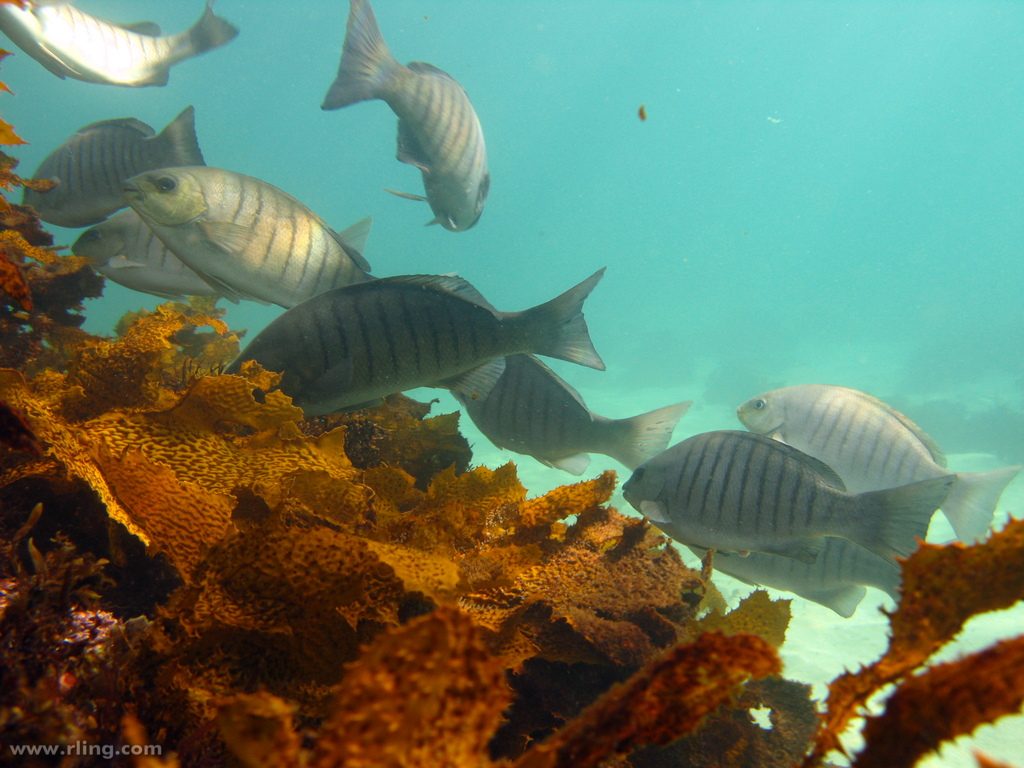
Identify black drummer
Eastern rock blackfish, Girella elevata, is commonly called black drummer. It is a dark, strong-bodied coastal fish with a long dorsal fin and thirteen dorsal spines. Silver drummer, Kyphosus sydneyanus, is generally more silver and has eleven dorsal spines. Colour can be misleading in wet light, so use several features and avoid unnecessary handling just to count spines.
Rock blackfish occur on rocky shores along the NSW coast and extend into southern Queensland, Victoria and northeastern Tasmania. They use surge areas and can dive into crevices or under ledges when hooked. Food includes seaweed and attached or mobile invertebrates, including cunjevoi and crabs. A compact purchased prawn bait makes a practical starting test without collecting organisms from the platform.
The fish's association with wash explains why a bait moving beside a rock face can be useful. It does not make a wave-washed standing position necessary. Fish the water the surge reaches from a position the surge cannot reach, or choose a different day.
Use named access as a planning reference
Destination Kiama lists Kiama Harbour, Blowhole Point and Black Head at Gerroa among local fishing locations. These are named access examples, not proof that every ledge is open or holds drummer. Consult the current NSW declared-area map and signs. Some of these locations include high-risk rock-fishing areas.
For this plan, inspect a permissible rock-edge lane with a clear route back and enough room to use a landing net from dry ground. A protected harbour-side position can be a more controllable option when it provides suitable rocky cover and lawful access. Do not fish through vessel traffic, across a swimming area or from a closed structure.
Watch the water from well back before choosing a spot. Identify the outer edge of foam, any visible ledge and the direction the water runs after each surge. Look for a lane that carries the bait parallel to the edge and then into clear water. Avoid a recirculating pocket that repeatedly sweeps the line behind the same boulder.
Fish the tide and light you can control
Start by comparing the upper metre with a slightly deeper lane, perhaps 1–2 m where you can estimate the depth safely. These are suggested working bands for close fishing, not measurements of a specific Kiama mark. A float set too deep may drag into rock at every surge. A bait held too high may pass over the fish without reaching the feeding edge.
As water rises, a ledge may gain depth and a new side lane may become accessible. The landing route can also disappear. Reassess the footing before following the fish. On falling water, the current may expose a useful boundary or reduce the depth so far that the method is no longer viable.
Late spring and early summer visits offer longer daylight, but there is no verified universal local bite window for this species. Use daylight to judge bottom and safe access. Foam can obscure the float, while wind can drive the line farther than the bait. Shift to the clearer boundary or change rigs when those effects defeat bite detection.
A rod that can steer a fish
Start with a 3–3.6 m rock or shore rod rated for the loaded rig, around the 6–10 kg class, and a 4000–6000 reel. Use 20–30 lb mono or 25–35 lb braid with roughly 1.5–2 m of 25–40 lb abrasion leader. The chosen hooklength should match the cover, not simply be the heaviest available line.
A longer rod helps hold the line outside a ledge and steer a fish across open water. Leave enough drag to absorb a surge and avoid locking the reel. If an early run would take any fish directly under an unmanageable shelf, move the rig farther from that shelf before fishing.
Inspect the leader after a scrape. A white or rough patch near the hook can fail during the first run. Keep a long-handled net and pliers ready, and plan where a companion can assist without stepping onto a wet ledge.
Rig one — a short float drift
Choose a sturdy 8–15 g float and weight it to the manufacturer's loading guidance. For a sliding design, put a stop knot and bead above the float, then thread on the float, add a small running weight and protective bead, and tie a swivel. Use a 45–75 cm hooklength of 20–30 lb mono and a strong size 1–2/0 J hook.
Use a compact peeled prawn piece around 2–4 cm long, adjusted to the hook. Pass the hook through a firmer section and leave its point and gap clear. A legally sourced compact crab piece is a second natural bait where suitable. Buy bait rather than assuming you may collect it at the chosen platform.
Set the stop so the hook drifts just above the visible ledge or weed. Make a short cast a little upstream or into the approaching wash and recover enough line to follow the float. Guide it along the outer edge with a high enough rod angle to keep line clear of near rock.
Lift firmly and smoothly when the float stays down or travels purposefully away. A brief dip in the same surge on every pass may be wave action. If it disappears at a fixed point, shorten the depth before trying another bait. If you cannot see the float through the foam, shift to a visible lane instead of striking blindly.
Rig two — a lightly weighted running bait
Where there is a clean pocket and modest water movement, slide a 3–10 g ball sinker on the abrasion leader, add a small protective bead and tie a swivel. Attach a 40–60 cm hooklength of 20–30 lb mono with a strong size 1–2/0 hook. Let the sinker run freely.
Cast short at an angle along the edge. Allow the bait to settle under controlled contact, then lift slightly and let it fall again. Do not drag it through every crevice. This rig works best where you can feel when it touches down and retrieve before it wedges.
On a sustained take, recover slack and apply a controlled side lift away from the ledge. Use the rod and drag together to prevent a slack line during the first turn. Do not attempt to pull a large fish up by the leader. Guide it into the preselected net lane.
Compare a small prawn piece with a compact crab bait only after finding a controllable lane. A firmer crab section may last longer through repeated dips, while a soft prawn is easier to reduce when fish nip the bait without taking it. Keep the same hook and depth for that comparison, and change the bait before changing the whole rig.
| Lane or response | Why it matters | Starting rig | Presentation | Change if needed |
|---|---|---|---|---|
| Clear edge beside foam | Food can move beside shelter | Sliding float | Drift just above the rock | Set shallower if it catches |
| Clean pocket with modest flow | Bottom contact is readable | Running bait | Short fall, lift and pause | Reduce weight if it wedges |
| Repeated dips in one place | Hook may be touching cover | Float | Repeat a shallower pass | Move the lane outward |
| Fish pulls toward a ledge | A landing route is at risk | Either | Apply early side pressure | Select a clearer lane before recasting |
A worked daylight session
On a suitable day, spend the first twenty minutes observing from well back and agreeing a landing route. Begin with a 10 g float, a 60 cm hooklength and a size 1 hook carrying a small prawn piece. Set the bait shallower than the ledge top and make several short drifts.
If the bait returns intact and there are no signs, deepen in small steps until you approach the cover without snagging. Then move to a second lane before changing the bait. If the bait is stripped, use a smaller firm section and inspect the point. Stop repeating a cast that reliably sweeps the hook behind a rock.
Compare a 5 g running rig only over a cleaner pocket. Keep the same bait so that the main change is depth and how it settles. If you cannot maintain contact or see a safe landing route, end that comparison. Record the depth, direction of drift and where bites occurred relative to the rock.
Rules and brief rock care
NSW DPIRD lists a 30 cm minimum length and bag limit of ten for rock blackfish. Check the current rules, fishing fee or exemption, and local restrictions before travelling. NSW requires approved lifejackets for rock fishing in declared areas, including declared locations in Kiama. Use the current map and signs for the exact position.
Wear appropriate flotation and footwear, fish with a companion and leave if waves threaten the standing or return route. Net fish from dry ground, support them with wet hands and unhook promptly. Do not climb down to recover a snag or a fish.