
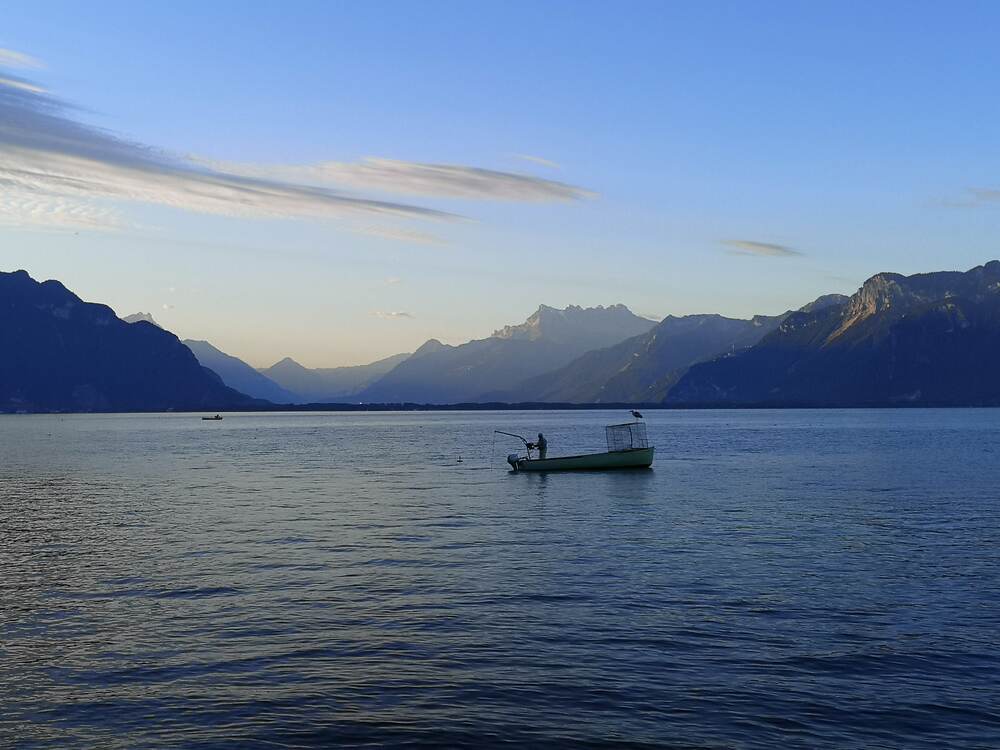
Lake Geneva, or Lac Léman, is too large and varied to approach as one uniform fishery. On the Vaud shore alone, an angler can move between sheltered harbour edges, open promenades, gravel or stone margins, reed-fringed bays and steep water that becomes deep within a short cast. Winter strips away much of the recreational traffic, but it adds cold water, short daylight, changing alpine wind and rules that must be checked for the exact method and species.
This guide is for planning a cautious shore or small-boat session rather than promising a particular catch. It treats the lake as a mixed fishery. Perch, pike, whitefish and salmonids all occur in the system, but seasons, protected periods, minimum sizes, daily limits and permitted methods are not interchangeable. The State of Vaud’s current fishing page and the legal texts linked from its permit service are the authority for the Swiss side. Recheck them on the day you fish.
Start with the legal check
The State of Vaud published several changes effective 1 January 2026 for Lake Geneva. Its summary says the minimum size for whitefish increased to 37 centimetres and the minimum size for pike to 50 centimetres. It also states that recreationally caught trout, Arctic char and perch must be retained rather than released, including fish below the minimum capture size, and that every such capture counts toward the applicable daily and annual total. The pike protection period was extended from 20 March through 20 April, while the trout quota changed to four per day and 100 per year for the named recreational categories.
Those points are important, but a summary of changes is not the whole rulebook. Before leaving home, open the current Lake Geneva regulations linked by the permit service. Confirm whether you need a permit, which permit class covers your method, the permitted number and type of lines and hooks, species closures, size and bag limits, bait restrictions, reporting duties and any local exclusion zone. The lake is shared across jurisdictions; a permit or rule applying on the Vaud shore should not be assumed to govern French waters or another canton.
Build the trip around what the current text allows, not around tackle already in the car. If a rule is unclear, reduce the plan to a simple lawful method or contact the competent fisheries office. Do not depend on an old screenshot, a forum post or a previous season’s pocket guide.
Choose a manageable piece of water
Winter success begins with a small search area. Select two or three legal access points within a short drive or walk of one another. A harbour mouth, a point beside deeper water and a shallow bay give three different options without turning the day into continuous travel. Check signs on arrival because access, construction and navigation restrictions can change independently of fisheries rules.
At each stop, look for transitions. A hard edge meeting softer bottom, a band of submerged vegetation, the end of a breakwater, a depth change or a stream mouth can concentrate food and provide a travel route. CIPEL’s public information on aquatic grass beds explains that these underwater meadows provide shelter and food for fish, including perch and pike. Treat the habitat carefully: do not rake vegetation, trample reed margins or anchor through sensitive beds.
Clear winter water makes observation useful. Polarized glasses can reveal weed edges, pale gravel, drop-offs and discarded line. Watch for baitfish, birds feeding over one lane, or a slight change in water colour. These signs are more useful than repeatedly casting to featureless open water.
A compact shore outfit
A general light spinning outfit keeps the session adaptable. A rod around 2.1 to 2.4 metres rated for roughly 5 to 20 grams, matched to a 2000- or 2500-size reel, will cast small jigs, spoons and float rigs while remaining easy to control on a promenade. Main line might be 6- to 10-pound braid with a fluorocarbon leader around 6 to 12 pounds. Increase leader strength near stonework or other abrasion; do not reduce it merely because the water is clear if the terrain makes break-offs likely.
Carry only lures that the current rules permit. A small soft plastic on a light jig head can be worked close to bottom with short lifts and long pauses. Use the lightest head that still reaches the selected depth without bowing far away from the line of the cast. A compact spoon or sinking minnow can search mid-water, but retrieve slowly enough to maintain control.
If lawful bait fishing is part of the plan, confirm both the bait and hook arrangement before rigging. A simple float or light ledger presentation should use enough weight to remain stable, not so much that a bite becomes difficult to detect. Keep hooks and bait proportional and monitor the rod continuously. Never collect or move live aquatic organisms on the assumption that visible means legal.
Work a repeatable sequence
Give each position a disciplined trial. Begin with a few casts parallel to shore, where the lure remains near the first drop or wall. Then cover diagonals across the transition and finally probe the deeper line. Count the lure down on each cast so the depth can be repeated. If weed or rock is fouling the hook, shorten the count or change the angle rather than grinding the bottom.
Cold-water takes can be subtle. Keep the rod tip positioned to control slack, watch the line for a small jump and use a firm lift rather than an exaggerated strike. When a fish is hooked, maintain steady pressure and guide it away from mooring lines, chains and sharp edges. A long-handled net is safer than leaning over a wall.
After fifteen to twenty minutes without a bite, follow or a useful sign, change one variable. Alter depth first, then speed, lure profile or position. Avoid changing everything at once because the session stops producing information. If two carefully worked stops show no life, move to the third habitat type rather than cycling through more colours.
Wind, visibility and boat decisions
The lake can look calm from a sheltered street while open water is already rough. MeteoSwiss provides current hazard information for wind, thunderstorms, rain, snow and ice. Check the hazard map and local forecast before departure and again before launching. A favourable forecast is not permission to ignore visible deterioration.
For a small boat, cold-water consequences should dictate the plan. Wear a properly fitted personal flotation device, carry reliable communication, use navigation lights where required and tell someone the launch point and return time. Stay close enough to shelter that an engine, battery or weather problem does not become an exposed crossing. Keep the deck clear, distribute weight sensibly and return before wind or darkness removes the safe margin.
From shore, ice on steps, spray-wet stone and a rising wave line can be more hazardous than the fishing itself. Use footwear with grip, avoid standing on algae-covered blocks, and choose a landing position before making the first cast. Never climb past a barrier for a better angle.
Fish care under unusual retention rules
Many anglers are accustomed to releasing small or unwanted fish, but current Lake Geneva rules require special attention. The State of Vaud’s 2026 summary explicitly says recreationally caught trout, Arctic char and perch must be retained and may not be returned, even when below the minimum size. That makes correct identification, lawful targeting and stopping at the applicable limit especially important.
Carry a measuring tool, dispatch equipment and a clean insulated container if the current rules allow and require retention. Decide in advance how a legal retained fish will be used. If you cannot store a catch safely or do not want to retain the species likely to take your method, choose another lawful plan rather than relying on release.
For species that may legally be released, minimize air exposure, wet hands and net mesh, and remove the hook with the fish supported. Cut the leader when removing a deeply embedded hook would cause more damage. These handling steps do not override a retention requirement.
Common planning mistakes
- Treating a cross-border lake as if one permit covers every shore.
- Reading only the list of 2026 changes instead of the complete current regulation.
- Starting with tackle before checking whether the method, bait and hook arrangement are lawful.
- Fishing one featureless spot all day because it is convenient.
- Launching into a calm bay without checking open-lake wind and the return route.
- Assuming every small fish should be released despite the lake’s specific retention rule.
- Leaving line, lure packaging or bait remains around public access.
A practical winter half-day
The evening before, verify the permit, current legal text, species provisions, access and MeteoSwiss hazards. Prepare one light spinning outfit, a small selection of legal lures or bait gear, a net, forceps, ruler, warm layers, gloves, polarized glasses, drinking water and the required fish-storage equipment.
At first light, spend thirty minutes at a sheltered access point and map the near-shore depth with controlled casts. Move to the nearest hard-to-soft transition for the middle hour. If the evidence remains weak, use the final stop to fish a different depth and exposure rather than another similar wall. Finish while there is still enough light to pack safely and record what the water revealed: temperature if measured, visibility, wind, productive depth, habitat and any fish encountered.
That record makes the next session better without pretending that winter fish are guaranteed. On Lake Geneva, disciplined legal checks, modest gear, careful habitat reading and conservative weather decisions are the real foundation of a useful day.