
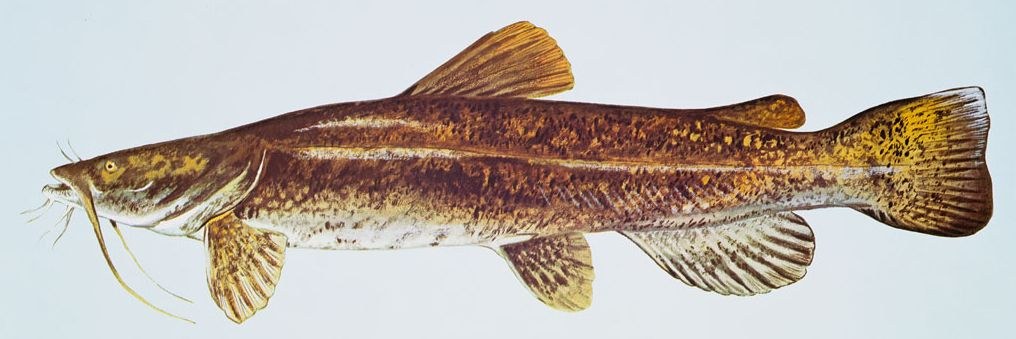
A flathead session is a cover-and-position problem before it is a bait-size problem. You need a fishable edge beside a likely shelter, enough open water to land a fish, and a bait that stays active without swimming into the snag. At Lake Livingston, that is a different plan from drifting cut bait across broad water for blue catfish.
Flatheads occur in the lake, but a strong general catfish fishery does not establish a strong bite for this species on a particular evening. This guide is a careful late-autumn plan, not a claim that early winter is a peak season. As conditions cool, expect to work fewer suitable positions thoroughly rather than promise a fast succession of bites.
Separate flatheads from other catfish
Flathead catfish, Pylodictis olivaris, have a broad flattened head and a projecting lower jaw. Their tail is only slightly notched, unlike the deeply forked tails of blue and channel catfish. Adults are often mottled yellow-brown, but colour varies and young fish can be very dark.
The species is native to parts of central North America, including the Mississippi drainage and Gulf states. It is a fish predator as it grows: young flatheads eat invertebrates, while larger fish rely heavily on fish prey. A lively, legally obtained baitfish is therefore a targeted choice. A tub of prepared bait designed for small channel catfish is a different experiment.
Adults often use deep cover and move into shallower feeding areas at night. That general behaviour suggests fishing the route between shelter and feeding water, but it does not prove that the nearest submerged tree holds a flathead. Nor does it justify placing a bait inside branches that you cannot fish effectively.
Choose Livingston access with a landing plan
Lake Livingston is a large Trinity River reservoir northeast of Houston. The official lake page lists flatheads among its fish species, while noting that blue catfish dominate the catfish fishery. Keep that distinction in mind when reading broad reports of good catfishing.
Lake Livingston State Park provides a named starting base with bank fishing, a fishing pier and boat ramps. Check the park's current alerts, entry arrangements and opening hours before travelling. The current alerts warn of low ramp water and exposed stumps, plus construction causing temporary campsite closures through December 2026. A daytime entry is not permission to remain past closing.
From the bank, find a permitted position with a broad, firm landing area. Inspect it before dusk. You want a clear retrieve lane beside cover or a depth change, not a cast across a mass of branches. Keep lines out of launching lanes, swimming areas and other visitors' routes.
A boat can help you examine a cove edge or an accessible section beside the old channel. Use maps and electronics to establish actual depth and obstacles; do not turn a guessed contour into a named hotspot. Position so a hooked fish can be guided toward open water. Do not anchor in a navigation route or approach dam exclusion areas.
Build an outfit for control, not a record claim
A 7–8-foot medium-heavy or heavy rod with a casting rating suited to your bait and sinker is a practical starting point. Pair it with a robust 4000–6000 spinning reel or a comparable conventional reel. Around accessible cover, 30–50-pound braid with a 40–60-pound abrasion-resistant leader offers a useful range; a suitable heavy nylon mainline is another option.
Those numbers are starting suggestions, not a guarantee against snags or large fish. Match the rod, reel, knots and drag as a complete system. If the only way to fish a spot is to lock the drag and pull through timber, choose a better spot.
Prepare 5/0–8/0 inline circle hooks, selecting the actual gape to fit the bait. The point must remain clear of the bait's body. Carry swivels, beads, sinker slides, and roughly 1–3-ounce weights for modest conditions. Stronger current may require a different location or a properly matched heavier outfit, not just a heavier lead on an overloaded rod.
Have a large landing net and a realistic handling plan before casting. Do not depend on lifting a heavy fish by the line, jaw alone or rod tip. A partner is useful when the bank is awkward, but the landing route should be workable even before a fish is hooked.
Rig one: a short running sinker presentation
Slide a sinker carrier onto the mainline, add a bead, and tie to a strong swivel. Attach 30–50 centimetres of abrasion-resistant leader and finish with an inline circle hook. Clip on only enough lead to hold the chosen edge. The running link allows the line to move while the weight stays on the bottom.
Use a modest, legal baitfish rather than an oversized one that overwhelms the hook or rod. A shallow hook placement through suitable tissue near the back, clear of the spine, allows movement in still or very slow water; a lip-hooked bait can face gentle flow. Check that the point and gap remain exposed and that the bait swims normally.
Lower or lob the rig smoothly into the open lane outside the cover. A violent cast damages bait and stresses the rig. Once settled, take up slack without dragging the sinker into wood. Keep the rod secured and attended, with the drag ready to release line under a strong pull.
With a circle hook, resist the reflex to strike sharply. When the fish moves away and the rod begins to load, reel steadily into the pressure and let the hook turn into place. Maintain smooth pressure and guide the fish away from the cover. Exact hook performance depends on pattern, bait placement and line angle, so test your setup rather than assuming the word circle solves every problem.
Rig two: a three-way rig above soft bottom
For a bait that keeps burying or fouling close to the bed, tie the mainline to a three-way swivel. Attach a 40–70-centimetre hook leader to one eye and a shorter 20–35-centimetre sinker dropper to the remaining eye. The bait fishes above the weight instead of immediately behind it.
Use a deliberately weaker sinker dropper where appropriate so a trapped lead is more likely to break away than the whole rig, but do not treat lost lead as normal practice. Cast gently because the separate legs can tangle. Test the assembled rig beside you and shorten the hook leader if the bait reaches the dropper.
This rig is best used on a reasonably clear patch with a modest current. It is not an invitation to suspend bait deep inside wood. If the bait repeatedly wraps the structure, move farther outside, shorten its leader or choose another lane.
An adjustable float rig is another option when you have a clean, quiet area and need to hold a bait above submerged weed. Use a float large enough to support the bait, a stop to set depth and sufficient weight below it to keep the bait controlled. Do not allow a free-roaming float rig to drift into other anglers' lines or boat traffic.
Search by cover, depth and bait condition
| Situation | Starting rig | What you are testing | Adjustment |
|---|---|---|---|
| Clear bottom beside substantial cover | Running sinker, short leader | Whether fish patrol the outside edge | Shift a few metres along the edge |
| Soft bottom fouling the bait | Three-way with short dropper | Whether a slightly raised bait stays effective | Shorten the hook leader if it tangles |
| Clean water above low weed | Controlled float presentation | A higher feeding lane | Reduce drift and keep clear of traffic |
| Bait repeatedly returns exhausted | Gentler placement or smaller bait | Whether presentation damage is the problem | Replace with a healthy legal bait |
| Snags on every retrieve | A new lane or position | Whether the spot is actually fishable | Move rather than sacrifice more rigs |
A worked evening session
Arrive at a confirmed open Livingston access well before dusk. Spend twenty minutes inspecting the bank and probing a clear lane without a baited hook. Select a near edge and a second position slightly farther toward depth, with neither requiring a cast through timber.
Begin with the running rig and a modest baitfish. Fish one position attentively, checking the bait after a sensible interval rather than leaving it indefinitely. A lively bait returning clean means the presentation is functioning; it does not prove a flathead is nearby.
After roughly twenty to thirty quiet minutes, move the bait a few metres or test the deeper lane. Keep bait type and rig similar for that comparison. If the bait comes back fouled, change its height with the three-way rig rather than simply waiting longer.
As light fades, test the clear route toward the shallower edge. A small tremor could be the bait itself, so watch for sustained movement and a developing load. End with enough daylight or lighting and time to leave within the access conditions. Do not extend a blank session into an unsafe overnight stay.
In colder conditions, reduce expectations and pay more attention to suitable cover near depth. A warm afternoon may offer easier, more comfortable fishing, but no temperature threshold guarantees success. Keep notes on bait condition, time, position and actual takes; a nearby blue catfish catch is not proof of a flathead pattern.
Rules and a material food advisory
TPWD's current statewide flathead limit is five daily with an 18-inch minimum. Livingston's special high limit for blue and channel catfish is not a flathead allowance. Check current regulations, licences and exemptions before fishing. Game fish cannot be used as bait; use legally obtained permitted bait and follow transport, invasive-species and draining rules.
The current Livingston advisory limits adult consumption of blue and flathead catfish to one 8-ounce serving per month and advises women of childbearing age and children under twelve not to eat them. A release-focused session avoids turning a legal catch into an assumed safe meal. Support fish horizontally, minimise air exposure and use tools for unhooking. Keep clear of alligators, unstable banks and sudden wind; the landing and return plan remains part of choosing a useful fishing position.