
Fish the openings, not the entire weed bed
Lake Raven in Huntsville State Park, Texas, is a useful place to learn how bluegill relate to vegetation and nearby depth. Texas Parks and Wildlife lists bluegill among the lake’s predominant species and describes heavy hydrilla cover that can make bank fishing difficult. The practical problem is therefore not simply finding weeds. It is finding an opening where a small bait can reach fish, remain visible and return without a bundle of plants.
This guide offers a bank-and-pier approach for the cooler months, with alternatives for a small boat. It is not a current catch report. The tackle sizes, depths, countdowns and trial periods below are practical starting suggestions; measure the water in front of you and change them when the presentation requires it.
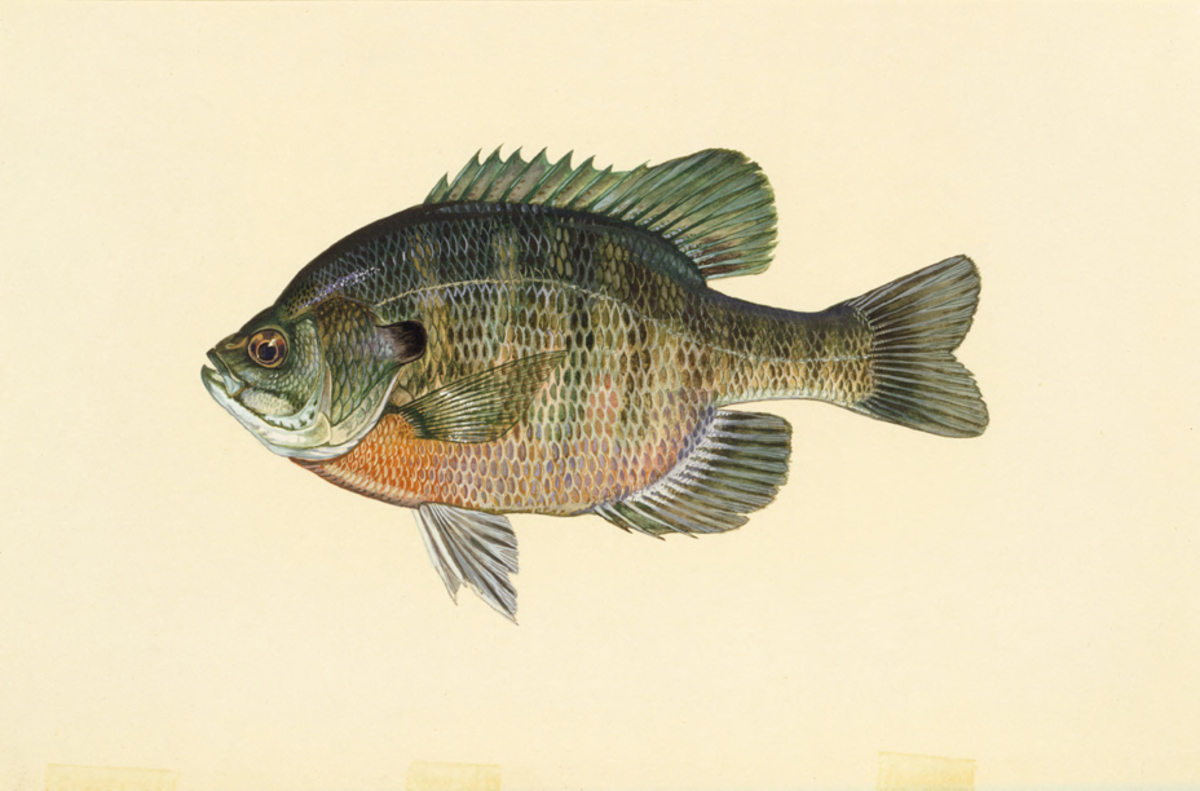
The cover is Duane Raver’s scientific illustration of a bluegill, identified by the U.S. Fish and Wildlife Service as Lepomis macrochirus. It is representative artwork, not a Lake Raven catch.
Know the fish and what it eats
Bluegill have small mouths, a dark patch toward the rear of the dorsal fin, a dark gill-cover flap and often vertical body bars. Colour varies with age and condition. “Perch” and “bream” are sometimes used loosely for several sunfishes, so identify the fish rather than relying on the local nickname. Lake Raven also holds redear sunfish; a red or orange margin on the ear flap is a useful clue to that different species, but inspect the whole fish.
TPWD records bluegill throughout Texas. Young bluegill begin with tiny planktonic food, while larger fish make considerable use of aquatic insects and larvae, including midges. This is one reason a little worm section or a small insect-shaped lure can outfish a large bait hanging from a heavy hook. Keep the bait within the fish’s mouth size.
Warm-water spawning behaviour is not a reliable winter plan. TPWD describes nesting as beginning around 70°F, commonly with a spring or early-summer peak. A late-autumn fish may instead be feeding along cover or a slope without any connection to a nest. Do not spend the whole session searching for circular beds.
As a tactical hypothesis, look first where accessible vegetation meets open water and a route to greater depth. The plant edge offers food and shelter; the opening allows a fish to intercept a drifting bait. After a cold change, test a deeper layer before declaring the fish inactive. A sunny afternoon may make a shallow edge worth revisiting, but there is no fixed temperature or hour that guarantees a bite.
Verified access and an ordered search
Lake Raven lies inside Huntsville State Park in Walker County. The park provides fishing piers and a boat ramp, and its lake page describes generally clear water with a maximum depth of 28 feet. That maximum is not the depth beside every pier. Use the park’s current map and open facilities; avoid inventing informal bank access through vegetation.
Begin from a permitted pier or a clear established bank station. Look straight down before casting. Check the near shade edge, any visible gap in hydrilla, the outside weed edge and then the open-water slope. Work these in that order so a long cast does not disturb fish already close to your feet.
Lower a plain weight on your line to estimate depth, watching for the first slack as it lands. Compare the bottom feel with the resistance of weed. In a boat, sonar can help distinguish the bottom from the top of vegetation, but verify by lowering the rig; a screen mark is not a species identification.
Choose an initial band of approximately 3–6 feet where access allows. If it is empty, investigate the next accessible depth, perhaps 6–12 feet, without assuming the fish must be at the lake’s deepest point. From a pier, a vertical presentation often reveals depth better than casting randomly into open water.
One light outfit, several useful rigs
A 1.8–2.1 m light or ultralight spinning rod, a 1000–2000 size reel and 4–6 lb monofilament make a forgiving starting outfit. Use the heavier end near abrasion. With fine braid, add roughly 0.8–1.5 m of 4–6 lb mono or fluorocarbon leader. Fluorocarbon is an option, not a promise of more bites.
Carry size 8–12 fine-wire hooks, a few small split shot, a slim fixed float, a small slip float, and jigheads around 1/64–1/16 oz. Hook and reel sizes vary among makers; check the actual hook gape and whether the rod casts the chosen rig comfortably. A size 10 hook is a reasonable first trial for a short worm section.
The small mouth is the useful design constraint. A long worm trailing well beyond the hook invites pecks without contact. Start with about 1–2 cm of worm, or a compact cricket where local rules permit. Leave the point and some gape clear. Replace a ragged bait before deciding the fish dislike it.
Rig one: fixed float over a shallow opening
Attach a slim float to the main line, tie on the hook, and pinch a small split shot about 15–25 cm above it. If using a separate hooklength, start around 30–45 cm and connect it to the main line with small loops. Load the float only enough to stand correctly while keeping the bait in position; excessive shot makes a tiny bait drop abruptly.
Set the hook approximately 15–30 cm above the measured weed top or bottom, whichever is higher. The distance from float to hook is the fishing depth, not automatically the water depth. This distinction prevents a bait disappearing into hydrilla while the float appears perfectly positioned.
Cast just past the edge of the opening and draw the float gently into it. Keep the line from rod to float reasonably straight without pulling it toward you. Let the bait settle, then try a small twitch and a pause of several seconds. If the float drifts out of the clean lane, retrieve and recast rather than dragging the hook through plants.
A decisive sideways movement, sustained dip or sudden lifting of the float merits a short tightening lift. Avoid a violent strike. If every dip is missed, shorten the bait first, then inspect hook size and point. Keep the rod bent during the fish’s short runs and use a net when the pier height makes lifting awkward.
Rig two: slip float for a deeper layer
When the chosen depth is longer than a convenient casting drop, use a slip float. Thread a line stop onto the main line, then a small bead, the sliding float and a suitable amount of shot below it. Tie on the hook or short hooklength. The bead prevents the float passing the stop; the stop determines how far the bait sinks.
Start with the stop set so the hook hangs about 30 cm clear of bottom. Cast gently, allow the line to run through the float until it stands, and wait for the bait to settle. A float lying flat may mean the weight has landed on weed, the stop is too deep or there is too little loading. Diagnose that before treating every movement as a bite.
Make a small depth ladder: fish the original setting, then shorten by approximately 30–60 cm, then test another layer. Bluegill do not always feed on bottom. If bites start midway down, move the stop to keep the bait in that band.
In wind, a slightly heavier slim float can improve control, but a giant round bobber adds resistance and drags the bait. Choose only enough buoyancy to manage the bait and shot. Bring the rig back when the float leaves the opening; avoid letting it cross another angler’s line.
Rig three: a small jig, or a bottom weight below the bait
For a lure alternative, thread a 1–3 cm soft-plastic insect, grub or short worm straight onto a 1/64–1/32 oz jighead. Push the hook into the centre of the nose, bring it out where the body can lie straight, and check that the tail moves freely. A bent plastic can spin instead of swimming.
Cast along the outside edge at roughly 30–45 degrees to the bank so the lure spends time beside cover. Let it sink on a controlled line, counting consistently. Establish your own countdown over clean ground; a three-count does not correspond to a universal depth. Retrieve slowly enough to stay in the chosen layer, adding tiny rod-tip movements and pauses. Increase toward 1/16 oz only when depth or wind prevents control.
Start with a subdued brown, olive or translucent lure in clear water. Try white or chartreuse as a visibility comparison in stained water or shade. These are experiments, not evidence that a certain colour always wins. Keep the same weight and retrieve during the comparison. If the lure comes back coated in weed, change depth or cast angle before colour.
A small drop-shot is another option for an open patch beside a pier. Tie a size 8–10 hook into the leader with a Palomar knot, leaving a long tag. Pass the tag downward through the hook eye so the point faces upward, then attach a 1/16–1/8 oz drop-shot weight 20–40 cm below. Nose-hook a short worm or small plastic. Lower vertically, let the weight touch clean bottom and hold the bait almost still. Tighten and reel when the line draws away; do not snap-strike. Avoid dragging this rig through thick hydrilla.
| Feature or condition | Likely feeding opportunity | Starting method | Presentation | Main caveat |
|---|---|---|---|---|
| Clear opening in shallow weed | Bluegill can inspect food beside shelter | Fixed float and small worm | Suspend above plants; brief twitches | Too much depth hides the bait |
| Deeper accessible weed edge | A route between cover and open water | Slip float | Search successive depth bands | Wind can move the rig off the edge |
| Open patch beside a pier | Insects and other small food near structure | Small drop-shot | Vertical, nearly motionless | Bottom weight catches dense weed |
| Long outside vegetation edge | Fish distributed along cover | Micro jig and short plastic | Slow parallel retrieve with pauses | Heavy jigs fall into plants |
| Several missed pecks | Fish contacting the bait’s loose end | Smaller bait on the same rig | Leave hook point exposed | Do not assume every peck is bluegill |
A worked session and the changes that matter
For a two-hour visit, start with the fixed float, a size 10 hook, 4 lb line and a short worm section. Measure the first clear opening and suspend the bait above the weed. Make several quiet presentations close to the pier, then along its outer edge. This is a test plan, not a report of fish currently occupying those positions.
After ten to fifteen minutes without a bite, check whether the bait is clean and still present. Raise it, then try a little deeper while staying clear of plants. If both layers are quiet, move to the next opening. Do not repeatedly add feed to water that has shown no fish.
At a deeper station, switch to the slip float and search the lower and middle layers. If small fish continually take the worm, try the micro jig to cover a longer edge, or slightly enlarge the bait while retaining a small exposed hook. If fish follow the lure without taking, reduce the movement and let it pause longer.
Repeated snags call for a shallower presentation, a more vertical angle or a different opening. Increasing line strength alone does not solve the cause. Once you find a productive depth, repeat the same cast before changing tackle. Record depth and presentation so the next visit starts with a useful question.
Brief local notes
Check the linked TPWD Outdoor Annual, Lake Raven rules and park alerts before travelling. Raven’s current rules allow pole-and-line fishing with no more than two poles and specify no minimum size or daily bag limit for sunfish; check for changes before retaining fish. The park alert currently lists December and January closure periods without a year, so confirm the applicable dates directly before booking. Boats operate at idle speed. Alligators occur here: use established fishing facilities, keep clear of animals and follow park guidance. Handle unwanted fish carefully and return them promptly.