
Winter blue-catfish fishing on Lake Tawakoni is a search for food and usable bottom, followed by a choice between holding baits in a promising lane and moving them through a larger area. Fresh cut bait is useful, but bait alone cannot compensate for a rig that spends the session tangled or a boat drifting too fast to keep contact.
This is a November–January planning guide, not a claim about present catch rates. Winter trophy fish are part of the lake's documented fishery, but no rig guarantees one. The measurements below are practical starting suggestions for ordinary rod-and-reel fishing, with adjustment for bait size, depth, wind and the strength of fish encountered.
Know the species and its feeding role
Blue catfish, Ictalurus furcatus, are large-river and reservoir fish found across major central and southern North American drainages. They are established throughout much of Texas. Their diet includes invertebrates and fish, with fish becoming useful prey early in life. Cut fish therefore has a clear feeding rationale, rather than serving merely as a strong-smelling object on bottom.
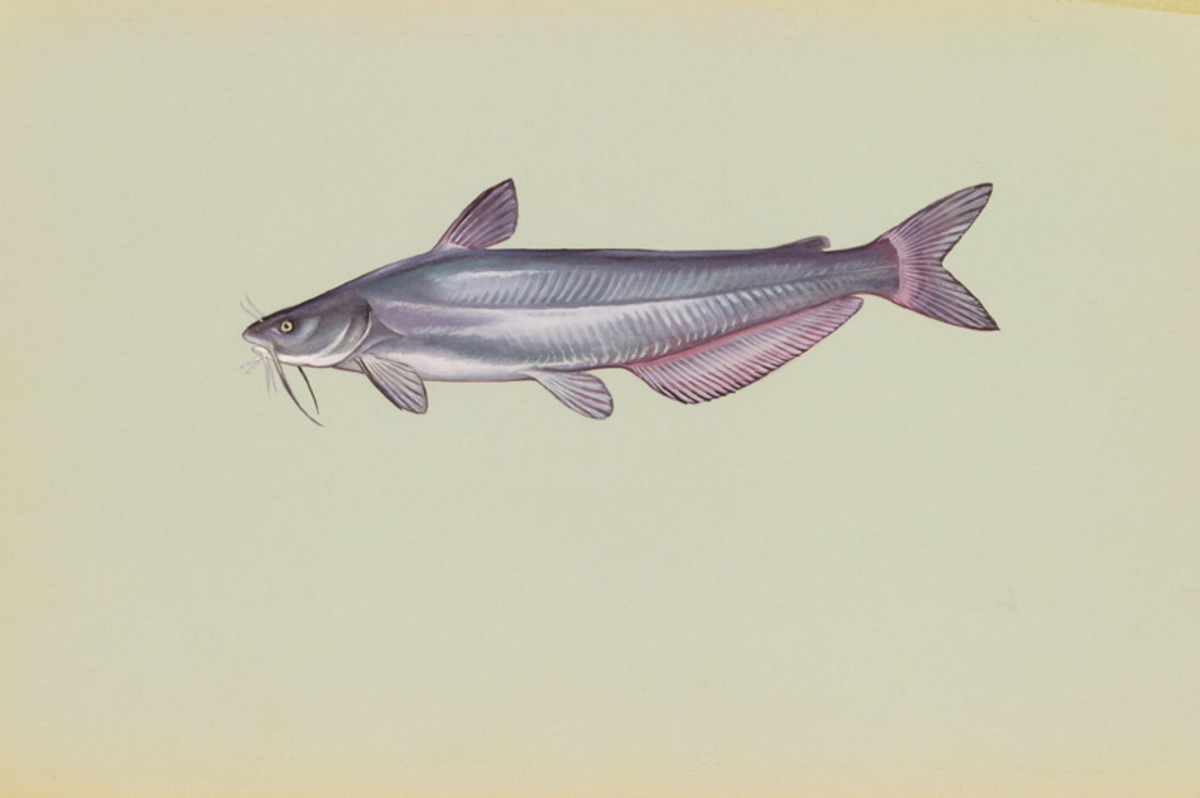
Blues and channel catfish can look similar, especially when large channel cats have few obvious spots. Blue catfish have a deeply forked tail and typically a long, straighter-edged anal fin with more rays. Do not rely on a slate-blue back alone. Flathead catfish have a different head and tail profile and are a separate species with separate retention rules.
Tawakoni supports blue and channel catfish, with some flatheads. A bite on cut bait does not establish which species is taking it. Identify the landed fish before keeping it, and do not describe an uncertain catfish as a trophy blue merely because it is large.
Find a flat linked to deeper water
Tawakoni is a Sabine-basin reservoir east of Dallas. The official lake guide documents cut bait and drift fishing among local methods, and winter opportunities for larger blues. Use that as a reason to plan a systematic search, not as a live forecast.
Choose a broad flat near a creek or river-channel edge, a gently sloping point and an adjacent deeper lane. These are feature types to identify on a chart. Lake Tawakoni State Park provides a verified access option, subject to current facilities and alerts; it is not proof that the best fish are beside the ramp.
As an exploratory bracket, compare roughly 10–20 ft with 20–35 ft when conditions and equipment allow. Baitfish location can justify changing that bracket. A deep hole without food may be less useful than a shallower slope with bait passing through it.
Wind affects both prey distribution and rig speed. A manageable wind can help a controlled drift cover water, but the side of the lake exposed to it is not automatically better. If wind prevents you from interpreting the rig, choose a sheltered lane or an anchored presentation instead.
| Feature or condition | First approach | Presentation | Change when |
|---|---|---|---|
| Defined channel edge with bait | Anchored cut bait | Hold on two nearby depth steps | No response after a fair comparison |
| Broad clean flat | Controlled drift | Slow travel with intermittent contact | Baits drag too fast |
| Broken snaggy bottom | Shorter rig or raised bait | Keep hook clear of obstacles | Repeatedly losing terminal tackle |
| Bites without hook-ups | Inspect bait and hook | Reduce bulk and expose gape | Rod never loads steadily |
Tackle sized to the bait and fish
A 7–8 ft medium-heavy catfish rod and a reel with dependable drag are useful starting equipment. Consider 25–40 lb main line and 40–60 lb abrasion-resistant leader for this style. Select the stronger end when larger fish and rough bottom justify it, while keeping the entire outfit manageable for the angler.
A rod with a responsive tip shows loading while its lower section supplies lifting control. Do not set drag so tight that a sudden pull breaks a knot or drags an unattended outfit from its holder. Secure rod holders appropriately and keep lines separated.
Circle hooks around 5/0–8/0 are a useful range for medium cut baits, but sizes vary greatly by brand. The important dimensions are the free gape and wire strength. A bait filling the entire curve defeats the hook design. Bigger hooks are not automatically better when the available fish and bait are small.
Assemble an anchored sliding rig
Pass the main line through a suitable sinker slide or an egg sinker, then add a bead and tie to a strong swivel. Attach about 18–30 in of leader and a non-offset circle hook. Begin with roughly 1–3 oz of weight where that holds the bait, within the rod's rating. Depth, current and wind may require a different choice.
Use fresh legally obtained baitfish cut into manageable chunks or fillets. Pass the hook through a firm edge once, leaving the point and most of the gape exposed. A compact piece around 1–3 in is a useful trial range; reduce it when fish repeatedly mouth the bait without loading the rod. Do not assume an enormous bait is required for every large fish.
Set baits at different distances so you sample two depth steps, while avoiding crossed lines. Cast with a smooth motion suitable for the loaded rig. Allow the weight to settle, take up slack and place the rod where you can see it. The line should communicate a take without dragging the bait continuously toward the boat.
Let a circle-hook bite develop into a steady bend and wind into it. Do not snatch at the first tap. If the bait returns wrapped around the leader, shorten the leader, reduce casting force or change the bait shape before repeating the same mistake.
Build a drift rig for cleaner bottom
For a slow drift, use a three-way swivel or a purpose-built sliding arrangement with a separate sinker connection. With a three-way, attach the main line to one eye, a short lighter sinker dropper to another and a 24–36 in hook leader to the third. A small buoyant float on the hook leader can lift the bait slightly above bottom; test the float and bait combination in the water.
The lighter sinker dropper can reduce the amount of tackle lost if the weight snags, but it is not permission to pull recklessly. Keep everyone clear before freeing a stuck rig. Use a sinker shape intended for the substrate rather than dragging an unsuitable fixed weight through every obstruction.
Begin with a very slow drift, perhaps around 0.2–0.5 mph as a trial, and adjust to maintain occasional bottom contact. That is a presentation suggestion, not a locally proven ideal speed. A drift sock or appropriate boat control may help; if you cannot slow down safely, anchor in sheltered water or change plans.
Fish off the boat's trailing side with enough separation to avoid tangles. The goal is a bait moving slowly across feeding lanes. Constant heavy bouncing can indicate too much weight, excessive speed or unsuitable bottom.
Read bites and correct the cause
Several light taps followed by silence can mean small fish, a bait too bulky for the hook, or a bait stripped without the hook turning. Retrieve and inspect. Replace stale or damaged bait, expose the gape and compare a smaller piece before changing scent.
A steady bend followed by release may reflect a fish dropping the bait, a hook point buried in flesh or too much abrupt resistance. Check the entire rig. Do not respond by loosening every component until you can no longer tell where the bait is.
A rod moving rhythmically with the boat is different from a progressively loading bite. Learn that background movement during the first few minutes of a drift. If every bottom contact looks like a strike, slow the presentation and reduce the line angle.
A worked winter session
Launch from an open facility and spend the first twenty minutes checking the planned flat and its edge. Look for bait and changes in bottom rather than stopping at the first deep contour. Begin with two anchored baits at distinct levels where legal and manageable.
Give each position enough time to compare, while checking bait condition. After roughly twenty to thirty minutes without response, move to a related feature or change to a controlled drift across cleaner bottom. These are practical time boxes, not claims that fish must bite within them.
When a drift produces a clear take, mark the location and repeat the same lane before making a random long move. Compare a nearby parallel pass and a slightly different depth. If snags dominate, raise the bait, shorten the rig or leave that substrate. A successful session is based on repeatable position and bait presentation, not the number of rods deployed.
Rules and handling
The current TPWD Tawakoni table sets a combined blue/channel daily bag and possession limit of 25, with no more than five at least 20 in and no more than one of those at least 30 in; there is no minimum for those two species. Check the linked current table, licence and bait rules before fishing. Older survey summaries can contain superseded trophy limits.
Use a suitable net, support a large fish's weight and keep release handling brief. Secure the boat and choose an anchoring method suited to conditions; never improvise a stern anchoring arrangement in hazardous wind or waves.