
A productive smallmouth search on Lake Texoma starts with changes in rock size, slope and depth. One point may offer a shallow feeding shelf, a steeper face and a nearby channel; another may remain almost uniform from shore outward. Fish the first as several separate lanes. This creates an informative search even before a fish bites.
For a late-autumn or early-winter trip, carry a moving bait to find willing fish and two slower rigs to examine promising bottom. Do not assume all bass move deep together after a calendar date. Wind, bait location, clarity and recent temperature changes can make adjacent banks fish differently. The numerical tackle and depth ranges here are practical starting suggestions, not measured current fish positions.
Know which bass you have found
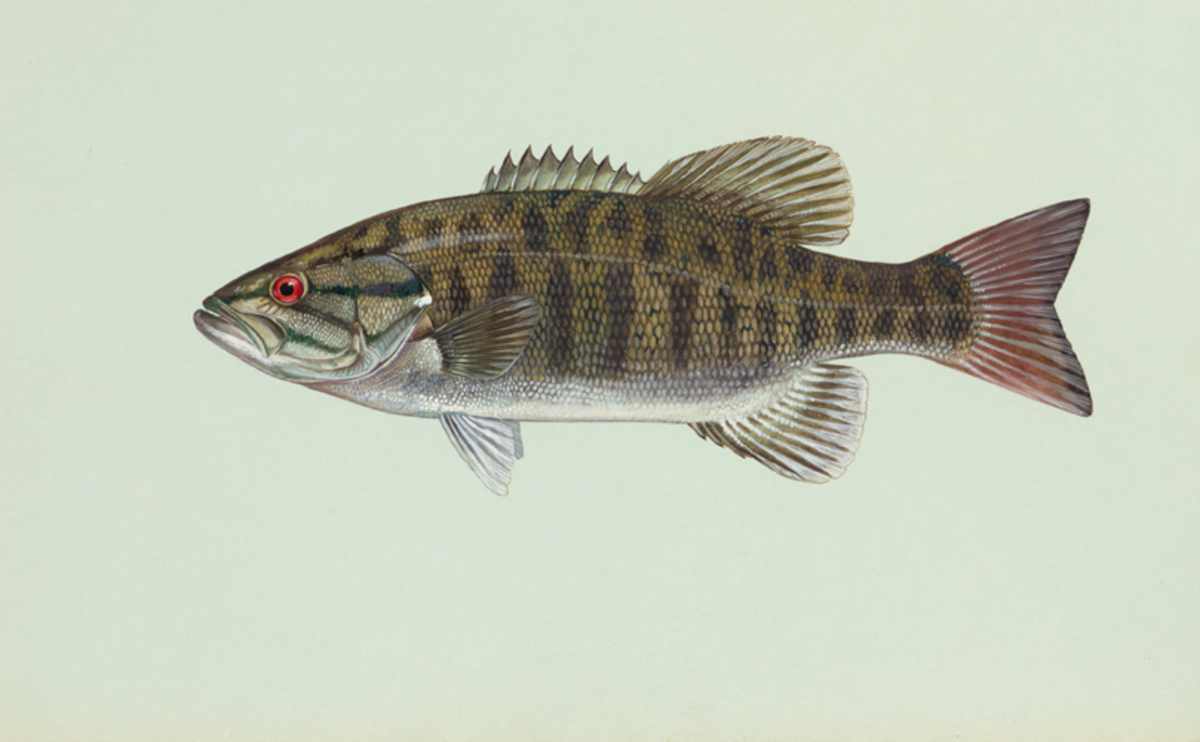
Smallmouth bass, Micropterus dolomieu, share Texoma with spotted and largemouth bass. The target often has brown-green coloring and vertical barring, but color varies with water and condition. Check mouth position and several features together: the upper jaw of a smallmouth does not extend beyond the rear edge of the eye when closed. A largemouth's jaw extends farther back, while a spotted bass can show rows of smaller spots beneath its lateral markings.
Smallmouth are native to portions of eastern and central North America and established in Texoma through introductions. Here, verified reservoir surveys describe rocky and gravel shoreline and relatively limited vegetation. That supports a search based on bottom transitions; it does not prove every riprap bank holds smallmouth.
The reservoir's forage includes shad and sunfish. Crawfish-shaped presentations offer a different bottom-oriented approach. Use these as two useful feeding hypotheses: fish may be intercepting small fish off the bottom or examining food close to rock. A particular colored tube is not evidence of what a caught fish has been eating.
Choose three connected features
Begin with one rocky main-lake point, a nearby sheltered secondary point and a bank where chunk rock changes to smaller gravel. These are feature types to locate on a chart and inspect, not named secret spots. Eisenhower State Park and other facilities in the official public-access directory provide planning options; check the actual launch status and permitted bank areas before choosing a route.
In clearer water, a longer cast can keep the boat farther from the shallow lane. In stained water, shorten the search and put the lure closer to the feature. Work from the easy-to-control side of the wind. Wind can move bait and produce useful water movement, but it can also make bottom contact impossible with a light rig.
Start by sampling roughly 6–15 ft, then compare an adjoining 15–25 ft slope if fish or bait are absent. Those are exploratory brackets rather than a claim about the lake today. Sonar can show depth, hard bottom and suspended targets; it cannot establish species with certainty.
| Feature | Feeding hypothesis | First presentation | Follow-up |
|---|---|---|---|
| Rock-to-gravel change | Bottom prey near a transition | Compact tube | Drop-shot just above bottom |
| Wind-influenced point | Small fish crossing a shelf | Paddle-tail or crankbait | Repeat at greater depth |
| Steep rocky face | Fish holding close to slope | Short tube hops | Vertical drop-shot |
| Sheltered secondary point | Less disturbed feeding lane | Slow small swimbait | Pause a bottom rig |
Set up two outfits if possible
A 6 ft 10 in–7 ft 3 in medium-light or medium spinning rod with a 2500 reel is a useful finesse outfit. Start with 10–15 lb braid and 6–10 lb leader, around 5–8 ft long. Choose the stronger end when rough rock is damaging the line. A medium baitcasting outfit with 10–14 lb line can handle compact crankbaits or heavier tubes, but one spinning rod can cover most of this session if its lure rating fits.
Thin line helps a light rig stay in the intended depth and reduces drag in moving water. It also demands careful abrasion checks. Run the last few feet through your fingers after repeated rock contact and replace a rough section before the next cast. Do not compensate for a damaged leader by simply loosening the drag.
Start with a natural baitfish shade for swimming lures and a subdued brown, green or dark tube. Compare a more contrasting lure when visibility is poor. These are practical visibility trials rather than established color laws. Profile and depth deserve attention before a series of cosmetic changes.
Rig a tube for broken rock
Choose a 2.75–3.5 in soft tube and a head around 1/8–3/8 oz, with hook size matched to the tube. Insert an internal tube head through the open end, bring the eye through near the nose and ensure the body hangs straight. A straight body falls and turns differently from a kinked one. An exposed hook gives easy penetration on fairly clean rock; it is a poor choice in dense snagging timber.
Cast across the point rather than directly down its steepest face. Let the tube reach bottom on controlled slack, watching the line for a jump or an unexpectedly early stop. Retrieve with small lifts and pauses. The aim is to move between rocks, not continuously wedge the weight into each gap.
If repeated snags occur, shorten the cast, lift more steeply or switch to a lighter head before sacrificing many lures. A weedless Texas-rigged tube is another option: a small bullet weight above an offset hook, point lightly buried in the body. It protects the point but requires enough rod pressure to clear the plastic. Do not tighten the whole rig into a rock crevice after it has stopped moving.
A bite may feel like extra weight rather than a sharp tap. Reel until contact is clear, then sweep firmly with an exposed jig. With a buried point, use a more positive sweep while maintaining pressure. Avoid an uncontrolled overhead strike on a lightly built rod.
Rig a drop-shot for a defined depth
Tie a size 1–1/0 drop-shot hook into the leader so it stands away from the line, leaving a 12–24 in tag below. Attach a 1/8–3/8 oz drop-shot weight at the end and nose-hook a 3–4 in worm or small minnow-shaped plastic. Keep the hook point clear. The sinker establishes bottom contact while the bait is presented above it.
From a boat, cast a short distance or lower beside the boat when targets are directly below. Touch bottom, take out the largest belly of slack and make small tip movements without constantly lifting the sinker. A taut diagonal cast holds the bait closer to bottom than the same leader fished vertically; account for that geometry when comparing presentations.
If the weight drags continuously, reduce drift or increase weight slightly. If the line is vertical but the bait is above the targets, shorten the tag. After several motionless seconds, move the rig a little rather than shaking it continuously. Often the useful comparison is quiet versus active, not a different soft-plastic color.
Use a moving bait to search
A 2.5–3.5 in paddle-tail on a 1/8–1/4 oz head is a useful starting alternative. Thread it straight, cast along the shelf and count it down consistently before a steady retrieve. The countdown is a repeatable reference, not an exact depth unless you have calibrated that lure under those conditions.
A compact crankbait can cover rock quickly, provided its diving depth and hooks suit the bottom. Touch occasional rock and pause or ease it free when possible; do not deliberately drive it into every crevice. If bites occur only as the lure first touches bottom, reproduce that contact on another point with similar slope.
A worked morning and the next move
Launch through a confirmed open facility and spend the first quarter-hour mapping the chosen point. Fish the shallow edge with a swimbait, then the outer edge with the same retrieve. After a follow or bite, mark depth and position without assuming a large school is present.
Use the tube on the most promising transition for ten to fifteen minutes. If fish are visible on sonar but will not chase, make a controlled drop-shot presentation nearby. If there is no response to either method, move to the sheltered point and repeat the depth comparison. This tests a new environment rather than endlessly changing lures in empty water.
After a catch, repeat the successful angle before circling the boat over the fish. Record whether the bite came during the fall, on bottom or while swimming. Those details tell you which alternative deserves more time. A blank morning still produces a useful result if you have eliminated particular depth bands and water types methodically.
Rules and handling
Texoma spans Texas and Oklahoma. Check current lake-specific limits and the license valid for the waters you will fish; do not transfer a statewide bass rule across the boundary by assumption. The official lake and access pages link the relevant planning material. Drain, clean and dry equipment between waters because invasive-mussel precautions materially affect this trip.
Keep a landing net ready, support the fish briefly and release it promptly if not retaining it legally. Wind exposure can make a return crossing much harder than fishing a sheltered bank, so choose the search area within the boat's and crew's capabilities.