Fish the river you find today
At Lanesborough, the Shannon passes between Lanesborough and Ballyleague just north of Lough Ree. The old Hot Water Stretch is still a useful name for finding the venue, but the power station has shut and the former hot-water discharge has ceased. Plan around water level, flow and cover. Do not carry over a claim that the bank fishes well because warm water is still being released. The fisheries access guide identifies several Lanesborough coarse venues and describes winter and spring roach fishing as possible when water levels and conditions suit.
Start at a permitted fishing position on the old stretch where you have room to recover a float or feeder without crossing the navigation. Look at the near bank before casting into the main flow. A slower lane beside the faster water gives a roach a place to hold and a way for food to reach it. Watch for debris that briefly stalls or changes speed. It helps identify the inside of the seam. A back eddy can be useful if it has a predictable exit; a float that circles back under your feet can tangle before it gets to depth. When the river is high and dirty, find a safer sheltered bank position or postpone the visit.
Confirm the fish before interpreting a bite
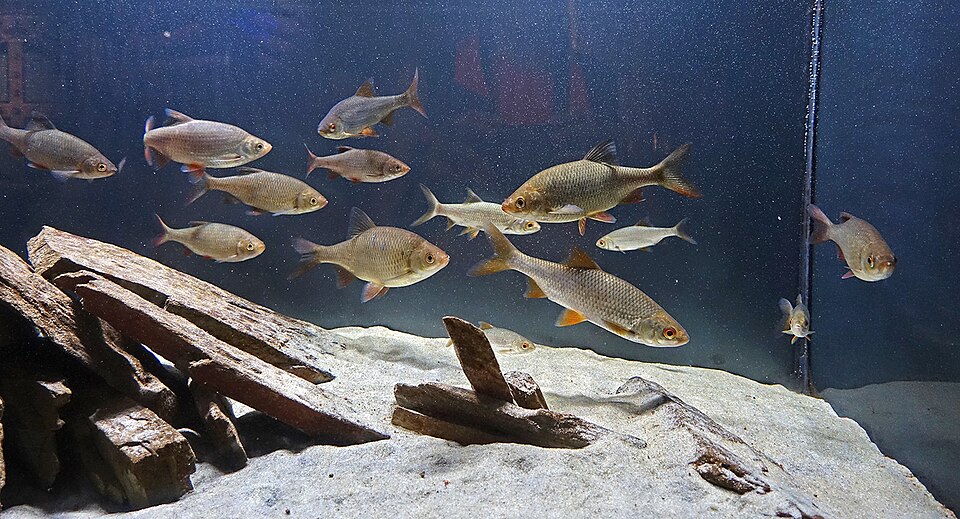
Roach, Rutilus rutilus, is a Eurasian freshwater fish introduced to Ireland. Its silvery body, reddish eye and orange to reddish lower fins are useful clues. Rudd generally have a more upturned mouth and the dorsal fin begins farther behind the pelvic fins. Roach and bream can hybridise, so colour and fin position may not give a clean answer on every fish. This is a release session. Do not keep a fish whose identification is uncertain.
Roach eat a wide range of material, including plankton, plant matter and invertebrates. A maggot or small piece of worm gives a compact invertebrate presentation. It does not require a large feed bed. A shoal may use a lower seam in cold water where it can remain close to the bed with less effort. In a quiet margin with fish visibly intercepting particles higher up, a float can keep a bait in that layer. Take the bottom as a first reference and move up if the signs support it. An overcast daytime visit offers usable light for reading the line and seeing the floats. The river level and whether you can present steadily are better decision points than a claimed winter bite hour.
Build a float that you can slow
A 12 to 13 ft float rod and a 2000 to 3000 reel with 3 to 5 lb mono are a reasonable start. Fit a stick float with rubbers where depth and wind allow a fixed rig. Use a float in roughly the 1 to 3 g range that carries enough shot to get the bait down without leaving a large section of tip above water. Tie 15 to 25 cm of 2 to 3 lb hooklength and a size 16 to 20 hook. Group the larger shot above the hooklength, with one or two small droppers below the main group. Test in the margin and move the shot if the rig tangles or takes too long to settle. The heavier part establishes the layer and the lower shot shows small changes in bait movement.
Plumb the depth in the lane and start just clear of the bed. Cast a little upstream, let the float settle and follow it with the rod. Lift stray line off the surface before it bows into the faster flow. Check the float briefly where it reaches the seam. The bait can rise when you slow it, then settle as you release line. If every check pulls the float under, ease the hold or fish slightly shallower. Lift to a clean dip or steady sideways move. When the float stalls at the same point every drift, examine the hook for debris and shorten the depth a little. Repeating a snag is a poor substitute for reading the bottom.
Hold a feeder when the drift cannot settle
Use a light feeder rod around 10 to 12 ft and a 2500 to 3000 reel with 4 to 6 lb mono. Slide a small cage feeder on a suitable running link, add a bead and tie to a swivel. Add 25 to 45 cm of 2½ to 4 lb hooklength to a size 16 to 18 hook. A 15 to 30 g feeder is a useful starting range in the slower reachable lane. Use a manageable loaded weight within the rod rating and choose the lightest feeder that stays in place. A small mix of fine damp groundbait with a few maggots is enough to begin. If you have no bites, increasing the amount of feed is less informative than verifying where the feeder settles.
Cast slightly across the slower seam. Let the feeder settle and take up slack until the quivertip takes a slight bend. Keep the tip low if wind is catching the line, or a little higher if the near water is creating drag. A series of sharp taps can be small fish or movement of the feeder. Watch for a sustained pull or the tip straightening as the fish moves toward you. Tighten with a short lift. If the feeder rolls and the tip repeatedly springs back, try a shorter cast into quieter flow before increasing weight. On a clean bed a longer hooklength lets a bait settle more naturally. Shorten it if the bait comes back tangled or takes are hard to see.
| What the reach offers | Start here | Change if needed |
|---|---|---|
| Readable near seam and even drift | Stick float near the bed | Lift the bait slightly or change shot spacing |
| Deep lane with enough flow to carry a float too fast | Small running cage feeder | Shorten the cast if the feeder rolls |
| Debris stalls the float at one point | Shallower float or a new line | Fish outside the obstruction |
| Bites fade after several fish | Same lane with a smaller feed | Try adjacent slack before adding bait |
A worked winter visit
Start with a 2 g float, 4 lb main line and a size 18 hook carrying one maggot. Test the inside seam for several drifts, then adjust depth by a few inches. If the float never settles before the lane ends, switch to a 20 g feeder and a 35 cm hooklength in the same slow edge. Give it a few casts with a modest feed, taking care to keep the cast location consistent. If the bait returns untouched and the feeder is holding, test a second seam instead of assuming the rod needs a finer hook. If you catch a roach, repeat the depth and speed before feeding again. Use the net for a larger fish or one caught below a high edge rather than lifting it by the fine line.
Use the empty hook as evidence
A maggot still moving after several drifts suggests that you at least presented a viable bait. A torn skin can mean small fish have picked at it, while a hook tangled around the lowest shot gives you no useful test. Check the float rig before deciding that the shoal has moved. With the feeder, a return packed with intact feed means the mix may be too wet or too firmly squeezed into the cage. Loosen it and test a short drop in clear water. A bare feeder and a clean hook mean you can move on knowing the method worked mechanically. Once the rig is fishing as intended, change one aspect of the depth or lane rather than adding more food to compensate.
Local rules and handling
Check Inland Fisheries Ireland's local access and coarse fish rules, including the rod limits, live bait prohibition and protections for coarse fish over 25 cm fork length. Use a stable permitted position, keep clear of navigation and release the fish promptly with wet hands or a wet net.