
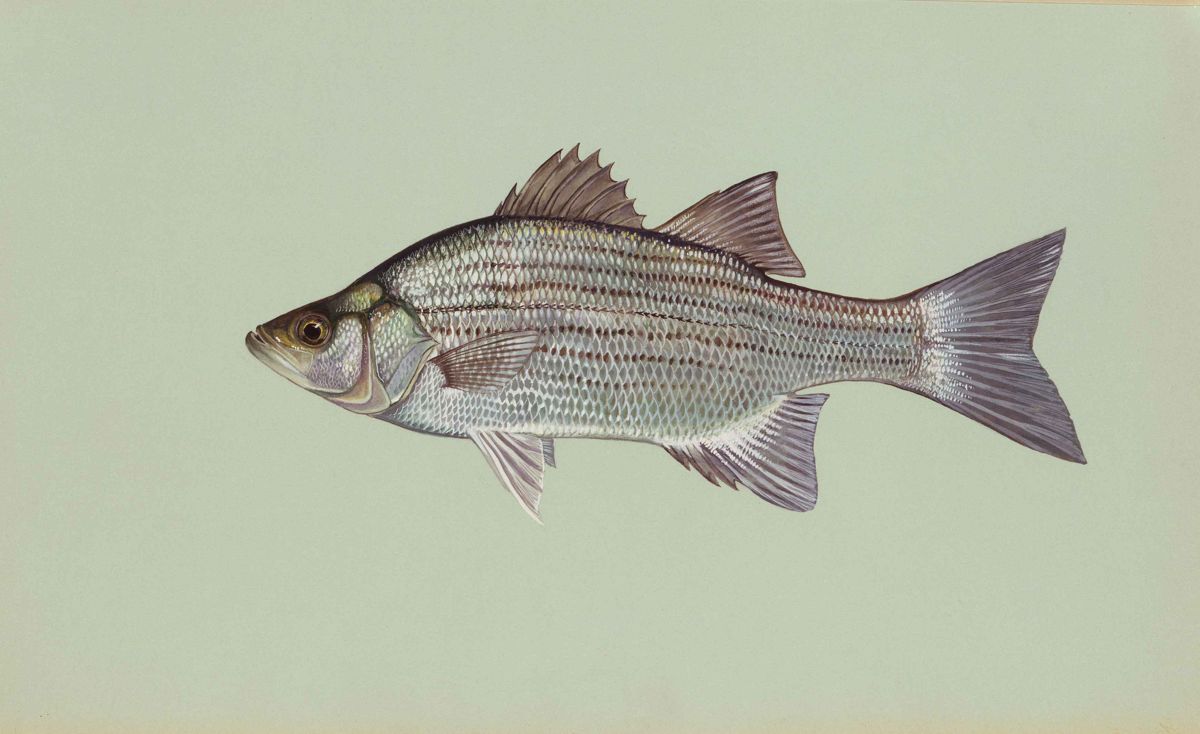
White bass fishing on Lewisville Lake is often a problem of finding a moving group rather than coaxing one territorial fish from cover. The useful combination is a small lure that can search quickly, a vertical presentation that stays with a school and a clear way to decide when to move. Repeated casts in the wrong depth can consume the morning even when the tackle is otherwise sensible.
For late autumn and early winter, use the lake's open-water fishery as a starting framework and follow present bait observations. The familiar summer surface-schooling pattern does not guarantee November surface activity. This guide offers practical starting tackle ranges and search methods, not a current report of where fish were caught yesterday.
Identify white bass and their food
The target is Morone chrysops, native to parts of central North America and the Red River drainage in Texas, and established in many reservoirs. Adults school and feed heavily on small fish, including shad. Young fish begin with smaller invertebrate prey, so a juvenile feeding pattern need not describe the larger fish an angler is targeting.
Lewisville also contains hybrid striped bass. White bass have a relatively deep body and faint lines, usually with only one stripe extending to the tail. Hybrids often have a deeper body with several stronger broken stripes. Tooth patches and the full suite of features in the official identification guide help resolve uncertainty. A larger fish from the same school is not automatically a white bass.
The feeding lesson is straightforward: match the approximate size and level of prey first. A 2 in lure may represent the available food better than a bulky 5 in bait, but inspect what you can actually see rather than assuming all shad are one size.
Divide the lake into a small circuit
Lewisville is an impoundment of the Elm Fork of the Trinity River near Dallas–Fort Worth. The official lake guide confirms a strong white-bass fishery and open-water schooling in summer. For a cool-weather session, begin with main-lake points, their adjoining slopes and connected open water. These are search features, not claims that every point holds a winter school.
Use the official access directory to choose a legal ramp or bank facility close to the circuit. Hickory Creek is a verified lake area, but the published reference to its humps and ridges concerns hybrids; do not turn that into proof that white bass currently occupy a particular hump. Search and identify the fish you catch.
At a point, compare a roughly 10–20 ft shelf with the adjacent 20–35 ft zone. Those are initial sampling brackets. Bait may be shallower, deeper or suspended. If there is no evidence, make a second pass from a different angle and then leave for the next feature.
| Observation | Likely decision | Method | Limitation |
|---|---|---|---|
| Active surface feeding | Approach outside the school | Small cast jig | Species still needs confirmation |
| Bait and fish suspended | Present at their level | Counted-down jig or slab | Sonar is not species identification |
| Fish close to bottom | Keep contact without dragging | Vertical slab | Snags may mimic bites |
| Two empty passes | Search a different feature | Slow survey before fishing | Do not infer the whole lake is empty |
A compact outfit and two ready lures
A 6 ft 6 in–7 ft medium-light spinning rod with a 2000–2500 reel handles many white-bass lures. Start with 6–10 lb mono, or 10 lb braid and a 6–10 lb leader around 3–5 ft long. Slightly stronger tackle can be appropriate when hybrids are common or the boat is close to rough structure.
Choose the rod around the lure rating. A rod suitable for a 1/8 oz jig may not comfortably lift a heavy slab. Keep the drag smooth enough for a stronger fish while allowing the hook to penetrate with a firm lift. A small net is useful when the hook hold is light.
Prepare one 1/4–3/4 oz slab and one 1/8–3/8 oz jig with a 2–3 in grub or paddle-tail. These are starting ranges. Carry a heavier option only when depth or wind prevents control; extra weight is not an automatic remedy for fish that refuse to bite.
Fish one slab accurately
Tie the slab to the leader with the maker's suitable connection. Inspect the hook, split ring and line tie. A single lure is easier to untangle and interpret than a multiple-lure rig when learning where the fish are. Do not add extra hooks until you have checked applicable rules and can manage the rig.
Lower it to the chosen level and stop the spool before it creates excessive slack. If fish are near bottom, touch down once to establish the reference, then lift the lure a short distance clear. Use lifts of perhaps 6–18 in, followed by a controlled fall, and compare that with a more active 2 ft lift.
Watch for the line stopping early, a tap or extra weight as you lift. Reel into contact and set with a smooth upward movement. Constant large sweeps can move the lure above a compact school and make small bites hard to feel.
If the line angles far behind the boat, the lure is no longer exploring the depth shown directly beneath the transducer. Slow the drift, move back over the fish or change weight. Correct geometry before interpreting a blank run as proof the school has stopped feeding.
Cast the small jig to cover water
Thread the plastic straight so it swims without turning sideways. Cast along a shelf or beyond the outer edge of visible activity, let it sink on controlled slack and retrieve steadily. A short pause lets the lure fall into a lower band; too long a pause may put it into bottom snags.
Use a consistent countdown on consecutive casts. If fish bite after five counts, repeat that before experimenting with two and eight. The count is a relative reference because line thickness, current, wind and lure shape change sink rate.
Start with a white, pearl or silver baitfish profile. In stained water compare a contrasting darker body or a small bright accent. Color can change visibility, but there is no verified shade that guarantees Lewisville white bass. If your lure passes beneath the school, a new color will not solve the main problem.
When a fish strikes during the retrieve, keep winding into weight before lifting. Repeatedly striking at a visible splash can pull a small lure away. If fish follow without taking, reduce lure size or briefly slow the retrieve while keeping it at the same level.
A bait alternative for a holding group
When a group stays at a repeatable depth, a small legally obtained baitfish can be presented beneath the boat. Build a simple downline with a sliding sinker, bead, swivel and 18–30 in leader. Choose a small hook suited to the bait, perhaps size 4–1, with its point clear; the exact size varies by maker.
Use only enough weight to control the line and position the bait above the bottom or at the observed band. A circle hook is wound into steadily; a small J hook gets a smooth lift after a positive take. Do not carry live bait or water between lakes in violation of transport and invasive-species rules.
Bait is not automatically better than the jig. It is a useful comparison when fish hold still but reject a moving lure. Weak bait, a hidden hook point or a long uncontrolled line can make the alternative less effective.
A worked three-feature session
Spend the first fifteen minutes searching the nearest suitable point and its slope. If you find bait and fish, make a controlled slab pass. Record the level of contact and whether the bite came during the fall or lift.
After a catch, repeat the same depth and angle. If several bites stop, search slightly outside the last position before returning to the original waypoint. A school may have shifted with the prey; the waypoint marks where it was, not a permanent feeding station.
If nothing responds, move to the second feature and search with the cast jig. Use two depth counts and one consistent retrieve. On the third feature, compare a quieter slab or bait only when evidence supports stopping. This avoids spending the entire trip changing presentations over unoccupied water.
From shore, apply the same logic within your casting reach: near edge, farther shelf, then a different permitted position. Do not cast into navigation lanes or assume a private dock is public access.
Rules and handling
TPWD's current Lewisville table lists white bass at a 10 in minimum and 25 daily bag. Hybrid and striped bass have different rules, so identify fish before retention. Check the current lake page, licence requirements and consumption advice before the trip. Drain water and clean, drain and dry gear when leaving this mussel-infested reservoir.
Land fish promptly, handle briefly with wet hands and release unwanted catches gently. Keep weather planning proportional to the lake crossing: safe boat control is also what makes a vertical presentation work.