
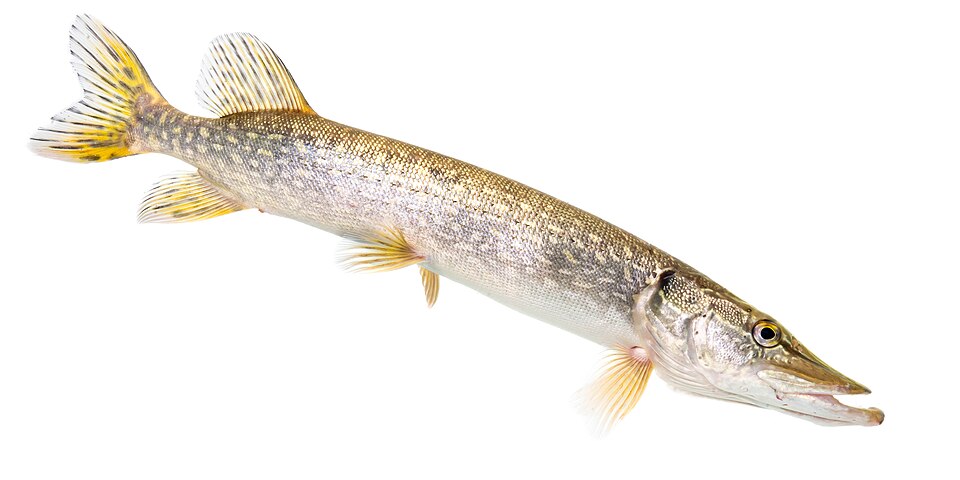
A productive pike search separates locating fish from waiting for them. On Lough Gara Lower, use a lure to examine reachable edges and depth changes, then consider a carefully placed deadbait where the bottom is suitable and there is a reason to expect prey nearby. The key is to fish a defined lane well, rather than casting blindly into the widest expanse of water.
This shore-based plan is intended for the cooler months ahead. It uses documented access and species information, while the tackle dimensions, cast sequence and example session are practical starting suggestions. No current catch rate, water level or particular shoal position is implied.
Pike, prey and the significance of an edge
Northern pike, Esox lucius, has an elongated greenish body with pale markings, a broad toothed mouth and fins positioned for rapid acceleration. It is readily distinguished from deeper-bodied perch and bream. Juvenile pike eat invertebrates and small fish; larger fish are predators for which suitable prey and an interception position matter.
The Boyle-area angling material records bream, roach and hybrids in the local fisheries, including Lough Gara. Their presence makes prey-fish location a reasonable part of the search, but it does not prove that a particular bay holds a shoal today. Watch for small fish and repeated predator activity without assigning every surface disturbance to pike.
A weed edge, a deeper lane beside a shallow shelf or the outside of a reed fringe can provide a meeting point between cover and open water. These are features to identify on arrival, not a claim that every mapped bank has the same habitat. Pike may also use open water around prey concentrations, so avoid spending the entire session on vegetation after the evidence points elsewhere.
Cold weather does not make lures useless. It makes controlled depth and a presentation that remains in the useful layer especially important. Static deadbait is an alternative for a known holding area; it is not an automatic cure for failing to locate fish.
Where to start on Lough Gara Lower
Lough Gara lies within reach of Boyle in the Upper Shannon region. The official angling description identifies northern and southern access areas on Lough Gara Lower with parking, slipways and fishing stands, reached from the local road towards Monastadan. It also describes open-shore fishing.
That access account dates from 2018. Confirm the present condition of stands, parking and any permissions locally before travelling. A slipway is a launch facility, not a place to block with rods, and a fishing stand can become unusable at a different water level. Choose a safe position with room to net a fish before assembling the tackle.
Begin with the nearest reachable edge. If you cast over a shallow shelf into deeper water, remember that a sinking lure will cross the shelf again on its return. Many repeated snags happen in that final section. Mark the point where the bottom rises and lift the lure earlier on the next cast.
A breeze can help conceal your approach, but an exposed shore becomes unproductive when it prevents depth control or safe landing. Compare accessible sheltered water before assuming you need a boat. This guide does not extend to unverified offshore marks or unfamiliar open-water crossings.
Lure tackle that handles both casting and landing
For medium-sized lures, start with a 7–8 ft medium-heavy spinning or casting rod rated approximately 20–60 g, a suitably sized reel and 30–40 lb braid. Match the actual lure weight to the rod. A 15 cm soft bait can weigh much more than its length suggests once the head and hooks are included.
Use a properly made 40–50 cm wire trace rated at least 30 lb, with strong, reliable swivels and snaps appropriate to the lure. Check crimps or knots, kinked sections and the snap closure before fishing. Ordinary fluorocarbon leader is not a substitute for a bite-resistant pike trace in this plan.
The line must also cope with cover and casting load. Strong tackle allows controlled pressure without exhausting the fish unnecessarily. It does not justify dragging a hooked fish through a solid reed bed. Identify an open route, set a yielding drag and keep a large landing net, long forceps, cutters and a wet unhooking mat within reach.
First rig: a shallow minnow or suspending lure
Attach a 10–14 cm shallow-running minnow or suspending lure to the trace snap. Check that the snap does not bind against the lure's eye or prevent its action. Use sound hooks and split rings; crushed barbs can make release easier where appropriate.
Cast along the outside of a visible edge before casting across it. Retrieve enough line to make the lure work, then use short pulls and pauses. Begin with pauses of roughly one or two seconds, lengthening them only if the lure remains clear of the bottom or plants. A nominally suspending lure may rise or sink with different trace weight and water temperature, so test it beside you.
In a shallow lane, the advantage is keeping the lure above the obstruction while still showing a clear change of pace. If it digs into weeds repeatedly, select a shallower model or a different angle. Retrieving faster through the same snagging route may simply pull it into trouble harder.
When a fish follows, keep the lure moving through clear water and avoid lifting it abruptly at the bank. On the next cast, change the pause or route. A follow establishes interest, not a reason to strike before contact.
Second rig: a weighted soft bait for a deeper track
Rig a 12–16 cm soft shad straight on a strong jighead, beginning around 10–20 g where depth and wind permit. A 4/0–6/0 hook is a possible starting range, but match its gape and shank to the specific lure body. The point should emerge cleanly without bending the plastic. Keep the same wire trace.
Cast into open water and count the fall. On the first exploratory cast, use controlled contact and watch for the line to slacken as the lure reaches bottom. On later casts, begin the retrieve before that count if you want to swim above the bed. A countdown measures that particular cast, not a fixed depth in metres.
Use a slow, steady swim with occasional short lifts rather than repeated high snaps. At the near-bank shelf, raise the rod and recover the lure sooner. If contact with bottom is impossible to judge, shorten the cast or add a little weight; if the lure buries itself, reduce weight or start the retrieve earlier.
Natural silver, perch-like and darker solid patterns offer useful contrast options. Try a conspicuous pattern in stained water as a visibility experiment, then compare it with the same depth and speed. Do not assume a colour can compensate for a lure running several metres above the fish.
Third option: an attended running deadbait rig
Choose this only where you can keep the rod under continuous observation and land and unhook a pike competently. A roughly 12 ft pike rod of about 2.75–3 lb test curve, a strong fixed-spool reel and 15–20 lb monofilament form a practical starting outfit. Use a commercial, correctly assembled wire deadbait trace of at least 30 lb and about 50 cm, commonly with size 6–8 trebles matched to the bait.
Run the main line through a large-bore running ledger link carrying a 30–60 g lead, add a protective bead and tie to the trace swivel. The lead should move freely and be able to separate from a broken main line. Avoid arrangements that permanently trap a heavy lead above the fish.
A modest shop-bought deadbait such as a thawed smelt or mackerel section is easier to cast and position than an oversized bait. Attach the trace hooks securely but shallowly to the bait as intended by the trace design, leaving the working points clear. Use a smooth cast; a forceful snap can tear the bait off. Ask an experienced pike angler to demonstrate the rig if you have not used one before.
Place it on a clean patch beside the suspected prey route, not deep inside weed. Set a visible drop-off indicator or float indication with minimal unnecessary resistance and remain beside the rod. Respond promptly to a sustained take; do not allow a pike to swallow the bait before tightening and setting the hooks. If you cannot maintain close observation, retrieve the bait.
| Feature or condition | Method to test | Working path | Reason | Main limitation |
|---|---|---|---|---|
| Shallow clean lane beside reeds | Shallow minnow | Along the outside edge | Keeps a moving target near cover | Diving too deep fouls the lure |
| Open water beyond a shelf | Weighted shad | Count down, then swim above bed | Tests a lower layer | Lift before the near-bank rise |
| Located prey activity over clean bottom | Running deadbait | Stationary beside the activity | Gives a slower feeding opportunity | Requires constant attendance |
| Strong wind and poor contact | Shorter lure casts | Controlled accessible lane | Restores depth and bite detection | Less water covered per cast |
A worked three-hour search
Begin with the lure outfit and a shallow minnow. From one safe position, make short casts along both near margins, then a fan of progressively longer casts. Compare one steady retrieve with one pull-and-pause pass. Move only after covering different paths, not after repeatedly casting down one line.
At the next suitable position, use the soft shad to test below the minnow's depth. If the first casts bring weed, count down less and swim higher. A fish seen following from deeper water justifies returning to that route with a slower presentation; it does not justify casting into an inaccessible snag.
If you find convincing prey activity beside clean bottom, spend the final part of the session with one closely attended deadbait rod. Otherwise continue searching rather than waiting in an arbitrary spot. Record the actual lure depth method, wind direction and fish response so the next visit begins with something more useful than a remembered lure colour.
Brief rules and handling note
Checked 2 November 2026: Inland Fisheries Ireland prohibits live fish as bait and fishing with more than two rods. Pike over 50 cm fork length cannot be killed; the national daily kill limit is one smaller pike, with additional possession and bait-fish rules in the linked regulations. State licensing is generally unnecessary for pike, but permission or local permits may still apply. Buy bait locally and retain required purchase evidence. Keep fish supported and wet, keep fingers away from teeth and gills, and cut difficult hooks rather than prolonging an unsafe unhooking attempt.