
A Louisiana sheepshead trip in November or December is best planned around a manageable piece of structure and a safe way to fish it. A sheltered position near lawful access can teach more than an exposed destination chosen because someone once caught a large fish there. The aim is to present a small bait accurately, recognise a tentative take and land the fish without turning the structure itself into a hazard.
This guide covers a modest rod-and-line session in Louisiana state saltwater, with rules checked on 23 October 2026. It does not promise a winter aggregation, identify an unrestricted dock or extend Louisiana rules into another jurisdiction. The tackle sizes and sequence are practical editorial starting points. No firsthand catch report is implied.
Put Louisiana rules ahead of familiar rules from elsewhere
The LDWF licensing service’s current coastal-species table lists no recreational size limit or bag limit for sheepshead and an open season throughout the year in state waters. Its page was updated on 5 June 2026. That does not make unlimited harvest a good objective, nor does it establish a right to fish any structure. Recheck the current table and local restrictions before the trip.
For recreational saltwater fishing, the licensing service states that anglers aged 18 or older need Basic Fishing and Saltwater Fishing licences, with qualifying combination or special licences providing those privileges in some cases. Confirm which product applies to your circumstances. Do not assume a licence from another state covers the trip or that paying a charter operator automatically resolves every passenger requirement.
Keep this plan in state inshore waters. Different offshore species, methods and jurisdictions can bring additional requirements. A public road, bridge or waterfront view also does not prove that fishing or parking is permitted there. Choose a facility or launch whose current access you have confirmed, obey signs and respect private docks and working waterfronts.
Identify the fish beyond its bars
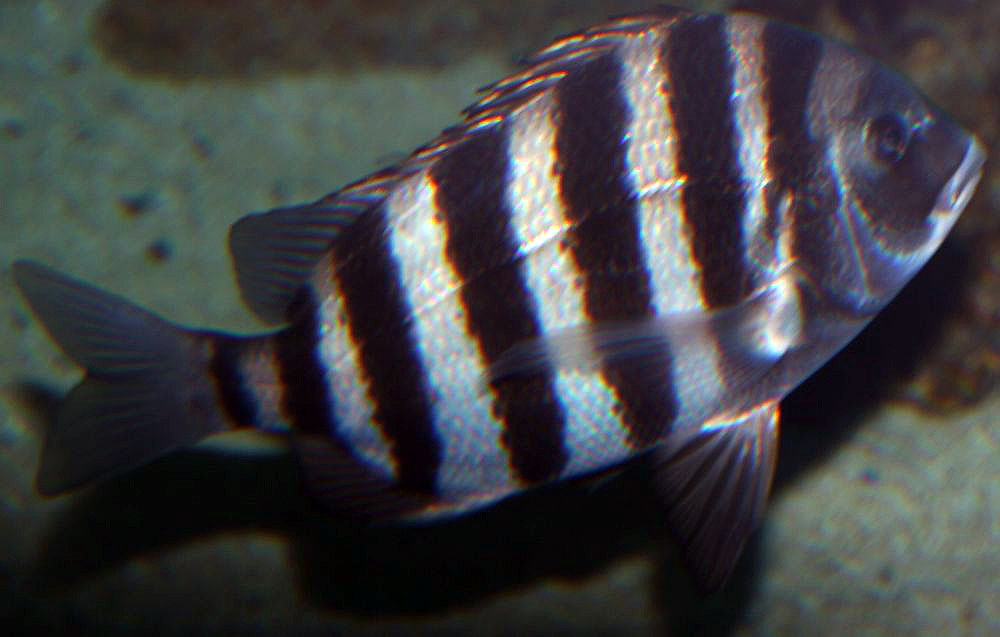
Sheepshead have a deep, compressed body, conspicuous dark vertical bars, strong fin spines and prominent teeth adapted to their food. FWC distinguishes them from black drum by the absence of chin barbels and the different teeth. Bars alone are not enough: young black drum can also look strongly striped.
This distinction matters before a fish goes into a cooler. If identification is uncertain, do not guess a legal category from colour. Use the official species information and examine the fish carefully while minimising handling. Keep hands away from the mouth, gill edges and spines.
The cover shows a correctly identified aquarium sheepshead for species context. It is not a Louisiana catch, a demonstration of release handling or proof of what fish are present at a chosen dock. The owner’s separate black-drum photograph remains identified as black drum; it is not used here.
Choose structure you can fish safely
Official species accounts associate adult sheepshead with hard structure such as pilings and rocks, where shellfish and crustaceans provide food. That gives the search a useful starting point, but it does not make every piling productive. Begin by finding a lawful position with stable footing, room for the rod and a realistic landing route.
From a bank or permitted pier, avoid the temptation to lean around a railing to place a bait closer. If the best-looking face cannot be reached safely, fish the accessible side or choose another position. Keep a long-handled landing net within reach where the height and rules allow it. Do not rely on lifting a fish up by the line.
From a boat, leave enough space to avoid contact with pilings, mooring lines and other vessels. Do not attach to navigation aids or private structures without permission. Station-keeping, current and nearby traffic should be within the operator’s ability before anyone starts fishing. An inexperienced crew should choose sheltered water and a conservative plan rather than treating a fishing technique guide as boat-handling instruction.
A compact outfit with useful strength
A 1.9–2.2 m medium-power spinning rod with a responsive tip and a 2500–4000 size reel is a reasonable starting outfit for modest inshore structure. Use the rod’s stated weight range as the limit. Around rough pilings, 10–20 lb braid with a 20–30 lb abrasion-resistant leader can provide contact and protection; 12–20 lb monofilament is a simpler alternative where abrasion is less severe.
Leader strength is a tradeoff, not a badge of expertise. Too light a leader can part against rough structure, while an unnecessarily bulky presentation can be awkward with a small bait. Start with approximately 40–60 cm of leader, inspect it often and change it when roughened. Avoid fishing through damage simply because it has not yet broken.
A small, strong hook in roughly size 1 to 1/0 is a useful starting range, adjusted to the bait rather than to a fixed rule. Hook sizes vary by manufacturer. The gap should remain clear after baiting. Use the lightest sinker that lets you place the bait where intended; roughly 7–21 g may cover modest current, but conditions and the rod rating determine the final choice.
Make one rig do one job
A simple sliding-sinker rig is easy to inspect: main line through the sinker, a protective bead where appropriate, a swivel and a short leader to the hook. Keep connections compact. Test knots under steady tension before fishing and keep spare terminal tackle organised so a break-off does not become a long interruption.
Small shrimp or suitably obtained small crabs are common sheepshead bait choices in official species guidance. Buy bait from a lawful supplier rather than assuming you may collect it at the site. Check any bait-collection restrictions separately. Do not scrape organisms from a structure as an improvised shortcut without establishing permission and the applicable rules.
Present a small portion with the hook point clear. An oversized clump can conceal the hook and make it harder to distinguish a fish taking the bait from current moving it. If bait repeatedly disappears, shorten the inspection interval and adjust how it sits on the hook before changing the whole rig.
Fish close, with controlled contact
Begin with a short drop or cast beside the accessible face of the structure. Let the sinker settle without feeding unlimited slack. Hold enough contact to notice a change while avoiding a tight line that continuously drags the bait away from the intended position.
Work a small area systematically. Try the edge nearest you, the face influenced by the current and one slightly more open lane, provided each is safe and permitted. If the sinker is repeatedly swept underneath an obstruction, change your angle or choose a calmer position. Adding weight is only useful when it restores control within the tackle’s limits.
A take may feel like a small tap, increasing weight or a change in the line rather than a dramatic pull. With a conventional hook, lift firmly once contact is established rather than making a violent strike beside other people. If you choose a circle hook, use a steady tightening action appropriate to that hook design. Do not treat the two hook types as requiring the same response.
After hooking a fish, use steady pressure to guide it away from rough cover towards the planned landing area. Do not lock the drag so tightly that an unexpected surge breaks the leader or destabilises you. If a position offers no safe way to play and land a fish, it was not a suitable position to begin with.
Let tide and weather shape the session
Use a local tide prediction as planning information, then observe the current at the actual fishing position. A tide time is not an exact description of current around every piling. Wind, the shape of a channel and local water movement can make the useful presentation window different from the one you expected.
For a first session, favour current you can manage rather than maximum flow. If the bait will not stay in the chosen lane without excessive weight, wait or relocate to a lawful sheltered position. When the flow eases, reduce sinker weight and test whether the bait moves more naturally. Make one change at a time so you can understand its effect.
Check the marine forecast and any warnings before leaving, and reassess if the wind strengthens or visibility declines. November and December are planning months, not a forecast of calm conditions. Set a clear return time and avoid making a long exposed crossing merely to extend the fishing.
The National Weather Service warns that cold-water immersion can rapidly disrupt breathing and movement even when air temperatures feel comfortable. Wear an appropriate life jacket near or on the water, carry dry clothing and plan for an unexpected fall. A boat crew should leave a float plan and carry suitable communications. Do not let a mild afternoon hide the consequences of entering colder water.
Land carefully and choose a modest outcome
Have pliers, a net and a measuring tool ready before fishing. Control the fish without putting fingers near teeth or sharp gill edges. If releasing it, keep handling brief, wet hands before contact and support the body. Avoid placing a fish on abrasive ground for a photograph.
A lack of a species-specific bag limit is not a reason to take more fish than you can use responsibly. Decide on a modest personal harvest intention before the trip, and recheck identification and current rules before retaining anything. Do not infer food safety from a successful catch; consult any relevant local consumption advice.
Finish with a simple record: access point, wind, observed current, sinker weight, bait presentation and what happened. Include unsuccessful tests. A useful first trip may produce more knowledge than fish, especially if it establishes a safe position and a rig you can control.
This AI-assisted guide uses the official sources below. Florida and Texas sources support species biology and general technique only; the legal requirements stated here come from Louisiana’s licensing service. It makes no claim of guaranteed winter success, firsthand reporting or unrestricted access.