
Bradford West Gwillimbury has announced an invasive-reed control operation at Middletown Pond, bringing a local freshwater habitat issue into focus. The town's notice, dated 16 October 2026, scheduled work at 2691 Sideroad 10 for 20–21 October, subject to weather. Our check on 23 October verified the announcement, not a completion record. Readers should therefore treat this as a report on a planned intervention and the evidence needed to assess it, rather than an announcement that the pond has recovered.
That distinction matters to anyone who uses small waters. An operation can be necessary without producing an immediately measurable improvement in habitat. A management notice tells residents what the municipality intends to do. A subsequent ecological assessment answers a different question: what changed in the water and along its margins, and did those changes meet the project's objectives?
What the town has announced
The municipal notice identifies invasive Phragmites as the target and describes a professional treatment operation. It is the primary source for the location, intended dates and local management purpose. We have not independently inspected the treatment permit, contractor records or a post-treatment inspection. Consequently, this article makes no independent finding about chemical authorization, application conditions, completion, or the pond's suitability for any particular recreational activity.
The practical next step is to consult the latest municipal notice and signs at the location before visiting. A date in a notice is not a guarantee that work occurred on that date, particularly where the announcement expressly depends on weather. Equally, the absence of a completion statement in the material checked is not evidence that the work failed to happen. It leaves a specific reporting question open.
Why an invasive reed is an aquatic-habitat story
Ontario's Invading Species Awareness Program explains that invasive Phragmites can displace native vegetation and affect wetland habitat. For anglers, this is a reason to look beyond the surface appearance of a pond. Vegetation management is part of caring for the water's edge, even where the immediate announcement contains no fish survey or named fish population.
There is also native Phragmites in North America. A tall reed, a green leaf or a photograph labelled with the species name does not by itself establish that a particular stand is invasive. The municipality identifies the target at Middletown as invasive; that site-specific statement should not be generalized to every reed patch a reader encounters elsewhere. The awareness program's identification and reporting resources are more useful than an improvised decision to cut plants.
The Ontario Invasive Plant Council identifies the invasive form as Phragmites australis subsp. australis and documents its wider occurrence in southern Ontario. That regional context helps explain why municipalities are addressing the plant. It does not demonstrate the extent of infestation at this particular pond, nor does it establish which aquatic species occur there. We have not inferred either from the regional distribution.
Control and restoration need separate evidence
The council's management guide, last updated in February 2024, recommends planning across several years, with site evaluation, objectives, monitoring and restoration considered together. It describes monitoring before and after management, including measures such as infestation extent, native vegetation and wildlife use. Those are management principles, not a claim that Middletown already has a published monitoring program or has achieved its targets.
For readers evaluating the local project, a useful reporting structure would separate three things. First is the work record: what was done, where and when. Second is control performance: whether the targeted plant declined or returned. Third is habitat response: what replaced it and how the wider site changed. Combining all three into a single statement that an area was “restored” would conceal information that residents could reasonably want.
Our suggested distinction is not a demand that every small project fund an elaborate research station. A clear, proportionate public account can still identify the objective, show how observations were made and explain the next decision. It should be possible to understand why a follow-up visit is being made without needing to interpret a specialist contract.
What follow-up would make the story stronger
The Minnesota Aquatic Invasive Species Research Center provides a useful comparison, expressly outside Ontario's jurisdiction. Its guidance treats control as a multiyear process, emphasizes correct identification, and links follow-up work to observed regrowth. It also warns against assuming that native vegetation will necessarily return without further attention. These are ecological and management lessons; Minnesota treatment calendars, permits and product instructions are not instructions for this Ontario pond.
Applied as questions rather than as a prescription, that comparison suggests a practical sequence for future local reporting. Has the town confirmed the actual treatment date? Will it explain what evidence it uses to decide whether another visit is needed? Will its public account distinguish a reduction in invasive plants from a recovery of native vegetation? These questions make room for honest progress even where the final result takes time.
A useful update could also say who receives observations from residents and when the next assessment is expected. We are recommending those communication steps, not reporting that the municipality has promised them. No follow-up date should be inferred from the two dates originally allocated for field work.
What photographs can and cannot tell residents
A photograph can help people recognize a location, follow a visible change or describe a concern. For an informal record, take pictures from an existing safe public viewing position and note the date and direction. Do not enter a treatment area, disturb plants or approach contractors simply to obtain a closer image. A consistent viewpoint makes a sequence more understandable than unrelated close-ups.
A picture alone cannot supply a treatment history or explain why vegetation changed. Our editorial recommendation is to keep observation and interpretation separate: “this patch looks different from last month” is a narrower statement than “the treatment succeeded.” If a reader forwards an observation, include enough context for the responsible team to assess it, and avoid presenting an unconfirmed identification as a fact.
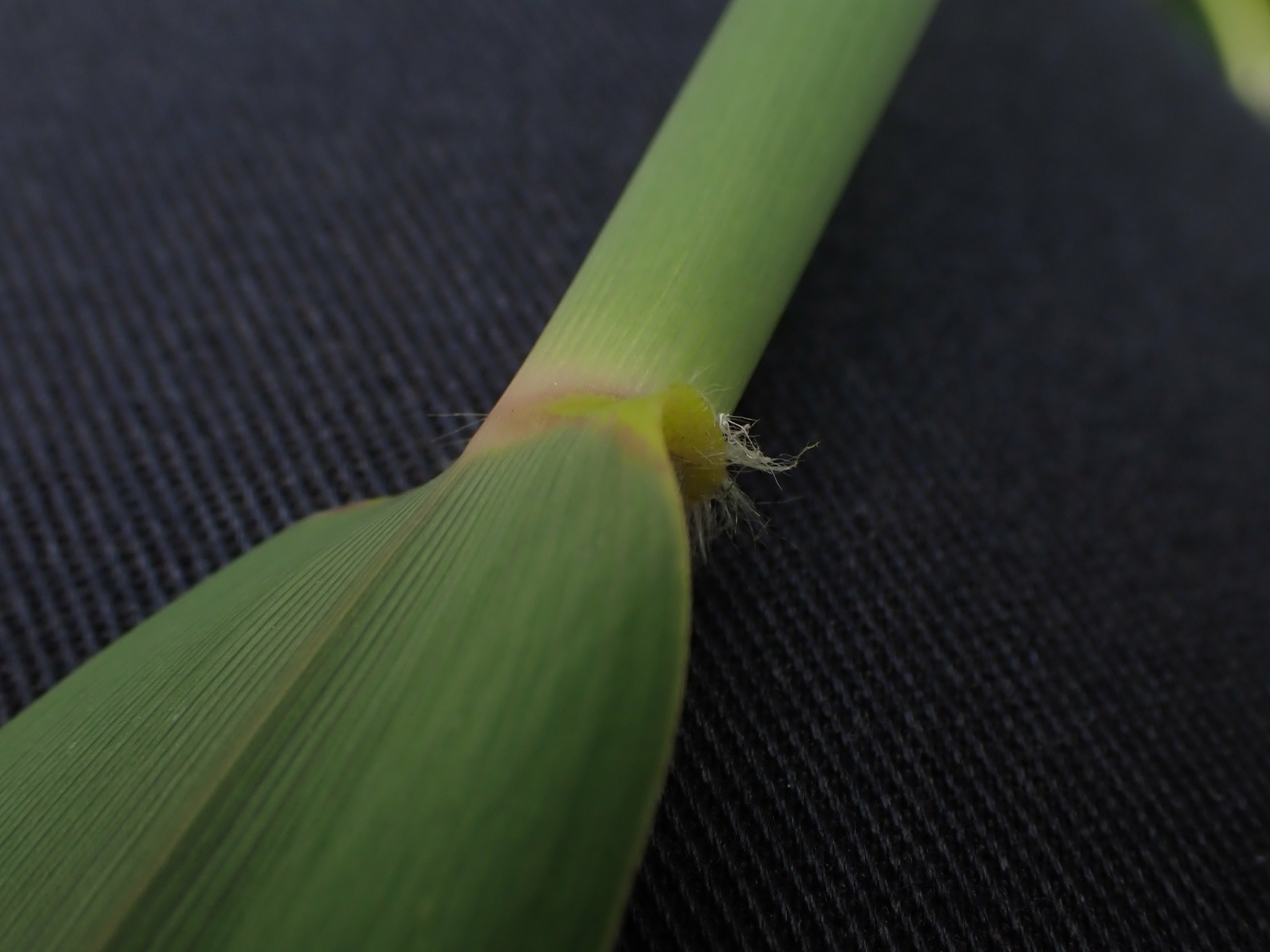
The cover here is a representative common-reed detail photographed in Manitoba by Mary Krieger in June 2022. It shows the leaf and stem junction; it is not a photograph of Middletown Pond and does not establish the plant's subspecies. The full credit and source remain attached so readers can understand that limitation.
Anglers can help without doing the treatment themselves
The Invading Species Awareness Program recommends reducing accidental transport of invasive plants: remain on designated routes and clean visible plant material, mud and seeds from equipment and clothing. It also cautions against composting invasive Phragmites. These prevention measures are relevant to people moving between waters, whether they carry fishing tackle, footwear or other outdoor equipment.
Do not turn the municipal announcement into an invitation for an informal cutting party or a home herbicide experiment. A fishing visit and a vegetation-control operation have different purposes and responsibilities. Readers who notice a suspected stand should use the linked identification and reporting resources, rather than transplanting a sample or deciding on treatment from this article.
Nor is this story a new fishing-access guide. It does not establish permission to fish Middletown Pond, identify an approved launching point, name fish present or replace current fisheries rules. Someone planning recreation should verify those matters separately. Keeping those questions distinct avoids attaching an unsupported fishing opportunity to a legitimate conservation announcement.
The wider Ontario effort is context, not a local funding claim
The Invasive Species Centre's current funding page says its Phragmites control fund supports 120 community-action projects in 2026/27 and that applications are closed. That indicates the scale of the broader management effort. The page does not, on its own, establish that the Middletown work is one of those funded projects. We make no such attribution and report no grant amount for the pond.
This distinction also matters when comparing projects. A provincewide number describes participation, not hectares restored, fish recovered or the effectiveness of a particular intervention. Residents can reasonably welcome organized attention to invasive plants while still expecting project-level evidence before drawing conclusions about outcomes.
For a community group considering its own water, the useful lesson is to begin with a verified problem and an accountable site manager. A nearby announcement is a starting point for learning, not a transferable treatment plan. The appropriate questions concern the actual site, its objectives and the capacity to follow through after the first operation.
The next milestone to watch
The most immediate unresolved milestone is confirmation of what happened during or after the proposed October work window. Beyond that, a public explanation of assessment and follow-up would allow residents to distinguish a completed operation from a durable habitat improvement. We have found no basis in the checked announcement for reporting a percentage reduction, a native-plant recovery rate or a benefit to a measured fish population.
Middletown's announcement is meaningful because it names a local invasive-plant problem and an intended response. Its value does not depend on describing an unmeasured recovery. The next useful story will be built on dated observations and documented decisions, with enough information for the community to see what the intervention accomplished and what still needs attention.
Sources were checked on 23 October 2026. This is desk reporting and analysis with AI assistance, not a site visit or an independent ecological inspection.