A good Otamangakau presentation spends time in a clear feeding lane without burying itself in weed. That sounds simple until a long leader folds, a weighted fly drops out of sight or a breeze moves the line faster than the fly. Build the session around seeing those problems and correcting them. Spring into early summer offers a useful planning period, but no date guarantees a hatch, a cruising fish or suitable water temperature.
Two trout, one lake, several feeding routes
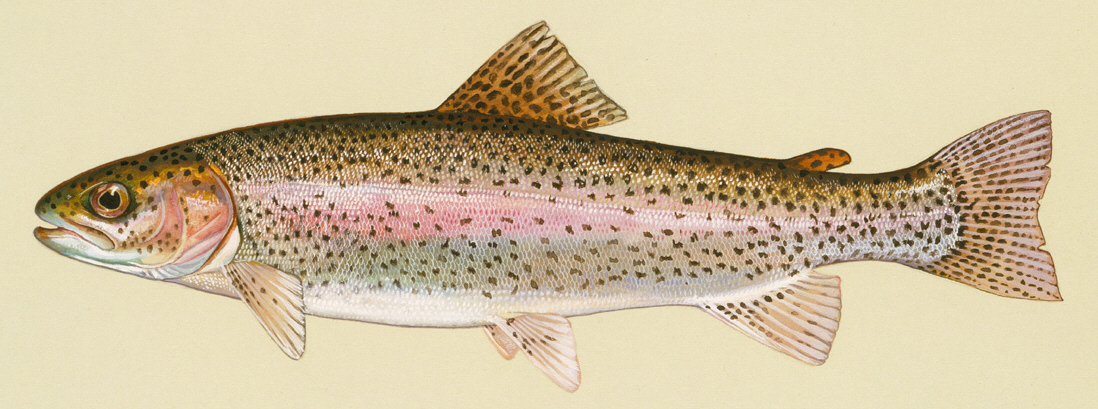
This shallow hydro-lake in New Zealand's central North Island holds wild brown trout, Salmo trutta, and rainbow trout, Oncorhynchus mykiss. Rainbows commonly show dark tail spots and may have a pink lateral band; lake fish can be largely silver. Brown trout also vary in colour, but usually have few or no obvious tail spots. Avoid deciding from a red flank alone.
Both species are introduced to New Zealand, although these fish form a wild fishery. Do not confuse Otamangakau's small-lake weed fishing with a deep-water smelt-jigging plan for Lake Taupō. The productive question here is often where a fly can travel beside vegetation at the depth a trout is using.
Historical lake research published in March 1998 described brown trout patrolling weed patches and feeding on damselfly nymphs and snails. Those observations explain why a gap between shore and weed can be worth watching. They are not a survey of today's food abundance or a promise that a fish returns on a fixed schedule. Inspect the water in front of you: repeated rises, a moving shadow, drifting insects and clean gaps in vegetation are better immediate clues than a remembered hotspot.
Access and the first ten minutes
The angler track north of the dam provides a shore option. The inlet and outlet canals have limited shore access, with other opportunities around ramps and at nearby Lake Te Whaiau. Use the current access information and signs; a visible shoreline is not automatically reachable or safe. Boats expand the choice of weed edges, but they also add drift and positioning problems.
Start from dry land and watch before wading. A near-bank corridor can be ruined by walking through it. Look for the inner weed edge, holes within the bed and the outside edge where the bottom falls away. Polarised glasses help in suitable light; if glare prevents seeing the bottom, do not assume a dark patch is shallow weed rather than deeper water.
Choose a casting position that puts the fly ahead of a cruising fish without dropping the fly line across its path. If you cannot see fish, select one clean lane and fish it systematically rather than casting randomly over a broad weed mat. From a boat, approach quietly, avoid anchoring in the intended casting lane and let the disturbance settle. A short controlled drift is useful only while you can keep the fly clear and detect a take.
A floating-line outfit that stays manageable
A 9-foot 6-weight fly rod, matching floating line and reel with a smooth drag are practical starting choices. Use a tapered leader around 3–4 metres, finishing in roughly 0.20–0.25 mm tippet, commonly about 6–10 lb depending on material and brand. Large fish and weed argue against unnecessarily fine tippet. If wind defeats turnover, shorten the leader before adding power to every cast.
Build from a stout butt section that turns over the fly, through a taper, to about 60–90 cm of replaceable tippet. Test every knot with a steady pull. A single fly is easier to place, untangle and keep clear of weed than a complicated team. The ranges here are editorial starting suggestions, not measurements of a universal optimum for this lake.
Carry a few slim damselfly-style nymphs in sizes 10–14, smaller midge-style patterns around 14–18, and small woolly-bugger-type streamers around 8–12. Hook numbering differs between designs, so compare actual gape, weight and profile. Olive, brown and dark patterns offer useful contrast tests. Match the visible prey's shape and size where you can; there is no substantiated rule that one colour always works under a particular cloud cover.
Rig one: a single nymph in a visible lane
Tie on an unweighted or lightly weighted nymph. Make the first casts short enough to see the leader's behaviour. In shallow water, place the fly ahead and to the side of the anticipated route, then let it settle without dragging it immediately towards the trout. The required lead depends on depth and sink rate. Practise one measured cast into an empty lane rather than guessing with a fish directly below you.
For a blind search, cast diagonally along a clear weed margin. Allow a short, repeatable settling count, then use a slow hand-twist retrieve or tiny pulls separated by pauses. Keep the rod tip low enough to limit a large surface bow, but leave sufficient freedom for the fly to sink. Watch the leader tip and line junction for a stop, draw or sideways movement.
When a take develops, remove slack and lift smoothly. A violent strike on a long leader can break fine tippet or pull the fly away. If the fly returns with weed, shorten the settling count first. If fouling continues, reduce fly weight or choose a clearer lane. A weed-covered fly fished for another five minutes supplies very little useful evidence about whether trout are feeding.
An adjustable indicator can help when wind hides the leader tip. Set it to suspend the nymph above the measured weed top, beginning perhaps 30–50 cm clear rather than trying to scrape vegetation. That clearance is an experiment. Move the indicator in small steps, record the effect and check that it releases or passes safely through the guides for landing. Avoid a heavy indicator beside a clearly visible shallow cruiser.
Rig two: a small streamer along the outside edge
A small streamer provides a searching alternative when fish are not visible or when a nymph cannot cover a useful length of open water. Use the same floating outfit with a somewhat shorter, strong leader if necessary for turnover. A lightly weighted fly is usually easier to keep above weed than a heavily loaded one.
Cast obliquely across the lane, let the fly settle for a repeatable count, then begin with pulls of about 10–20 cm and pauses of one or two seconds. These numbers establish a rhythm to test, not an imitation of a measured natural swimming speed. Compare that rhythm with a continuous slow retrieve. If you see a following trout, maintain control rather than lifting the fly abruptly out of the water.
Keep the line in the rod hand under gentle tension. A firm draw can be met by pulling line steadily before raising the rod. If there is only a brief bump, continue the retrieve for a moment rather than repeatedly striking empty water. Short takes can justify a smaller fly, slower pace or longer pause, but first inspect the hook and remove any weed strand around the bend.
A spinning alternative for open lanes
Spin fishing is an option here. A light 6½–7-foot rod, 2000–2500 reel, 6–8 lb main line and roughly a metre of 6–10 lb leader provide a practical starting outfit. A small 3–7 g spoon fitted with one suitable single-point hook can cover open water. Check the complete lure against current hook rules before use; a factory treble is not acceptable.
Cast along the outside weed edge, close the bail and begin a controlled retrieve after a short countdown. Raise the rod slightly if the spoon starts catching vegetation. A spoon must work at the chosen slow speed; if it stops wobbling, a different shape may suit better than simply winding faster. Avoid casting over an angler's fly line or repeatedly dragging a lure through a visible fish's holding patch.
| Water clue | First option | Depth control | Change after failure |
|---|---|---|---|
| A trout cruises the inner weed gap | Single light nymph | Settle ahead of its route | Reduce splash and reassess lead |
| No fish visible beside a clean margin | Small streamer | Repeatable count and short pulls | Compare slower continuous retrieve |
| Breeze conceals the leader tip | Indicator nymph | Suspend above weed tops | Adjust depth in small steps |
| Wide clear water beyond the bed | Single-hook spoon | Count down then swim clear | Change angle before adding weight |
A worked shore session
Suppose the track reaches a permitted, stable bank beside a clear corridor. Begin with the 6-weight outfit, a 3.5-metre leader and a size 12 lightly weighted nymph. Observe for several minutes. If a trout passes, note direction and depth, then place the next cast where the fly can settle before the fish arrives. Do not assume it will circle back; continue watching other lanes.
Without a sighting, make a short sequence of casts at the same countdown. Inspect the fly after each early retrieve. If clean but ignored, test a slightly longer settling time. If it catches weed, reverse that change. After a careful pass, try the small streamer through the same lane to compare a moving presentation, then relocate rather than turning one patch into a casting exercise. This is a hypothetical decision sequence, not a reported local catch.
Current rules and temperature matter
DOC currently lists the season as 1 October–31 May, with weather-dependent summer closures. The 2026 change replaced the fixed February closure with a response to heat risk. Check current notices before travelling. Otamangakau has a two-trout daily bag, no minimum and a 55 cm maximum measured to the tail fork; stop fishing once you retain the daily limit. Use a Taupō licence, one rod at a time and artificial flies or lures only, with single-point hooks and the current 14 mm maximum hook-gap rule.
Summer heat can compress suitable habitat through temperature and oxygen together; deeper water is not automatically a refuge. The linked historical assessment explains that mechanism but is not today's temperature reading. Stop if conditions threaten fish welfare, minimise handling, and use a net large enough to support a trout in the water. Clean gear between waters and do not use prohibited felt-soled wading footwear.