
A fish can look obvious in the net and become surprisingly difficult to identify once its fins fold, its colors fade or the photograph hides the feature that separates it from a similar species. That matters because identification, measurement method, season, bag limit and protected status are separate decisions. A sharp “trophy” picture may still omit the jaw, lateral line, fin shape or tail needed for a defensible identification.
This guide uses Florida saltwater guidance as a concrete North American example because the Florida Fish and Wildlife Conservation Commission publishes detailed photo and measurement instructions. The operating method travels well, but the legal answer does not: use the regulator for the water where the fish was caught, including federal rules when applicable.
Make the release-or-retain decision before fishing
Prepare two paths at the rigging table. The release path needs wet hands or wet gloves, a landing net suitable for the fish, long-nose pliers or a dehooker, line cutters, a camera already unlocked and a clear return route to the water. The retention path adds the current rule source, a rigid measuring board long enough for likely catches, a legal cooler and ice. Do not wait until an unknown fish is on deck to debate what to do.
The mechanism is simple: every extra task after landing extends handling time. Searching for an app, moving rods, finding a ruler and deciding who takes a picture all compete with dehooking and either release or chilling. Assigning roles beforehand turns those jobs into a short sequence.
If the species cannot be identified confidently and promptly, default to release unless a rule or safety instruction requires another action. A photograph is evidence for later learning, not retroactive permission to keep an uncertain fish.
The four-view evidence set
FWC’s photo guidance emphasizes a full side view that includes the head, body and fins. Build a fast four-view sequence around that principle:
- Full side: hold or place the fish perpendicular to the camera so head, tail, dorsal fin, anal fin and body pattern are visible.
- Head close-up: include the mouth closed, jaw ending, eye, gill cover and any chin barbels or teeth that can be shown without manipulating the fish.
- Tail and fin view: show tail shape, fin margins and finlets. This is especially useful for mackerels, tunas and jacks.
- Measurement view: show the entire fish on a flat board with the relevant endpoints visible. The picture supplements, but does not replace, the actual measurement.
Use normal camera mode, good light and focus on the fish rather than the angler. Avoid portrait blur because it can erase fin edges. Do not block the pectoral-fin base, jaw or tail with a hand. When a fish will be released, photograph it in the water whenever that is practical and lawful; do not repeat shots to perfect composition.
These are working views, not a universal legal checklist. Some groups need a different angle. FWC recommends a top-down whole-fish view for flounders so body markings and the long dorsal and anal fins are visible. Sharks may require a side view plus a top-down head view to show head shape and whether a ridge is present. For jacks, the upper jaw position and relative dorsal and anal fin lengths can be decisive.
Match the picture to the likely confusion
| Situation | Features to preserve | Decision consequence |
|---|---|---|
| Greater, lesser or almaco amberjack; banded rudderfish | Full body, first dorsal spines, upper jaw beside the eye, dorsal and anal fin proportions | Similar silhouettes can lead to a wrong species and wrong rule |
| King versus Spanish mackerel | Whole side, lateral-line path, body marks, dorsal-fin color, all tail and finlet areas | Size, bag and season rules can differ |
| Grouper, snapper, porgy, grunt or drum | Body depth, full tail, head slope, jaw, pectoral-fin base, dorsal spines and markings | Color alone changes with stress, light and age |
| Flounder | Top view, both long fin margins, tail and spots or ocelli | A cropped side image can hide the useful pattern |
| Shark | Entire side, fin tips, gill slits, tail pattern and top of head when safe | Identification and protected-status errors have high consequences |
This table does not identify a fish. It tells the photographer which evidence an agency guide or qualified identifier will need.
Measure by the rule, not by habit
Florida provides a useful demonstration of why “length” is incomplete. Total length is taken in a straight line from the most forward point of the closed mouth to the farthest tail tip with the tail compressed. Fork length runs from the closed jaw or snout to the center of the tail fork. Billfish can use lower-jaw fork length. A flexible tape curved along the body is not equivalent to a straight measurement.
Before a trip, write the required method beside every intended species. Mark the measuring board with a removable label: TL, FL or another regulator-defined method. At the catch, put the fish flat, close the mouth without forcing it, align the correct head point and read the correct tail endpoint. Photograph the board only after the fish is positioned correctly.
A starting suggestion for a small boat is a rigid 36- to 48-inch board for typical inshore fish plus a longer lawful method for larger targets. That range is operational advice, not a rule. Choose capacity from the species and local regulation. A board that is too short invites an improvised, inaccurate measurement.
A 90-second working sequence
Minute zero starts when the fish is controlled, not when the camera opens.
1. Control the hook and fish. Keep hands clear of teeth, spines and gill plates. If release is certain, keep the fish in the water when possible. 2. Call the intended path: release, regulated measurement, or lawful retention. If identification is uncertain, call “release and document.” 3. Take one full-side image. Add only the group-specific head, tail or top view needed for identification. 4. If a legal measurement is needed, use the regulator’s method on the rigid board. Do not move a prohibited fish elsewhere merely to weigh or measure it. 5. Record waterbody, date, approximate capture position without publishing a sensitive exact spot, depth, habitat, bait or lure, and the rule source checked. 6. Release promptly or place a lawfully retained fish into the prepared cold chain.
Ninety seconds is a planning target, not a promise or safe limit for every fish. Large, exhausted, deep-caught or heat-stressed fish may need a much shorter out-of-water interval and specialized release steps. The decision rule is to remove optional tasks when the fish’s condition is poor.
Use context without letting context become identity
Habitat, depth and behavior narrow possibilities but rarely prove a species. A striped fish beside an oyster piling may suggest one group; the same pattern offshore may suggest another. Juveniles can differ from adults, spawning colors can intensify, and ice or deck light can wash colors out.
Record structure and conditions as supporting fields: freshwater or saltwater; river, estuary, reef or open coast; approximate depth; bottom type; current strength; water clarity; and temperature if measured. Record the lure or bait and presentation depth. Those details help an expert assess plausibility, but diagnostic anatomy must lead.
After the trip: identification before storytelling
Keep the original full-resolution files. Do not crop first and discard the evidence around the fish. Compare the image with a current agency field guide that covers similar species, then check the current rule page separately. FWC’s Fishing Lines field guide explicitly says it is educational and not the current regulatory authority because rules can change.
If the useful features are hidden, label the identification uncertain. Do not let a filename, social-media comment or an old caption harden into a species claim. When submitting to a scientist or agency, provide the original images and contextual notes, not just an edited hero crop.
Common mistakes and corrections
A vertical hold may hide the tail, stretch the jaw and concentrate weight at the head. For a fish that can be safely lifted, support it horizontally with two hands; for a large or protected fish, leave it in the water as agency guidance requires. Fingers through gills may obscure critical features and injure tissue. A measuring tape following the fish’s curve overstates a straight-line length. A dramatic wide-angle shot distorts proportions. A single photo under colored deck lights can make color unreliable.
Another mistake is measuring every fish “just in case.” If the fish is clearly not being retained and the law does not require a measurement, the better release decision may be to skip the board. The photograph should serve identification or documentation, not become the reason handling continues.
Worked Florida example
Suppose an unfamiliar reef fish comes aboard during a mixed-species trip. The photographer is ready. The angler controls the hook while the second person takes one full-side image showing all fins, then one head image showing jaw position and pectoral-fin base. The recorder notes reef structure, approximate depth and bait. Because the team cannot separate two similar species immediately, it does not search multiple websites while the fish waits. It releases the fish according to current handling guidance, saves the originals and checks FWC’s identification guide afterward.
If the team had identified a lawful target before fishing, it would already know whether Florida uses total or fork length for that species and would use the corresponding board position. It would still reopen the current recreational rule page on the trip date because the educational field guide is not a live rule source.
Prepublication checklist
- Geography: pass — Florida is the legal example; the workflow is labelled transferable, not globally controlling.
- Habitat and structure: pass — reef, estuary, open coast, depth and bottom context are recorded as supporting evidence.
- Forage: not applicable — this article documents identification and measurement, not feeding tactics.
- Methods: pass — release, photograph, measure and retain paths are ordered.
- Lures and presentation: not applicable — lure and depth are recorded as context, not prescribed as a catch method.
- Examples and table: pass — five confusion groups and a worked reef-fish case are included.
- Sources: pass — current FWC identification, measurement, handling and rule pages were opened on 26 October 2026.
- Local rules: pass — measurement method and retention are explicitly tied to current jurisdiction pages.
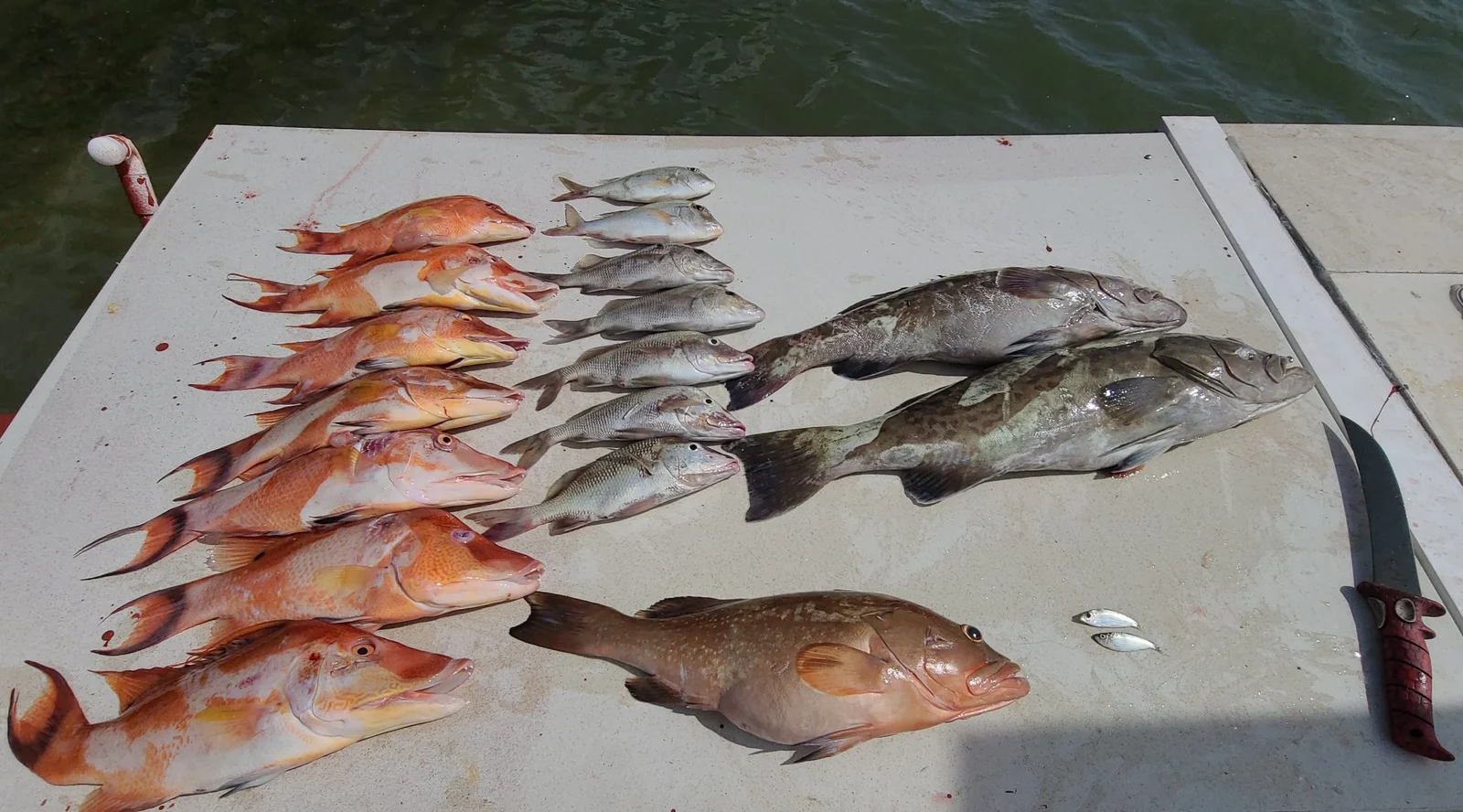
- Image match: pass — the registered owner photograph shows a mixed retained catch on a dockside surface; no pictured species, place or legality is claimed.
- Ethical handling: pass — the workflow prioritizes rapid release, safe control and cold storage for lawful harvest.