
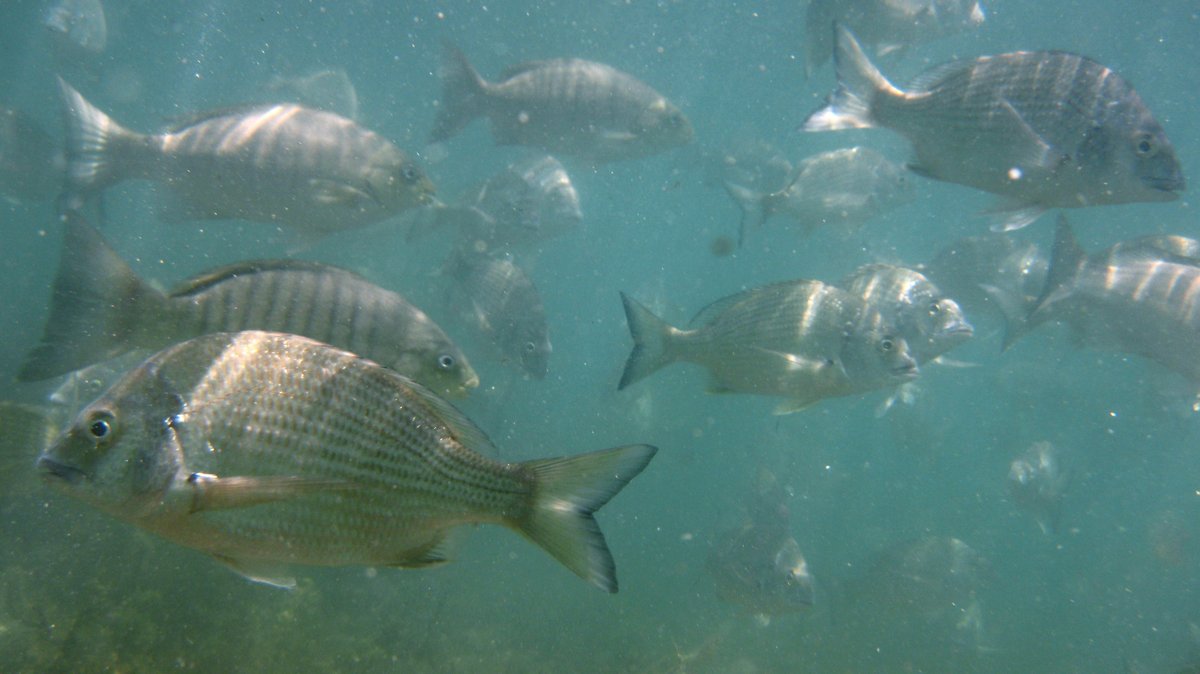
A useful Port Hacking bream session starts with a reachable edge, not the longest cast you can make. Put a small bait or lure beside a depth change, keep enough contact to recognise a take, and retrieve it without repeatedly dragging through the same obstruction. The aim is to compare presentations where fish can feed, then move when the evidence is weak.
Swallow Rock Reserve at Grays Point provides a documented starting point on the Hacking River. This is a shore plan for that public reserve, not permission to fish every wharf, mooring or reserve elsewhere in Port Hacking. Shiprock Aquatic Reserve is specifically excluded. All rig dimensions, countdowns and trial periods below are practical starting suggestions to adjust after observing the water.
Know which bream you are targeting
Yellowfin bream, Acanthopagrus australis, occur along eastern Australia, from Queensland south into eastern Victoria. Their silvery body often has an olive tone above, with yellowish pelvic and anal fins and a dark mark near the upper pectoral-fin base. Black bream tend to have duskier fins, and identification can be complicated by hybridisation. Do not rely on one colour patch.
Tarwhine are another possible look-alike: their more rounded forehead and golden lines along scale rows help distinguish them. Confirm identification before keeping a fish because the legal size for tarwhine differs from yellowfin bream.
Yellowfin bream use estuaries and coastal habitats including seagrass, mangrove margins and sandy areas. They eat bottom-associated prey such as crustaceans, molluscs and worms, as well as small fish. Juveniles use sheltered estuarine habitat. This supports fishing close to a useful feeding surface, but it does not establish that every bream at Swallow Rock is eating prawns on a particular tide.
Choose a shore position with room to fish
The council lists Swallow Rock Reserve at 20R Swallow Rock Drive, with parking, toilets, a boat ramp and floating pontoon. It is also a swimming and picnic location. Treat boat launching, swimmers and other visitors as part of your position choice: the pontoon is not an entitlement to occupy the launching area with fishing lines.
Local visitor information identifies bream among the fish caught from the river edge and describes deeper water near the rocks beside the ramp. Use that as a reconnaissance lead. Inspect the approach and the water yourself; the guide does not establish a safe standing position at every tide or a fixed channel depth.
Choose an open river-edge position with a clear landing route. Start close, then work outward toward a visible colour change or a depth change you can establish with the lure. Do not clamber onto slippery rocks simply to add a few metres to a cast.
Avoid casting beneath occupied boats or across navigation routes. A productive-looking object is not worth losing control of where the line runs. If the reserve is busy, a shorter session in an unobstructed area is preferable to squeezing a cast between swimmers and trailers.
Read the edge before choosing weight
Look for a shallow area meeting deeper water, isolated hard cover and any safely observable patchwork of bare bottom and vegetation. Different surfaces demand different presentations. A small jighead can be worked over open ground, while the same hook repeatedly pulled through weed may spend little time fishing cleanly.
Watch the direction of line movement after a short cast. Tide predictions are useful planning aids, but the current at your exact position determines how quickly a bait moves and where a lure settles. Wind can push a surface loop in a different direction from the water below.
Rising water may make a shallow edge worth testing; falling water suggests comparing the edge with the adjacent deeper route. These are tactical hypotheses, not verified local bite schedules. Neither high tide nor dawn guarantees a feeding period. In bright, clear conditions, first test a quieter approach, more distance from the water and a longer pause before changing colour.
For a November or December visit, build the session around access, comfortable weather and an opportunity to observe changing water movement. The sources support the fishery and habitat, not a promise that those months produce the largest bream or that a particular tide is always best.
Assemble a versatile light outfit
A 7 ft light spinning rod rated around 2–4 kg and a 2000–2500 reel are practical starting choices for reachable estuary edges. Approximately 6–8 lb braid helps detect small changes, connected to 1–1.5 m of 6–10 lb abrasion-resistant leader. Increase leader strength when contact with rough structure becomes likely; do not compensate for a badly chosen casting lane only by using heavier line.
Tie the braid-to-leader connection carefully, wet and tighten the leader knot as appropriate, and test it before fishing. Trim loose tags without cutting the knot. Inspect the final half metre after contact with rock or a rough fish mouth. A visibly nicked leader should be replaced.
Set the drag so line can leave the reel under a firm pull before the leader is overstressed. A sudden locked-up strike close to the bank is an easy way to break light tackle. Have a landing net ready wherever lifting a fish by the line would otherwise be tempting.
Rig a small bait to move naturally
Start with bait sold for fishing by a reputable local supplier, rather than collecting organisms from an unverified area. A compact prawn piece on a size 4–1/0 hook provides a useful size range to test. Hook numbering varies among manufacturers; match the gape to the actual bait so the point remains clear.
For a running-sinker rig, slide a small ball sinker onto the main line, add a protective bead and tie to a small swivel. Attach 50–80 cm of leader and the hook. Begin with the smallest sinker that lets the bait settle in the chosen lane, perhaps around 1–4 g in manageable conditions. Account for wind and current before increasing weight.
A single non-offset circle hook is a useful option for a closely watched bait presentation. Secure the prawn lightly so it cannot fold over the point, and avoid packing the whole gape with bait. Cast gently beside the edge, allow the rig to settle and recover loose line without dragging the bait straight back toward you.
Small taps are a reason to stay ready. When the line moves steadily and loads, wind smoothly until the rod bends. Do not make a sharp striking motion with a circle hook. If the bait is continually stripped, reduce its size, check the point and compare a different position before deciding the fish need a larger meal.
Where flow is very weak and the cast is short, an unweighted bait is an alternative. Its slower descent can be useful, but it also makes depth and bite detection less certain. Keep watching the line and use it only where the bait can actually reach the intended water.
Compare a soft plastic on the same edge
A 2–2.5 inch prawn or small minnow-style plastic on roughly a 1/32–1/12 oz jighead is a practical shallow-water starting range. Use a hook around size 2–1 appropriate to the lure body, leaving the point exposed without forcing the lure into a curve. Heavier heads may be necessary in deeper or faster water, within the rod’s rating.
Hold the jighead beside the plastic first to mark where the hook should emerge. Enter through the centre of the nose, thread the body straight and bring the point out at the intended position. A twisted plastic may spin or fall differently from a correctly mounted one.
Cast diagonally along or slightly upstream of the edge where space allows. Close the bail, recover only obvious slack and count the fall. On a short exploratory cast, note when the line relaxes as the lure reaches bottom. Use that as a local reference; a fixed five-second countdown means little without knowing weight, depth and current.
Lift the rod tip gently to move the lure a short distance, then lower it while recovering slack and allowing another fall. Compare a couple of small hops with a slow draw and pause. Keep enough controlled slack for a natural descent, but not a large loop that hides every take.
A twitch, unexpected acceleration or a line that stops sinking early can signal a fish. Wind into contact and make a short controlled lift to set the jig hook. This is different from the smooth winding response used with the circle-hook bait rig.
Make colour a controlled experiment
Carry a restrained natural-looking plastic and a visibly contrasting alternative, rather than ten nearly identical packets. Begin with a translucent or muted prawn/minnow pattern in clear water if it is easy to monitor. If visibility is poor, test a darker silhouette or a more conspicuous colour over the same lane.
These are comparison choices, not evidence that yellowfin bream always demand a certain colour in stained water. Depth, straight rigging and pause length should be checked first. Change only one feature at a time so a bite gives you some useful information.
| Water or response | First presentation | Why test it | Adjustment |
|---|---|---|---|
| Open shallow edge, gentle movement | Light jighead and small plastic | Controlled fall beside the feeding surface | Lengthen the pause |
| Reachable deeper edge | Slightly heavier jighead | Maintain useful depth contact | Shorten the cast if line bow grows |
| Very weak flow, short clear cast | Unweighted prawn piece | Compare a slower bait descent | Add minimal weight if it never settles |
| Small taps and stripped bait | Smaller prawn on clear-gape circle hook | Reduce loose bait without changing location | Move after repeated empty returns |
| Weed or repeated snagging | Higher retrieve path or different angle | Keep the hook fishing cleanly | Leave the obstruction if contact continues |
A worked shore session
Arrive with the bait rig, a few jigheads, two plastic colours and a net. Spend ten minutes checking signs, boat activity, footing and a safe landing route. Choose two reachable lanes rather than feeding or casting indiscriminately across the whole area.
Fish the small running-sinker bait for fifteen to twenty minutes while watching it closely. Check that it is still present after unexplained taps. Record whether movement occurs near the shallow edge or farther out; do not assume every touch is a bream.
Then work the plastic through the same area. Make a short cast to learn the fall before extending your range. Try a slow draw and pause, then a few gentle hops. If repeated snags occur, reduce time on the bottom or move the cast angle; losing three identical rigs is evidence to change the approach.
If both methods remain quiet, shift to the second lane or another safe position within the permitted shore area. Recheck the current as the tide changes. Finish by recording the useful observations—depth contact, clean retrieves, bait condition and actual fish—without turning one session into a universal tide rule.
Local rules and handling
Checked 29 October 2026: NSW DPIRD lists yellowfin bream at 25 cm minimum, with bream and tarwhine sharing a daily limit of ten and possession limit of twenty. Pay the NSW recreational fishing fee and carry evidence unless exempt. Shiprock Aquatic Reserve is closed to fishing. Port Hacking has additional net, trap and bait-collection closures, including Gunnamatta Bay restrictions; use the linked current closure information and signs, and do not collect bait as part of this plan.
Keep clear of swimmers and launching boats, avoid slippery approaches, and support fish with wet hands or a net for prompt unhooking. Do not lift a fish by the leader. Keep only a correctly identified legal fish if you intend to retain one, and return unwanted or undersized fish promptly.