
Possum Kingdom striped-bass fishing is an open-water search with a precise ending: the offering must reach the depth of a feeding fish. Birds, surface disturbance and sonar can shorten the search, but none helps much if a lure travels ten feet above or below the useful lane. Carrying a live-bait rig and two artificial alternatives lets you compare depth and activity without rebuilding the entire day around one method.
For a November–December trip, plan to search rather than expect a guaranteed winter hot spot. This guide is a tactical plan, not a current fishing report. Rod sizes, weights, depths and trial speeds are practical starting suggestions; the fish, wind and observed bait determine what remains useful.
Identify a striper before building a pattern
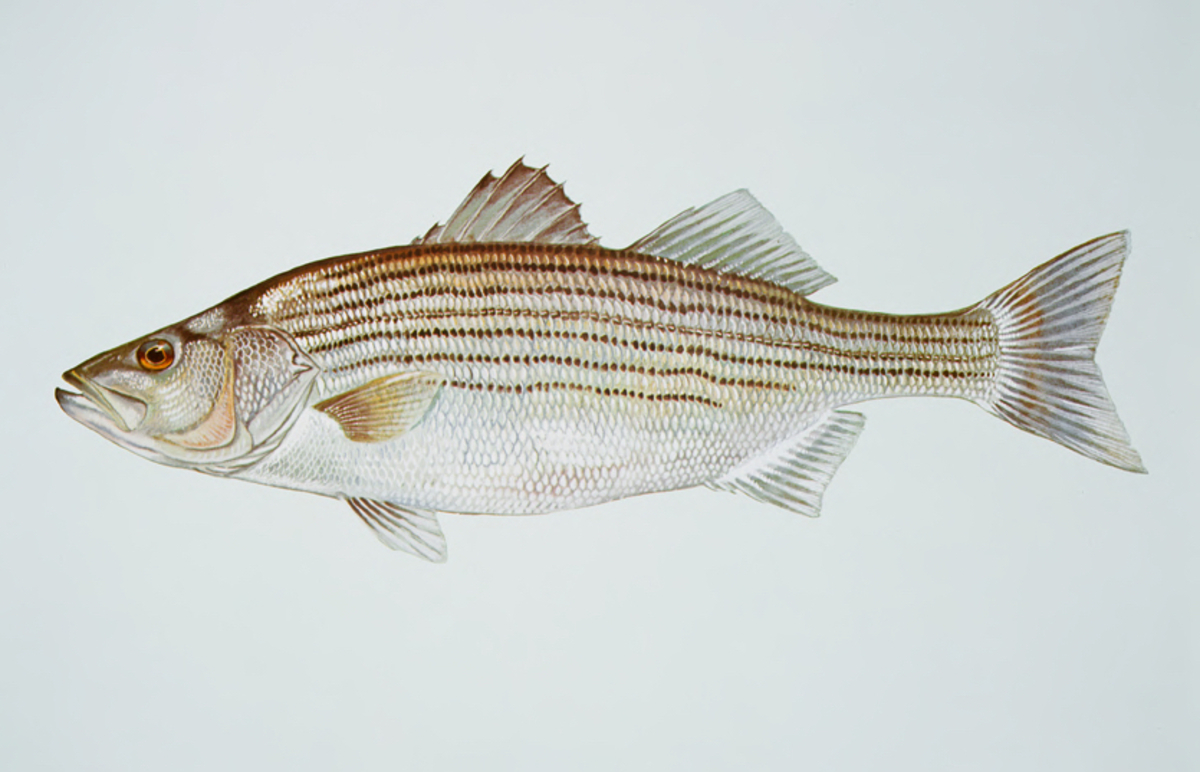
The target is striped bass, Morone saxatilis, a fish native to Atlantic coastal systems and introduced into Texas reservoirs. Possum Kingdom supports a stocked population. Do not apply the sea-run migration of a coastal striper directly to this landlocked fishery.
Stripers are relatively slender with several strong horizontal stripes extending toward the tail. White bass are deeper-bodied and have fainter striping, while hybrid striped bass can have broken lines and a deeper profile. Check the full combination of features, including the official identification guide, rather than identifying every small striped fish as a young striper.
Adult striped bass eat fish, particularly shad. Small juveniles and large adults do not necessarily use identical prey or depth. A cloud of tiny bait on a screen may contain useful food, but it does not prove that the larger marks beside it are stripers. One caught fish provides much better species evidence than a promising sonar shape.
Search the lake as connected depth bands
Possum Kingdom lies on the Brazos River west of Fort Worth. Its rocky margins, points and drop-offs offer a framework for finding bait near a depth change. The deeper lower lake and shallower upper areas should not be treated as one uniform habitat. Use the official lake page and chart to choose a manageable circuit rather than driving the whole reservoir at fishing speed.
Possum Kingdom State Park is a verified public access option. Confirm current ramp conditions and the route from your launch. A named park provides access planning, not evidence that today's fish sit immediately outside it.
Begin with a point and adjacent open-water slope, then compare a nearby channel edge. As a starting search, inspect approximately 15–40 ft of water, adjusting shallower or deeper when bait tells you to. Do not descend to the deepest water merely because it exists. If fish are feeding higher, stay with that level.
Birds actively diving on bait are worth investigating; birds resting on water are weaker evidence. Approach from outside the activity, stop short and cast or drift into its edge. Running the boat across the center can scatter the feeding opportunity and interfere with other anglers.
| Evidence | First approach | Target level | Reason to change |
|---|---|---|---|
| Bait driven near surface | Cast paddle-tail | Just below visible activity | Fish sound or stop chasing |
| Compact bait with fish beneath | Vertical spoon | Through and slightly above marks | Lure never meets targets |
| Fish holding a defined band | Live shad downline | At or just above that band | Bait weak or line angled far away |
| No bait on two passes | Move to next feature | New depth range | Avoid fishing a blank screen indefinitely |
Tackle for contact and control
A 7 ft medium or medium-heavy rod with a 3000–4000 spinning reel, or a suitable baitcasting outfit, covers many artificial presentations. Start with 15–20 lb braid and 12–20 lb leader about 4–6 ft long. Increase abrasion resistance where necessary, but do not let a thick leader ruin a small lure's action.
For a live downline, a medium-heavy outfit with a smooth drag and sufficient line capacity is useful. Match the rod to the sinker as well as the possible fish. A light rod overloaded by a heavy sinker loses both sensitivity and safe casting ability.
Keep one lure ready to cast while inspecting sonar. Feeding fish can appear briefly, and a long re-rigging delay wastes the most useful observation of the morning. Organize hooks and sinkers so that you can change presentation without loose exposed tackle on the deck.
Assemble a live-shad downline
Slide a 1/2–2 oz egg sinker onto the main line, add a bead to protect the knot and tie to a swivel. Attach 3–5 ft of 12–20 lb leader and a non-offset circle hook, perhaps 1/0–4/0 depending on the shad. Select the hook by gape relative to the bait rather than the number alone.
Hook a healthy shad lightly through a location that allows it to swim normally, keeping the point exposed. A bait spinning continuously or struggling on its side needs replacement or re-rigging. Obtain and use bait under current local rules, and do not move live fish between waters.
Lower rather than throw this rig when fishing vertically. Stop at the chosen depth using marked line, a line counter or a measured reference. If targets are around 25 ft, begin slightly above them and adjust; a fixed amount of line released is not the same as vertical depth when the line angles away.
A circle-hook bite is handled by allowing sustained load and winding steadily. Do not strike sharply at the first vibration. If the rod remains bent and line leaves under controlled drag, guide the fish clear of other lines before changing boat position.
Fish a spoon through the correct band
Choose a compact spoon around 1/2–1 oz to begin, within the rod's rating. Tie it to the leader using the recommended connection and check the hook and split rings. Silver or a pale baitfish finish is a reasonable first trial because the presentation is intended to resemble small fish; a contrasting finish is a comparison, not a magic cold-weather color.
Lower it to the target band, lift it perhaps 1–3 ft and follow its fall without allowing an uncontrolled heap of slack. Alternate that action with smaller lifts and pauses. A fall that stops unexpectedly can be a bite; reel into contact and lift firmly rather than making a violent strike.
Keep the boat sufficiently controlled to avoid dragging the spoon far behind you. If the lure repeatedly touches bottom while targets remain suspended, shorten the amount of line out. A vertical spoon is valuable because you can repeat a level accurately, not because it must always bang the lake bed.
Cast a paddle-tail to travelling fish
Thread a 3–5 in paddle-tail straight onto a 1/4–3/4 oz head, matching the hook to the body. Cast beyond the edge of feeding activity and count down before a steady retrieve. Begin with the lightest head that reaches the feeding band without excessive delay.
Hold the rod at a consistent angle and note the countdown and winding pace. When a fish bites, repeat those settings before changing color. If the lure tracks too high, allow more sink time or add weight; if it scrapes bottom constantly, reduce either. A slightly slower retrieve can deepen the lure while still keeping the tail working, depending on the lure.
Avoid casting directly over another boat's lines or through diving birds. If surface feeding disappears, inspect beneath the last activity rather than assuming every fish has left. A spoon or downline may now be more effective than repeated casts across empty surface water.
A worked half-day
Spend the first twenty minutes searching two connected features for bait. Keep the paddle-tail ready, but do not stop at every isolated sonar mark. Once you find a repeatable bait band, mark its edge and make a short controlled pass with the spoon.
If fish follow or show interest without taking, compare a quieter lift and a longer pause. If they remain at a stable level, try the downline with fresh lively bait. If neither produces evidence after a reasonable series of presentations, change feature rather than leaving six identical rigs in unproductive water.
After a catch, record the species, depth and exact presentation stage: steady swim, falling spoon or loaded downline. Repeat that pattern on one similar feature. If the lake becomes too rough for accurate control, shorten the circuit into sheltered water or end the boat session.
Brief rules and handling
Check TPWD's current statewide and lake-specific guidance for licensing, retention and bait use before the trip. The current lake page directs anglers to statewide regulations, but an old survey's historical limit is not today's rule. Do not use Texoma's special striper limit here.
Keep fish handling brief and support larger fish properly. For released fish, choose practical tackle and depths that avoid unnecessarily prolonged fights and difficult releases. Wear a suitable flotation device and keep the return route within the boat's capability.