Watch the water beside the bank
The Ash Pit Road side of Lake Rerewhakaaitu in the Bay of Plenty gives a shore angler room to test shallow water before reaching for a long cast. Start from an authorized piece of bank at the Department of Conservation reserve. Watch where ripples meet smoother water and where the visible bottom disappears. A trout looking for insects or following smelt can move along that transition. Choose a position where you can bring a lure along it and lift the hook over the shallows at your feet.
During spring, trout can cruise the lake's margins looking for smelt or insects. A shallow shelf with a clean outside edge is a reasonable first test. Treat shallow water as several lanes. Open water beyond the outer edge of plants fishes differently from a pocket inside the growth. A dark patch could be depth or weed. Retrieve a lure high on the first pass to distinguish them. If it returns with vegetation even on that high pass, change your cast angle or fish a clearer opening before adding weight.
Identify the fish and read the forage
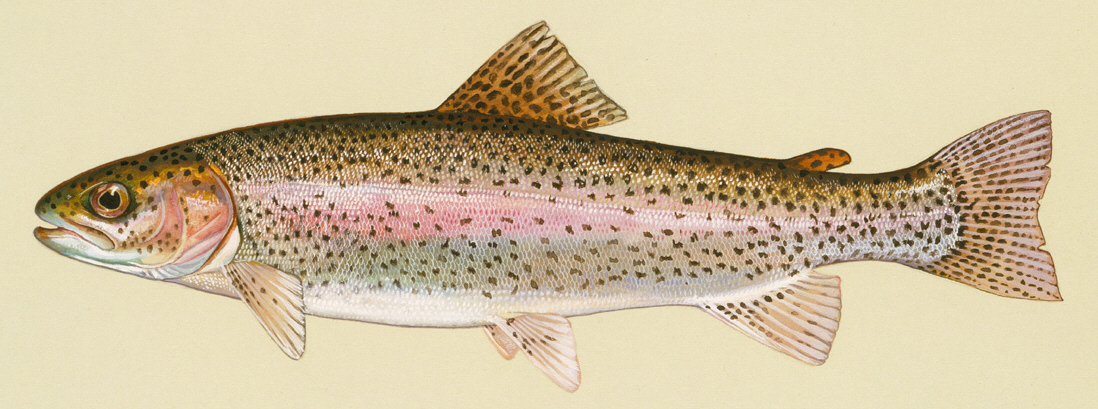
Rainbow trout, Oncorhynchus mykiss, is native to western North America and introduced to New Zealand. Dark spotting often extends onto the tail, and many fish have a pink band down the side. Brown trout generally show a different body spot pattern and less distinct tail spotting. Colour varies widely, so compare more than one feature. Release a fish you cannot identify with confidence.
Young rainbows often eat insects and other invertebrates, while larger fish can also hunt small fish. In this lake, smelt and insects are plausible targets in the spring shallows. A narrow lure is worth trying when you see small fish scattering. A quiet rise that repeats along one line suggests spending more time with a fly in that layer. One splash is less informative than repeated activity in a specific lane. Even if a rise turns out to be a different fish, it is evidence to look more closely at the water.
Low light lets you approach the edge with less disturbance. In bright conditions, look for a ripple line or try slightly deeper water if you can stay above vegetation. Wind can push insects toward shore, but a headwind that prevents you from feeling the lure makes that position a poor practical choice. During early summer, try a cool morning or a period of cloud and choose a lane with visible life. Warm water can shift fish away from the margin. Treat those conditions as a reason to try a location, not as a timetable.
Keep a spoon above the vegetation
A 6½ to 8 ft light spinning rod and a 2000 to 2500 reel work well for this starting setup. Try 6 to 8 lb braid and 1 to 1.5 m of 4 to 8 lb mono or fluorocarbon. Four to six pound mono straight through is an alternative if the casts are short. Choose a narrow 3 to 7 g spoon about 30 to 55 mm long. Fit a compatible single hook if the current rules and lure design allow. Tie directly to the lure ring or use a small snap and test the action within sight.
Cast across a clean strip at an angle. Close the bail and start winding immediately on the first pass. Repeat at the same angle after a short count. This compares two depths without pretending the count measures exact metres. Reel just fast enough to maintain a wobble. Silver or a subdued baitfish finish is a starting choice where you see smelt. A dark back can define the outline against glare. Test colour only after you know the lure swims well at the chosen depth.
A fish following the spoon may turn away at the shallow end of the retrieve. Give it a short change of speed a few metres earlier so it has room to follow. Watch for a line flick or sudden weight when the lure slows. Take up slack and sweep, letting the rod cushion the run. Repeated ticks at exactly the same distance are more likely to be bottom or plants than a fresh fish on every pass. Raise the rod or begin winding sooner and see whether the ticks disappear.
Hold a fly in the lane longer
Use a 5 or 6 weight fly rod with a floating line and a tapered leader around 9 to 12 ft. Finish with 4 to 6 lb tippet and a size 8 to 12 single-hook streamer such as a small olive Woolly Bugger or a sparse smelt pattern. Use a lightly weighted fly over a deeper clean edge. An unweighted fly stays clear of weeds longer on a shallow shelf. Keep the leader compact enough to turn over in a breeze and make a cast you can repeat without touching the bank behind you.
Cast along the outside of the margin. Let the fly settle briefly, then retrieve with short strips and a pause. Keep the tip close to the surface and take up excess line so you can feel a take. A line that stops or pulls away deserves a short strip and a lift of the rod. If the fly fouls the plants on every pause, shorten the pause or use a lighter fly. When fish are rising to small insects and ignore the streamer, a size 12 to 16 nymph under a small indicator with about 45 to 90 cm between indicator and fly gives another controlled layer. Adjust from observed depth and activity.
| Observation | Starting method | Change first |
|---|---|---|
| Smelt scatter along an open edge | Narrow spoon with a short count | Test one deeper pass |
| Trout follow and turn | Slow streamer on floating line | Pause before the shallow shelf |
| Quiet rises repeat in one lane | Small nymph under an indicator | Change depth in small steps |
| Spoon fouls on the return | Higher tip or earlier retrieve | Move a little for a cleaner angle |
Work two different shore lanes
Start with a 4 g spoon and a 6 lb leader along one clear strip before the sun is high. Compare a prompt retrieve with a short count. If you see a follow or get a bite, repeat the angle and speed before changing either. If the lure comes back clean but there is no activity, move a few paces to a different lane. When several fish rise beyond the weed and the spoon passes through too quickly, switch to a floating line and a size 10 streamer. Work it slowly enough to notice a change in the line. If the fish move higher, try the nymph under a small indicator. Spend the remaining time on the lane where you saw or felt a sign. That approach gives you a basis for the next cast even on a quiet morning.
Compare a change in depth with a change in light
Cloud passing over the lake can make the same edge look different within minutes. Keep one workable angle and repeat a known retrieve when the light changes. If a fish appears on that pass, the water already held a fish or the light made the route more usable. Either way, you have a reason to repeat the lane. If the wind pushes the line into weed, a switch to a heavier spoon may still leave it buried at the end of the cast. Turn along the shore or shorten the cast before increasing weight. With a fly, use fewer false casts over the shallow strip so the first presentation can reach any fish already near the bank.
Local rules and handling
Use the current Fish & Game Eastern sports fishing rules for Lake Rerewhakaaitu and carry the appropriate licence. This plan uses fly and spin methods. Check lake-specific conditions and DOC access before going. Keep casts clear of swimmers and release fish promptly in wet mesh.