
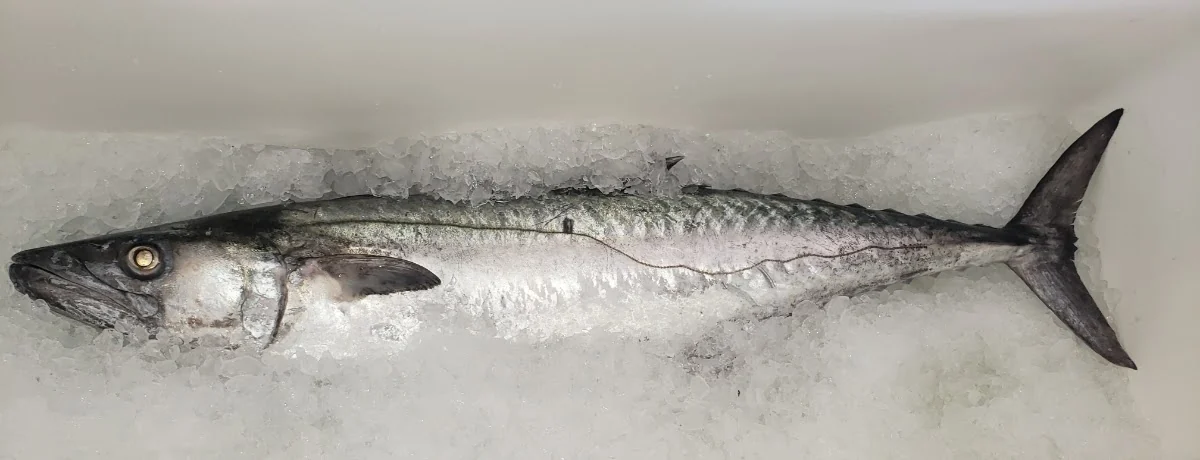
Keeping a fish for food changes the job at the moment of capture. The next objective is no longer presentation or another cast; it is to confirm lawful retention, end handling efficiently, remove heat and keep the catch protected from contamination. A cooler containing some ice is not automatically a cold chain. A working cold chain is a sequence with enough cooling capacity, clean surfaces, drainage, temperature checks and a plan for the trip home.
Food-safety authorities provide the boundaries. The U.S. Food and Drug Administration advises putting seafood on ice or under refrigeration promptly and keeping refrigerated seafood at 40°F or below. USDA guidance likewise uses 40°F or below and gives raw fish and shellfish a short refrigerated life, commonly one or two days before cooking or freezing. The exact quality curve varies with species, fish size, handling and starting temperature, so this guide treats those limits as ceilings, not promises.
Decide what will be kept before departure
Start with current fishing rules and health advisories for the exact water. Identify the species, season, size method, bag limit and any vessel limits before setting a hook. Check consumption advisories separately; a fish can be lawful to retain yet subject to meal advice for a particular population or waterbody.
Write a keep list and a release list. Include a conservative maximum number based on what the household can cool and use, not merely the legal bag. A limit is the most the law allows, not a harvest target. If the fish is uncertain, out of season, outside the lawful size range or beyond the cooler’s capacity, release it promptly using current local guidance.
Build the cooler as a system
Choose a clean, food-use cooler with enough room for the whole intended catch and ice around it. Long fish should lie straight rather than be forced into a warm arc with the tail exposed. If the cooler is too short, change the target or provide a lawful, sanitary alternative; do not assume a small drink cooler can manage a large catch.
A practical starting setup for a day trip is:
- a pre-chilled cooler rather than a sun-heated empty box;
- sealed drinking water and food kept in a separate compartment or cooler;
- clean ice from potable water;
- a drain that can be managed without letting fish sit in warm, dirty meltwater;
- a waterproof thermometer placed where it reflects the catch compartment;
- clean gloves, a washable board, a dedicated knife if processing is lawful, and sanitizer used according to its label;
- heavy bags or food-safe liners for transport, without using a sealed bag as a substitute for cooling.
Ice quantity cannot be a universal number. Air temperature, sun, cooler insulation, trip length, fish mass and how often the lid opens all change the load. Begin with enough ice to surround the expected catch and retain a visible reserve at the end of the trip. Record what remains. On the next similar trip, add capacity if most ice melted or the thermometer approached 40°F. This feedback loop is more reliable than a fixed “one bag” rule.
Why rapid cooling matters
Fish muscle begins changing immediately after death. Warmth speeds enzyme activity and microbial growth. A large fish also carries heat internally; cooling only the skin leaves the center warm. Crushed or flake ice makes more contact with an irregular body than a few large cubes, so it removes heat more evenly. Michigan Sea Grant specifically notes the contact advantage of flake ice for sport-caught fish.
Oily fish such as mackerels and tunas can develop quality defects quickly when warm, while lean fish such as cods and flounders have different storage characteristics. Those categories do not replace species-specific advice. The working decision is the same: chill promptly, keep cold and shorten storage when conditions were poor.
A slurry of ice and clean water can increase contact, but it is not automatically appropriate everywhere. Water source, species, bleeding or gutting practices, local rules and cross-contamination all matter. Use a method recommended for the target fish and jurisdiction. Do not add harbor or marina water to a food cooler simply because it is nearby.
The landing-to-ice sequence
1. Identify and measure with the current rule method while the fish is controlled. If it is not clearly legal and intended for food, release it. 2. Dispatch a retained fish promptly and humanely using a method appropriate to the species and local law. Avoid a prolonged photo session. 3. Bleed or gut only when recommended, lawful and safe for that species and location. Some ramps or waters restrict fish cleaning or require the fish to remain identifiable until landing. 4. Rinse only with clean, suitable water. Dirty deck wash can add contamination. 5. Bury or surround the fish with ice so the belly and thick shoulder area are cooled, not merely the tail. 6. Close the lid. Log the time and cooler temperature. 7. Recheck after a hot run, a long stop or repeated lid opening. Add clean ice before the cold reserve disappears.
This sequence separates regulatory verification from food handling. It also prevents a common error: putting an unmeasured fish on ice and later discovering that it should have been released.
Cooler decisions by condition
| Condition | What it means | Starting response |
|---|---|---|
| Ice remains abundant and catch compartment is at or below 40°F | Cooling reserve is still working | Keep the lid closed and continue monitoring |
| Ice is mostly water but temperature remains cold | Reserve is shrinking and heat load is rising | Drain as appropriate and add clean ice soon |
| Fish center is still warm after surface icing | A large thermal mass is not cooling fast enough | Improve ice contact, shorten the trip, seek species-specific processing advice |
| Food, bait and catch share leaking packages | Cross-contamination risk is increasing | Separate compartments and clean affected surfaces |
| Time or temperature history is unknown | Safety cannot be reconstructed from appearance | Treat uncertainty conservatively; do not taste-test questionable fish |
Smell, color and firmness help assess quality but cannot prove safety. When the cold history is unreliable, the decision should not depend on optimism.
A worked six-hour boat plan
The evening before, clean and air-dry the cooler, freeze sufficient potable ice and check the thermometer. At launch, pre-chill the fish compartment, verify the day’s rules and set a household harvest cap below the legal maximum.
During the first drift, one person handles rods while another controls the cooler. A lawful retained fish is measured, recorded, dispatched and iced immediately. The catch compartment stays closed while the crew fishes. At the two-hour mark, the cooler manager reads the thermometer without leaving the lid open and confirms that ice still surrounds the catch.
If the forecast becomes hotter or the ice reserve falls faster than expected, the crew shortens the route instead of adding more fish. At the ramp, the catch goes directly into a cold vehicle compartment, not onto a warm dock for an extended display. At home, the fish is processed on clean equipment. It is cooked or frozen promptly within current food-safety guidance, and the cooler, drain and tools are washed and dried.
Common failures
“On ice” may mean a warm fish resting on top of a thin layer while sun heats the lid. Correct it by surrounding the fish and measuring temperature. A beverage cooler opened every few minutes cannot hold a stable fish temperature; separate it. Reusing bait ice for food fish mixes purposes and contamination. A sealed plastic bag keeps meltwater out but can also reduce direct cooling contact; pack it deliberately, not automatically.
Another mistake is treating the legal bag limit as cooler capacity. Five large fish may overwhelm the ice that easily handles one. Stop harvesting when the cooling system is full. Photographing a retained fish is not itself harmful, but the sequence matters: quick documentation, then cooling.
Do not assume cleaning at sea is permitted. Many regulations require species to remain in a condition that officers can identify or measure. Do not discard carcasses at a marina or shore station unless local rules and facilities allow it.
Practical gear ranges
For a small day boat, a 40- to 80-quart insulated cooler can be a planning range for modest catches, but fish length and heat load matter more than the label. A compact digital refrigerator thermometer should be readable without prolonged lid opening. Use clean ice in small pieces for contact and larger frozen blocks or bottles as reserve only if they do not crowd fish out of the cooling zone.
These are starting suggestions, not official requirements. Test the actual setup on a no-catch day with water containers approximating fish mass, direct sun and realistic opening frequency. If it cannot remain at or below 40°F through the planned duration, increase insulation or ice, shorten the trip or reduce the harvest plan.
Prepublication checklist
- Geography: pass — U.S. food-safety boundaries are identified; fishing and cleaning rules are explicitly local.
- Habitat and structure: not applicable — the article covers post-harvest handling rather than fish location.
- Forage: not applicable — no feeding claim is needed.
- Methods: pass — landing, verification, dispatch, cooling, transport and home storage form one sequence.
- Lures and presentation: not applicable — harvest method is outside the cold-chain decision.
- Examples and table: pass — a six-hour boat plan and temperature-condition table are included.
- Sources: pass — FDA, USDA, FoodSafety.gov, Michigan Sea Grant and FAO guidance were checked on 26 October 2026.
- Local rules: pass — identification, measurement, cleaning and possession are deferred to current regulators.
- Image match: pass — the unused registered owner photograph visibly shows a whole retained fish against crushed ice; species and place are not claimed.
- Ethical handling: pass — retain only lawful usable fish, cool promptly and stop when capacity is reached.