
Río Pescado offers a useful reason to learn three fly presentations rather than carry three unrelated kinds of tackle. A streamer searches moving or open water, a nymph slows the approach near a holding lane, and a dry fly becomes worthwhile when you can see fish feeding upward. The method should follow the fish's position and food.
This is a plan for the authorised season beginning 13 November 2026, not a recommendation to fish the river or its mouth during the earlier restricted period. The local setting and rules are verified separately from the practical tackle suggestions below. No current catch rate, guaranteed hatch or personal field experience is claimed.
Identify rainbow trout carefully
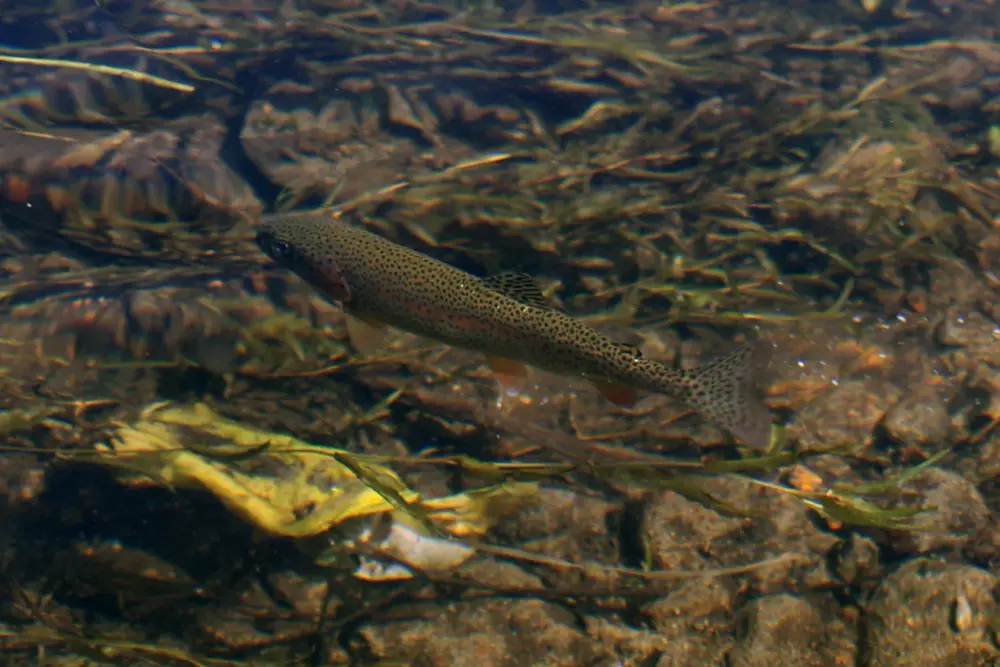
Rainbow trout, Oncorhynchus mykiss, often show dark spotting over the tail and body, a pale mouth and a pinkish lateral band. Colour varies with habitat and condition; a silvery fish is not automatically a coho or Atlantic salmon. Brown trout and several salmon species make identification important in this region.
Use a proper salmonid identification reference and inspect several features together. Do not treat a faint stripe as enough evidence to keep a fish under another species' allowance. A rainbow and an anadromous steelhead are the same species, but appearance alone does not prove that an individual has lived at sea.
Rainbow trout eat aquatic and terrestrial insects, with small fish becoming more important as they grow. That biology supports a nymph, streamer or dry-fly comparison. It does not establish the precise prey being eaten in Río Pescado today. Observe insects, rises and follows before choosing a pattern.
Put the river and lake on separate maps
Puerto Varas municipal tourism identifies Río Pescado east of Puerto Varas on Route 225 and describes a fishery associated with the river's entrance to Lake Llanquihue. That confirms the place and fishing context; it does not override current fisheries restrictions.
The river, its tributaries and the zone extending 1,000 m around its mouth have a specific fly-fishing rule. Elsewhere on Lake Llanquihue, different provisions apply. Do not stand near the mouth with a general lake rule in mind and assume it authorises a spoon or bait rig.
Arrange a permitted bank route with the landholder or a local guide. A road beside the water does not grant access across every fence. Choose a manageable stretch with secure footing and a clear landing area, rather than planning to wade the deepest or fastest water.
Read a small section thoroughly
Start from the bank and identify a moving tongue, its slower margin and any visible depth or cover change. A trout can hold beside the main current while taking food from it. The strongest flow is not automatically the best place to put the fly.
Where the river broadens, compare the near edge with the outer seam. Where it approaches lake water, treat the change in current as a presentation problem: your fly may slow, sink differently or begin swinging toward the bank. Do not assume a visually quiet lake edge is shallow.
| Water or evidence | First method | Presentation aim | Next change |
|---|---|---|---|
| Defined current seam | Single nymph | Drift through the feeding lane | Alter weight or angle |
| Deeper pool edge | Small streamer | Swim above the obstruction level | Count down longer |
| Slow margin beside moving water | Light nymph | Avoid towing the fly too fast | Mend earlier |
| Repeated surface rises | Single dry fly | Reach fish without leader drag | Change cast position |
| Following fish in clear water | Smaller streamer | Slow the final movement | Pause before accelerating |
These are general holding and feeding mechanisms, not claims about a surveyed pocket beside a named property.
A useful single-rod outfit
A 9 ft 5- or 6-weight fly rod, matching floating line and a reel with a smooth drag provide a flexible starting outfit. A 6-weight helps with a slightly larger streamer or wind, while a 5-weight can make small-fly work more comfortable in suitable conditions.
Use a tapered leader around 2.7–3.6 m long. A terminal section around 4X–3X is a starting range for nymphs or modest streamers, with a suitable lighter section for small dry flies when the conditions allow. Match the actual tippet diameter and strength to the fly, fish and obstacles rather than relying on the X label alone.
Carry a landing net and one small fly box containing different weights as well as shapes. This plan uses one single barbless hook at a time. It does not require a tandem dropper, bait or a treble-hook lure.
Streamer rig: search without scraping bottom
Tie a size 8–12 single-hook streamer to the leader, using a small slim pattern that the rod can turn over cleanly. Start lightly weighted in shallower water. A darker profile or a restrained olive/brown pattern offers useful contrasts; compare them against actual visibility rather than treating colour as a local certainty.
Cast across and slightly upstream when you need sink time. Allow a controlled count, then keep the fly swimming with short strips or a gentle swing. Follow the line with the rod while avoiding a large loose loop.
In slower water, a short strip followed by a pause can keep the fly in the lane longer than a continuous retrieve. In stronger current, the water provides much of the movement. Additional fast stripping can pull the fly away before a fish can respond.
If the fly catches bottom on each cast, reduce weight or shorten the sink. If fish follow near the surface but turn away, try a smaller pattern and a quieter final movement. Tighten into a take with line control and a firm low lift, then let the rod absorb the fight.
Nymph rig: make the drift believable
For a slower bottom-oriented presentation, tie one size 12–16 nymph to the leader. Select its bead or built-in weight for the water, beginning light enough to avoid repeated snagging. A small removable indicator can help in a suitable lane, but it should not be so large that it prevents an accurate cast.
Begin with the indicator-to-fly distance as a practical estimate of the working depth, then adjust after observing the drift. The line's angle means this distance is not an exact measurement of how far below the surface the fly travels.
Cast a little upstream of the holding lane, lift unnecessary line off conflicting currents and mend early. The aim is for the indicator and fly to travel without an accelerating line belly. A brief stop, sideways movement or unexpected dip warrants a controlled lift.
If every drift hangs up, shorten the depth or reduce weight. If it passes too high, add a small depth adjustment before changing patterns. When fish refuse repeatedly, examine drag first: a familiar fly moving unnaturally can be less convincing than a simple pattern drifting correctly.
Dry fly: use visible feeding evidence
Choose a single size 12–18 dry fly that broadly matches the observed insect size and profile. No named hatch is guaranteed here. If fish are not rising and no insects are apparent, continue the subsurface search rather than declaring that a particular afternoon hour must produce a hatch.
Approach from a position that keeps your line away from the fish. Cast upstream or across with enough slack for a short natural drift, then recover before the fly begins dragging conspicuously. False-cast away from the feeding lane.
Allow the fish to take before lifting smoothly. A rushed strike at the first splash often removes the fly. If the fly repeatedly drowns, dry it, check the leader and reposition; repeatedly casting a waterlogged pattern does not test the dry-fly method fairly.
An illustrative November session
Before travel, confirm the season, local boundaries, licence and land access. At the water, spend a few minutes watching from a low position. Identify one current seam and one slower alternative.
Start with the nymph if there is no obvious surface feeding. Test a short drift, then adjust depth and angle while keeping the pattern unchanged. After a fair trial, use the streamer to search the pool edge or the next legal open section.
If a fish follows without taking, shorten the streamer and slow its final approach. If regular rises develop, switch to the dry fly instead of forcing the streamer into a surface-feeding situation. After two well-tested features with no response, move quietly to the planned alternative.
Keep notes on current speed, fly weight and whether the bite came during drift, pause or swing. Those details support the next visit without turning one session into an unsupported seasonal rule.
Brief local rules and care
Checked 28 October 2026: Sernapesca's management table puts Río Pescado, Río Sur, their tributaries and the 1,000 m mouth zones under a separate fly-only provision from the second Friday of November, 13 November 2026. Barbless artificial flies are required; the listed allowance is one rainbow trout, brown trout or silver salmon in total per fishing day, with other captures released. Check the full current table and your recreational licence before fishing; this guide plans voluntary release and avoids the earlier closed-mouth opportunity.
Use the specified suitable landing net, keep handling brief, clean gear against invasive-organism transfer and avoid forceful wading. The useful work is choosing the right lane and making one fly travel through it naturally.