
Rocky shore fishing becomes more understandable when you separate three questions: where you can remain and land a fish, which part of the structure is usable habitat, and how to carry a lure through that layer without dropping it into every crack. The best cast is often a short, repeatable one along an edge, rather than the longest cast toward open sea.
This guide concerns presentations beside rocky habitat from a suitable shore station. It does not identify a particular rock platform as safe. The regional fish examples come from the northeastern Pacific, especially Oregon; they are not species predictions for Europe, Australia or tropical reefs. Lure dimensions and practice sequences are editorial starting suggestions to adapt to local fish, water and rules.
Choose the station before choosing the lure
Check official swell, wind, weather and tide information as well as the site's access rules. A sheltered, permitted fishing platform with appropriate barriers may be a better choice than an exposed natural ledge. Height alone is not protection from waves, and a platform can create an impossible landing problem. Decide how a fish could be brought to a net and released without climbing down or leaning over an edge.
NSW Government's rock-fishing guidance stresses watching conditions, keeping a usable exit, wearing an appropriate lifejacket and suitable footwear, and fishing with others. It explicitly says no rock-fishing place is perfectly safe. Apply the relevant local requirements wherever you fish; an Australian safety recommendation is not a statement of Oregon law. Do not fish exposed rocks in dangerous conditions, and never descend to retrieve a snagged lure.
The equipment plan includes a suitable landing net, accessible pliers, a line cutter and a way to handle a fish without putting fingers near teeth or spines. If the only apparent landing method requires dragging a fish up a wall or entering breaking water, choose another station. Prepare these decisions before the first cast, while both hands and attention are available.
Look for edges, height changes and open routes
A jumble of rocks contains several different habitats. Crevices provide cover; a sloping face gives fish a range of depths; an isolated block changes the path of moving water; a sand pocket gives an opening beside harder ground. Kelp adds another layer, but a dense canopy may also obstruct your retrieve. The visible shoreline does not tell you every underwater contour.
Watch floating material from your station to estimate the surface direction. That is only a clue: a lure deeper down may move differently. Note whether the line will swing toward a corner, rub across a ledge or enter a gap on the return. Plan the whole retrieve, especially the last few metres, before casting beyond a feature.
Do not assume all fish associated with rocks sit on the bottom. Alaska's fisheries agency describes black rockfish feeding in schools within the water column, including on small fish and planktonic prey. NOAA describes adult lingcod as predators using rocky and vegetated habitat, eating fish as well as squid, octopuses and crabs. These different feeding positions support different presentations above the same structure.
Use the table as a set of testable choices
Each fish example below belongs to its stated Pacific setting. Presence does not mean legal retention, and closely related rockfish can have different protections. Confirm identification and current local rules before targeting or retaining a species.
| Structure or condition | Regional fish example | Food or holding reason | Method or lure | Presentation to test | Important limitation |
|---|---|---|---|---|---|
| Water above a rocky rise on the Oregon coast | Black rockfish | Schooling fish may feed on small fish and drifting prey above cover | Small paddle-tail or compact swimming jig | Begin in the upper layer; count down progressively on later casts | Repeated bottom contact is unnecessary for a suspended school |
| Lower edge of broken rock in the northeastern Pacific | Lingcod | Adult predators use rocky habitat and eat fish and other animals | Robust soft swimming lure with one suitable hook | Swim past the edge with controlled depth and a clear return route | Do not drop blindly into cracks or assume an open season |
| Base of accessible rocky structure in Oregon | Kelp greenling | Inshore structure is a useful search area; small marine baits are effective | Small bait or short worm imitation on an appropriate hook | Hold the offering close to the base without dragging across blocks | Small mouths make oversized bait and hooks a poor starting choice |
| Kelp beside a clean opening on the Oregon coast | Cabezon or other locally confirmed bottomfish | Kelp and hard ground provide habitat; the opening allows a presentation | Compact bait or a restrained single-hook lure | Test the open margin with a short controllable cast | Do not force a rig through dense kelp or infer species from habitat alone |
| Sand patch adjoining rock near an Oregon bay mouth | Sand sole or English sole where present | Sandy bottom offers a different habitat from the rock face | Small bait presentation | Keep the rig on the clean substrate and retrieve before it reaches rocks | A change of bottom can mean a different target and tackle requirement |
Build a lure set around jobs
For searching above structure, start with a soft paddle-tail around 70–100 mm on a suitable single-hook jighead, or a compact swimming jig. That range is a useful trial for modest coastal tackle, not a biological rule. The paddle tail gives a visible swimming action at a steady speed. A slimmer straight-tail can be useful when you want less tail movement or a subtler fall.
For a larger locally appropriate predator, a roughly 100–150 mm robust soft lure is another starting option, but only if the rod, leader, hook and landing plan suit the possible fish. A larger lure is not automatically a solution to small bites. Fish the size you can present and land responsibly rather than escalating tackle to pursue something you cannot handle from that station.
A shallow-running hard minnow suits a clear upper-water route. It can pass above irregular ground without repeatedly falling into gaps, although exposed treble hooks complicate weed, snags and release. Suitable single-hook configurations can simplify handling where legal and compatible with the lure's action. A compact metal lure suits a defined open-water lane, but its rapid fall can make it a poor choice directly above broken blocks.
For bait, use a small, secure offering matched to the target and hook rather than a large bundle. ODFW lists marine worms, shrimp, squid and herring among shore-fishing baits and recommends keeping many bottomfish presentations close to cover. The crucial distinction is close to cover, not buried inside it. Do not move live bait between waters or collect it without checking the applicable rules.
Map depth with a countdown, not repeated snags
Begin with a short cast into the clearest accessible lane. Close the bail and retrieve promptly, keeping just enough tension to see the line respond. On the next comparable cast, allow a brief additional sink before starting the same retrieve. Increase cautiously only while the lure remains clear of the rocks. The purpose is to compare layers, not to measure an exact depth in metres.
A four-count does not mean four metres. Lure shape, line diameter, wind, current and line angle all change the fall. Record the count alongside the lure and cast direction. If the lure touches something, start the next retrieve sooner or adjust the route; do not repeatedly hit the same obstruction to confirm it is there.
Use a steady retrieve first so changes are interpretable. Add short pauses only when you know there is room below. As the lure approaches the shore, raise the rod within a comfortable working angle and keep it moving over the near ledge. Avoid lifting a fish by the rod or bending the rod severely overhead. Rod position helps line control but cannot compensate for an unsuitable landing place.
Angle often matters more than extra weight
A cast across moving water may sweep into rocks that were never in the original landing area. A shorter cast angled along the cleaner side can keep the lure in useful water longer and make its return predictable. Watch where the line enters the water: a growing sideways bow signals that your intended route and actual route are diverging.
If contact becomes vague, first shorten the cast or reduce the cross-current angle. Then consider a modest change of lure weight within the outfit's rating. Excess weight can make the lure wedge faster without improving its swimming path. If no practical combination stays clear and controllable, abandon that lane. Losing more tackle is information that the presentation is unsuitable, not evidence of commitment.
Inspect the leader after abrasion or contact. Feel for rough sections carefully away from hooks, and replace damaged material. A tidy knot and sound leader matter more than a claimed universal breaking strain. Choose strength for the fish, structure and outfit, and do not wrap braided line around a hand when dealing with a snag.
A worked 60-minute session
Imagine a permitted sheltered Oregon shore station with manageable conditions, an open patch beside rocks, a reachable rocky edge and a planned netting point. The current rules and fish identification have been checked. The example aims to learn the upper and middle layers before considering a lower presentation; it is not an invitation onto a particular jetty or headland.
Spend the first ten minutes checking the wave pattern, exit, landing arrangement and line path. Make the first short casts with an approximately 80 mm swimming soft lure. Retrieve immediately through the clear lane, then repeat with a slightly longer countdown. Keep the lure and speed unchanged while testing depth.
During the next 15 minutes, compare two cast angles that finish in the same clear recovery lane. Note whether any follows, taps or visible baitfish occur above the rocks. If a fish follows without taking, try a modest speed change on the next cast before adding a new lure. If nothing responds, that is not proof that the bottom is the only answer.
Use another 15 minutes for a smaller or subtler presentation along the reachable margin, or a legal compact bait if that suits the intended species. Spend the remaining time repeating the most controllable route and checking the changing water level. Stop early if the exit, footing or landing plan deteriorates. Leave with a record of usable lanes rather than a tally of lures lost.
Troubleshoot without sacrificing the shore
Frequent snags call for an earlier retrieve, a clearer angle or a shallower-running lure. Weed on every cast calls for a different corridor. Missed taps call for checking hook exposure, lure alignment and whether the contact is repeatably in the same place; rocks can imitate bites. A fish that repeatedly reaches cover calls for reconsidering the tackle and station before another cast.
Identify and release unwanted fish promptly with wet hands and supported weight. Some rockfish taken from depth need specialized release procedures; consult the current local agency guidance before choosing such water. If you cannot provide appropriate handling from the station, avoid that fishing situation. Pack out damaged line and soft lures, and finish while leaving remains straightforward.
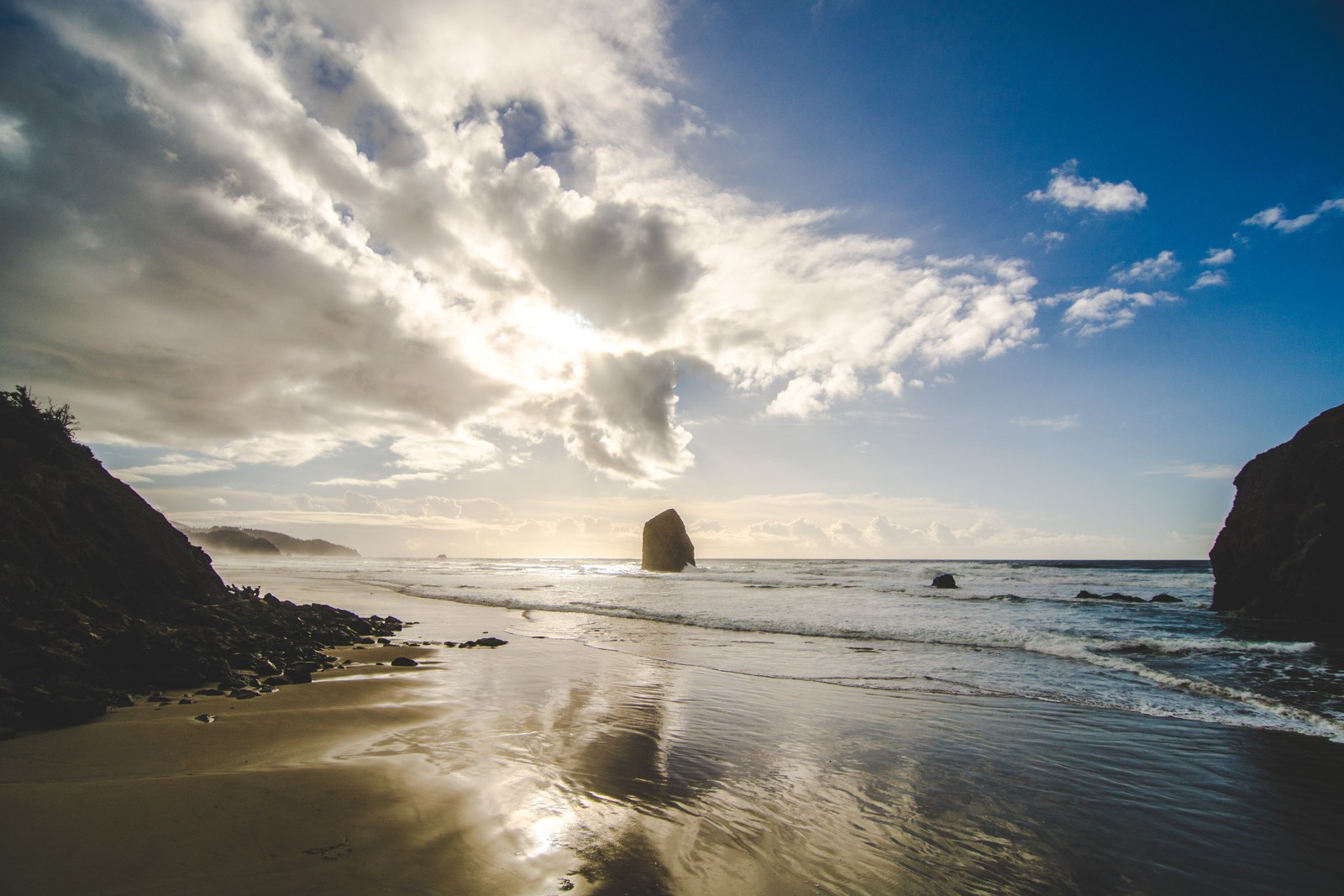
The cover shows rocky shoreline habitat. Its exact location and suitability for fishing have not been established; it is not a recommended standing place or evidence of conditions at an Oregon example site.