Why plan this trip now
Singapore’s reservoirs can be fished throughout the year, but the transition toward the wetter part of the year makes preparation more important than any claim about a guaranteed “season.” Short, intense rain can alter visibility and edge current, while lightning can end a session immediately. A sensible November–December plan therefore starts with a legal fishing zone, a compact artificial-lure kit and a willingness to stop when conditions change.
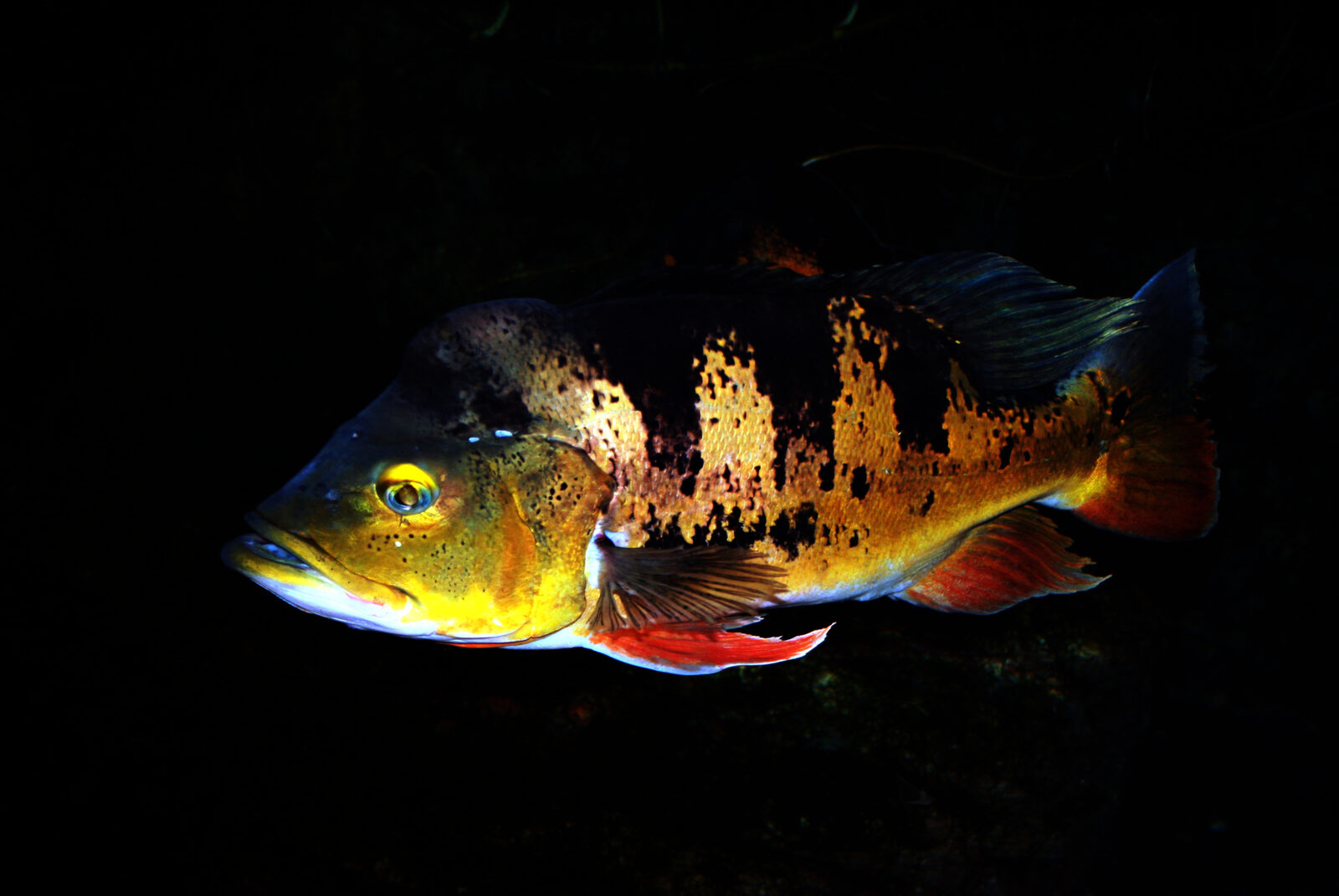
Peacock bass are visual, mobile predators. In reservoirs they may use shade, weed edges, drop-offs and man-made structure, but their position changes with light, disturbance and water clarity. Treat this guide as a repeatable search plan, not a promise that fish will be present at a particular railing or hour. The cover is a representative Cichla ocellaris photograph from an aquarium, not evidence of a Singapore catch.
Access and the non-negotiable rules
PUB’s current fishing page, checked on 24 October 2026, says fishing is permitted only within designated areas at 15 reservoirs and waterways. The zones are marked by signs and blue railings. Fishing outside them, or entering restricted waterways and embankments, can lead to enforcement and fines. PUB also requires artificial bait only and says fly fishing is not allowed. Check the live map before leaving because a familiar-looking bank is not automatically a legal fishing position.
NParks adds practical etiquette: keep away from boats and other users, do not stretch line across paths, use artificial bait and micro-barb or barbless carbon-steel hooks at reservoirs and waterways, dispose of line and hooks, and avoid harming wildlife. The agency encourages quick release when fish are not intended for consumption. If on-site signs are more restrictive than this guide, follow the signs.
Choosing a water and a small working area
Start with the PUB map rather than a species rumour. Lower Seletar, Kranji, MacRitchie, Upper Seletar, Bedok and other listed reservoirs have designated sections, but the exact legal footprint matters. Pick one water that is easy to reach and identify two or three legal subsections before the trip. On arrival, walk the rail first and note shade lines, inflows visible from the public zone, changes in bank angle and quiet corners away from heavy foot traffic.
Peacock bass often reward accurate casting more than long casting. A short stretch with two useful edges is better than roaming into an unsigned area. Leave space behind for pedestrians, and avoid casting across kayak or dragon-boat activity. If a position makes a safe back-cast or lure recovery impossible, move rather than improvise.
Tackle that suits confined public banks
A 1.8–2.1 metre spinning rod rated roughly 5–15 grams or 7–21 grams covers small hard lures and soft plastics without becoming awkward beside railings. Match it with a 2000–2500 size reel, 8–15 lb braid and a 10–20 lb abrasion-resistant leader of about 60–100 centimetres. The heavier end is useful around concrete, wood and dense vegetation; the lighter end improves action in open water.
Carry small minnow plugs, shallow crankbaits, compact topwaters, 7–10 centimetre paddletails and a few weedless soft-plastic hooks. Replace damaged hooks and flatten micro-barbs where necessary. Pliers, a rubber-mesh landing net, a damp measuring mat and a line cutter belong in the working bag. Avoid an oversized tackle box that blocks the shared path.
A search sequence instead of random casting
Begin with a quiet approach. Make parallel casts along the legal edge before casting toward open water. Work a shallow minnow with short pauses, then cover the same lane a little deeper with a paddletail. If the water is stained after rain, a lure with a stronger silhouette or vibration may be easier to track; in clear, bright conditions, a slimmer natural-coloured bait often looks less intrusive.
After five to ten deliberate casts at one angle, change either depth, retrieve speed or position. Do not change all three at once. A useful progression is surface or wake bait at first light, suspending minnow around shade, then a weighted paddletail counted down beside a drop. Peacock bass can follow without striking, so pause near the end of the retrieve and keep the lure in view until it clears the water.
Weather, lightning and drainage risk
Singapore’s Meteorological Service warns that lightning can occur even without rain directly overhead and advises people to seek a building or car, stay away from water and wait at least 30 minutes after the last thunder before resuming outdoor activity. A fishing rod is not worth testing against a thunderstorm. Stop at the first thunder, lightning alert or rapidly darkening sky; reel in, lower the rod and leave the exposed railing.
PUB also warns that interconnected canals can rise quickly after heavy rain upstream. Never climb into a canal, onto a wet embankment or beyond a barrier to retrieve a lure. Check the live rain and lightning information shortly before travelling and again during the session. Heat and humidity matter too: bring water, sun protection and a small towel, and schedule a break rather than fishing through fatigue.
Hooking, landing and release
Set the drag before casting. With braid, a controlled sweep is usually enough; an exaggerated strike can tear hooks free. Keep the rod low when a fish runs toward surface structure and guide it into clear water. A rubber net reduces contact time, but use it only where it can be deployed without leaning over a barrier.
Wet hands before touching the fish, support the body, keep it low over the mat and remove the lure with pliers. Do not suspend a peacock bass by the jaw while twisting its body. If a fish is deeply hooked, prioritise a quick, calm release and cut the leader when that is safer than prolonged manipulation. Photograph only if the fish remains supported and the entire process stays brief.
Common mistakes
The first mistake is treating any attractive shoreline as legal water. The second is using natural bait because it seems easier; PUB’s reservoir rule is artificial bait only. Other avoidable errors include casting over pedestrians, leaving clipped braid on the ground, fishing through thunder, and using a leader too light for abrasive concrete.
Technique errors are usually simpler: retrieving every lure at one speed, starting with long casts before checking the near edge, or repeatedly throwing a noisy bait at a fish that has already followed and refused. Rotate presentation thoughtfully and rest a visible fish rather than harassing it.
A practical half-day plan
The evening before, confirm the PUB zone map, weather outlook, lightning page and transport. Rig one rod with a shallow minnow and carry a paddletail ready to change. Pack water, pliers, line cutters, a rubber net and a small rubbish bag.
Arrive near first light, inspect the signs and spend ten minutes watching the water. Fish the near edge for 20 minutes, then work two deeper angles. Move once to a second legal subsection if there is no activity. Take a weather break after about 90 minutes and finish before heat, crowds or storms make the shared space uncomfortable. Record water clarity, lure depth, follows and weather in a log; those observations are more useful than an unverified catch report.
Conservation and final checks
Peacock bass are not native to Singapore, but that fact does not remove the obligation to follow current local rules or treat individual fish responsibly. Never move live fish between waters, release aquarium fish, damage vegetation or disturb otters and birds. Keep the bank cleaner than you found it.
This guide was reviewed against PUB, NParks and Meteorological Service Singapore sources on 24 October 2026. Rules, maps and closures can change. Recheck the official zone map and on-site notices on the day, and stop immediately if weather or access makes the session unsafe.