
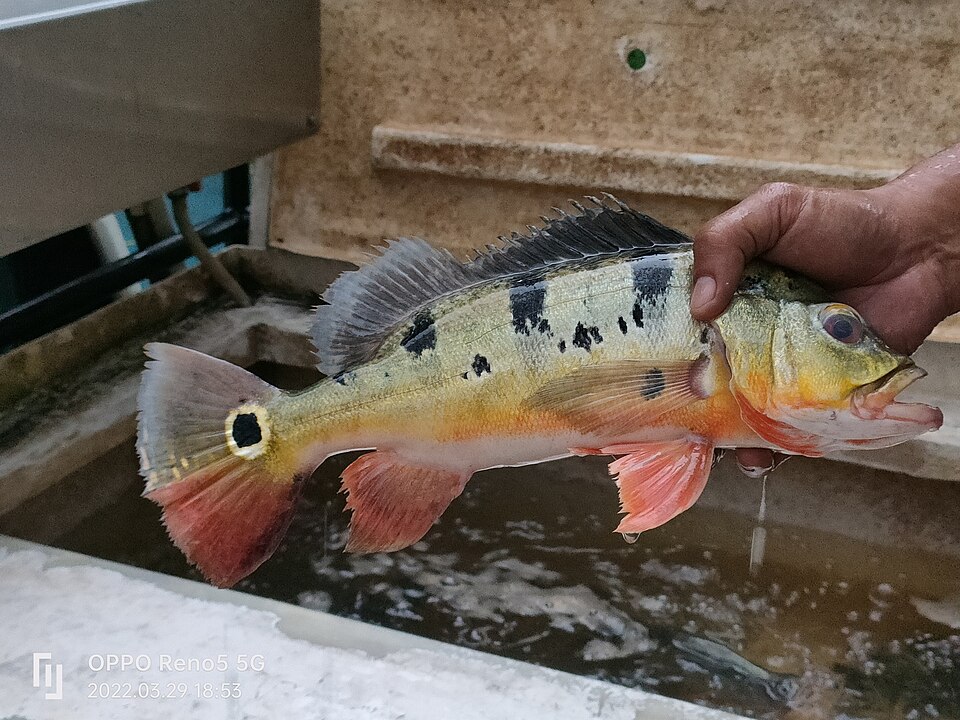
Butterfly peacock fishing rewards an active daylight search. In Miami's canals, the first useful question is where a small fish could be intercepted: beside a shaded wall, outside a fallen branch, or where a narrow side canal opens into wider water. Cover those edges with a minnow-shaped lure, then use a live shiner or slower jig to examine a promising holding place more carefully.
Snapper Creek, the C-2 canal, gives this approach a defined setting. This guide separates documented fish biology and access information from practical starting suggestions for tackle, casting and session timing. The suggested numbers are adjustable working ranges, not local survey measurements or guaranteed feeding windows.
Know the target
Butterfly peacock, Cichla ocellaris, is a cichlid despite commonly being called peacock bass. It is native to South America and was introduced into southeast Florida. The strongest established fishery is associated with warm coastal canals in Miami-Dade and Broward, rather than every freshwater waterbody in the state.
Typical markings include three dark vertical bars and a black tail eyespot surrounded by a gold-coloured halo. Colour and bars can fade in older fish. Compare that combination with the whole body shape: Mayan cichlids generally have more numerous bars and a more rounded, compressed outline. A tail spot alone is not enough.
Butterfly peacock feeds predominantly on fish and is a daylight hunter. Small fish imitations and live shiners therefore have a stronger biological rationale than assuming a largemouth-bass worm presentation will transfer unchanged. Deep pits and connected canals can provide refuge, while shade, bends and shoreline cover create places where prey and predators meet.
Use a real access point, then choose fishable edges
The published Snapper Creek angler guide identifies a boat ramp on Snapper Creek Drive North before SW 99th Avenue, reached from the SW 97th Avenue side. The canal connects with Tamiami Canal. Verify current ramp availability, parking and navigation conditions before travelling: the brochure describes the access network, not a live inspection.
For bank fishing, select a lawful public access section with a clear landing position. A mapped canal bank is not automatically a public right of way, and a bridge is not permission to fish from its traffic lanes. A boat can reach more intersections, but it also introduces navigation, boat-control and landing decisions. Keep clear of water-control structures and obey their posted exclusion areas.
The canal has variable width and depth, so avoid assigning one countdown to an entire outing. Begin at a near-bank feature you can work from several angles. Search the outside of cover before dropping a lure into it. Casting straight into a fallen tree may contact a fish but leaves no clean route to bring it out.
Choose one intersection or bend, one shaded straight bank and one more open reach. Those contrasting places make a short session more informative than fishing three nearly identical spots. Look for small fish, followers or surface movement, but remember that an apparently empty surface can conceal fish below it.
Plan for cooling weather without inventing a peak
This is a useful approaching-winter preparation plan, not a claim that December or January is the year's best peacock season. Butterfly peacock is cold-sensitive. A warm, stable spell may allow normal searching; after a cold front, begin with a slower presentation near accessible deeper water and be prepared for a poor response.
Daylight is a stronger starting constraint than an exact hour. If glare prevents you seeing cover, change your angle or use shade rather than treating noon as automatically unproductive. Wind can disturb the surface and push a line bow into the canal, making a light jig seem to stop sinking. Reduce cast length before concluding that the fish have moved.
Use visible water movement to control presentation. A sheltered dead end calls for deliberate coverage; an intersection with flow may let a bait swing past an edge. Water-management flows are not a marine tide timetable. Watch the actual direction and speed where you are fishing.
Assemble a versatile outfit
For ordinary open canal margins, a 6½–7 ft medium spinning rod, 2500–3000 reel and 10–15 lb braid are practical starting choices. Add approximately 60–90 cm of 12–20 lb abrasion-resistant leader. Use the heavier end near rough walls and wood, and adjust the rod and line to the cover rather than chasing the lightest possible tackle.
Tie the leader with a knot you can reproduce reliably and test it under steady pressure. Examine the last section after every contact with concrete or a branch. A stronger leader cannot compensate for a visibly abraded knot. Set the drag to give line on a hard surge while retaining enough control to steer a fish away from cover.
Carry a landing net with enough reach for the chosen bank. Keep a modest lure selection: a shallow minnow, a sinking jig and, if conditions justify it, a small surface lure. Depth control matters more than carrying many near-identical colours.
Live shiner: free line first, float when needed
Start with a small purchased golden shiner, a size 1–1/0 single circle hook and the leader already described. Hook it lightly through the upper lip without obstructing the hook gape. Match the hook to the bait's size; a heavy hook can overwhelm a small shiner. Use legally sourced bait and do not transfer live fish between waters.
In calm, open water, omit the sinker. Make a gentle underhand placement beyond the edge and let the bait swim with enough slack to move, but not enough to reach a snag unnoticed. Follow the line. If the shiner repeatedly hides in weeds or becomes difficult to monitor, add a small float rather than allowing it to roam indefinitely.
For the float version, set the bait initially about 60–100 cm below the float and adjust to the measured depth and cover. Add only enough shot, well above the hook, to keep the rig manageable. Cast slightly upstream of a target when there is flow and let it approach naturally; repeatedly pulling the float back can drag the bait out of the feeding lane.
With the circle hook, do not make a sharp overhead strike. When the line moves away and loads steadily, reel until the rod bends and maintain pressure. If the bait is repeatedly taken without a hook-up, check that the point is clear and reduce slack; do not simply wait progressively longer and risk deep hooking.
Minnow lure: cover the edge deliberately
A 6–9 cm shallow-running minnow is a useful first lure. Tie it to the leader directly or use a small, reliable snap only if the lure's design permits it without spoiling the action. Select a diving depth that clears the submerged cover. A lure that dives deeper than the available lane is a snagging tool, however attractive its colour.
Cast parallel to a shaded bank, or across the face of a side-canal opening, so the lure spends more time near the edge. Retrieve a few turns to establish its action, add two short twitches and pause briefly. Alternate that with a continuous brisk retrieve. The comparison tests whether fish respond to a steady escaping bait or a change in pace.
If a fish follows without taking, maintain the retrieve into a clear landing zone rather than stopping at your feet. On the next cast, alter one feature: lengthen the pause, shorten the lure or change the angle. Repeatedly throwing the identical lure directly over a visible fish is rarely a useful experiment.
Jig: reach below the minnow's track
Rig a 4–6 cm fish-shaped soft plastic straight on a 1/16–1/8 oz jighead with a suitable size 1–1/0 hook. Choose the lightest head that lets you control the intended layer. Cast beyond the feature, allow a measured sink and retrieve with short lifts separated by pauses. Watch for line movement during the fall.
A jig gives a different depth and speed option from the hard minnow; it need not be dragged along the bottom. If the head touches bottom after a three-count, begin the next retrieve sooner and keep it above that level. If the lure rises well clear of the fish, lower the rod and reduce speed before adding weight.
Use silver or pearl as a fish-like starting pattern and a darker-backed alternative where glare obscures the lure. In stained water, compare a more visible colour without changing the entire rig. Treat colour as a variable to test, not a fixed rule about sunshine or water clarity.
| Situation | First presentation | Why try it | Change after no response |
|---|---|---|---|
| Open shaded bank | Shallow minnow cast along it | Covers a long interception lane | Change pause length, then depth |
| Quiet pocket beside wood | Carefully controlled shiner | Holds a small prey item nearby | Move bait outside the branches |
| Fish seen below lure depth | Light fish-shaped jig | Reaches a lower layer | Adjust countdown in small steps |
| Strong line bow in wind | Shorter cast with the same lure | Restores contact and depth control | Move to a more sheltered angle |
A worked daylight session
For a two-hour trial, choose three legal fishing positions before starting. Use the medium rod, 15 lb braid, 15 lb leader and a shallow minnow at the first shaded edge. Make several parallel and diagonal casts, comparing a steady retrieve with short twitches. Record followers as evidence of interest, not as landed fish.
At the second feature, use the jig to compare a shallow track with a deeper one. If there is repeated snagging, stop and reconstruct the underwater path from the line angle and point of contact. Move sideways or swim above the obstruction. Increasing head weight usually worsens that particular problem.
At the most promising open pocket, try a shiner under close control. Give the bait enough room to swim but retrieve it before it reaches cover. If all three positions remain quiet after sensible depth and presentation changes, move to a genuinely different reach or finish. A colder day may simply not justify hours of repeating an unproductive pattern.
Short rules and fish-care note
Checked 2 November 2026: FWC's current statewide limit is two butterfly peacock per day, with only one 17 inches or longer in total length. Use that wording rather than the less precise size wording on older species material. Carry the appropriate freshwater licence unless exempt, check local restrictions and keep retained game fish intact as required. Support fish during unhooking, keep hooks clear of hands and companions, and avoid steep banks and alligator approaches.