
Estuary perch fishing is often a problem of putting a small lure beside the right piece of cover at the right depth. A long cast down the middle can pass well away from fish using an undercut edge or the lower side of a submerged branch. Begin by reading the accessible bank, then fish one feature at several levels before moving to the next.
At Tidal River in Wilsons Promontory National Park, keep this plan within the lawful lower estuary. The upper-water closure materially limits the search, so an attractive upstream pool is not an alternative fishing spot. The biology and access framework below are sourced; tackle dimensions, casting sequences and session timings are practical starting suggestions rather than local measurements or guaranteed bite windows.
Recognise estuary perch and its feeding opportunities
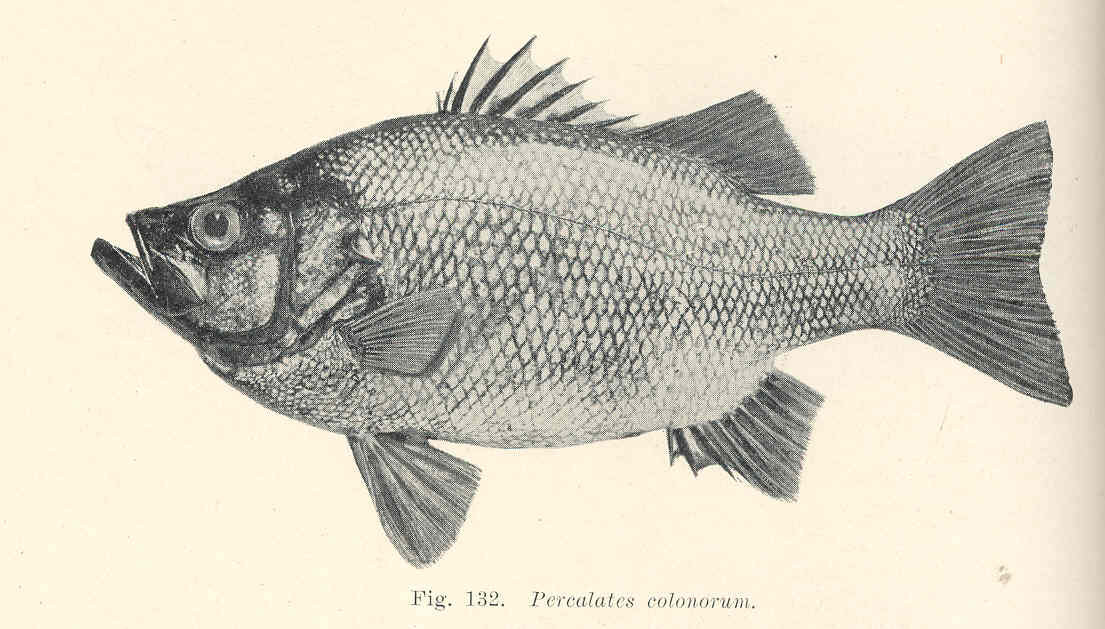
Estuary perch, Macquaria colonorum, occurs in southeastern Australian coastal waters, including Victorian estuaries and connected lower rivers. Its name does not mean it is confined to full-strength salt water. It can use fresh and brackish reaches, although the accessible fishery in this guide is the lower estuary.
Compared with Australian bass, look for a more concave forehead, deeper body and protruding lower jaw. Both can look dark or silvery in different light. Do not identify a fish solely from whether the water tastes fresh or salty, and do not rely on colour alone when distinguishing a perch from a bream.
Small crustaceans, fish, worms and molluscs contribute to estuary-perch food. Near-bottom presentations therefore deserve attention, particularly when there is no sign of surface feeding. A small fish-shaped plastic and a compact shrimp bait test different opportunities without requiring a large change in tackle.
Snags, weed edges and undercut banks are useful features to inspect. Their value depends on whether the fish can hold beside them and intercept food. A branch high above shallow water may be less useful than an unobtrusive deeper edge. Treat visible cover as the beginning of a depth question, not the answer.
Access and the reach to fish
The Victorian inland-angling guide identifies lower Tidal River as an estuary-perch water with boardwalk access and fishing spots. It states that water upstream of Tidal River Road is closed to fishing. Confirm the boundary, current path conditions and any temporary restrictions with park information before setting up.
Use established access and a stable landing position. The existence of a boardwalk does not mean every section is a safe casting platform or that pedestrians should have to pass behind an exposed hook. Choose a place with clear room, keep the walking route open and avoid trampling soft banks to reach an apparently better angle.
This is a shore plan, not an instruction to launch through the adjacent beach or cross the river mouth. Nor does it extend fishing permission into nearby marine national parks or sanctuaries. If the permitted lower reach is crowded or unfishable, shorten the session rather than pushing into a closed area.
Before assembling the rod, observe current direction, floating debris, water clarity and any visible prey. If the surface appears still, a light lure can help reveal movement below it. Do not presume a particular tide will produce a fixed period of feeding: mouth condition, freshwater flow and local depth can change how a small estuary behaves.
A useful spring-to-summer approach
Late spring and summer provide an opportunity to explore small-lure presentations in accessible estuarine habitat, but this is not a claim that Tidal River has a verified seasonal peak. Estuary perch can shift within connected waters, and a previously productive piece of cover may be empty.
Use low light as one option to test, while retaining enough visibility for safe casting and landing. In bright conditions, shade can help define a more concealed route for the lure. After rain, observe the actual clarity and flow before choosing weight; do not assume that every freshwater pulse pushes fish in the same direction.
Begin in the nearest safe lane. Fish it shallow, then a little deeper, before casting farther. This avoids disturbing a close fish with repeated line passes and gives you a depth reference. If the water carries debris, choose a path that lets the lure travel cleanly rather than spending the entire retrieve pulling weed off it.
The light spinning outfit
A 6½–7 ft light spinning rod, 2000–2500 reel and 6–10 lb braid are useful starting choices for small artificials. Add roughly 1–1.5 m of 8–12 lb leader. Near abrasive structure, move towards the stronger end without assuming a heavy leader makes every snag fishable.
Keep the leader knot compact enough to pass smoothly through the guides if it enters them. Check the final section after contact with wood or rock. A fresh, well-tied leader is more useful than a heavier but damaged one. Set the drag to release under a hard pull while retaining enough pressure to direct a fish away from cover.
A landing net is part of the outfit, especially from a platform. Select a position where its handle reaches the water without leaning dangerously. Carry only a few weights and lure styles so a change takes seconds rather than turning into a prolonged tackle search.
Rig one: an exposed jighead in clear lanes
Start with a 2–3 inch fish-shaped or shrimp-like plastic on a 1/16–1/8 oz jighead. A size 2–1 hook is a possible starting range; match it to the lure body so there is a clear gape without an unnecessarily long shank. Thread the plastic centrally and check that it hangs straight.
Cast a little beyond the feature and allow a short, watched sink. Close the bail manually, recover the slack and use one small lift followed by a pause. The lure should move through the intended layer without constantly ploughing into the bottom. Watch for a twitch or sideways draw during the fall as well as feeling for a tap.
To establish depth, make one careful exploratory cast in a clear lane and note the approximate time to bottom. Begin the next retrieve earlier to swim above it. Do not translate the count directly into metres; lure shape, current and line angle alter the fall.
Where water is moving, cast diagonally upstream and let the lure travel past the outside of cover. Mend slack without dragging it sharply away. A bite can feel like sudden weight rather than a violent hit. Reel into contact and make a controlled lift to set the single jig hook, then keep steady pressure.
Rig two: a lightly weighted weedless plastic
When exposed hooks repeatedly catch isolated weed or small branches, use a 2½–3 inch plastic on an offset size 1–1/0 hook matched to its thickness. Choose a belly-weighted version carrying approximately 1–3 g if the lure needs help reaching the layer; the weight sits on the hook shank below the plastic. Keep the rig compact rather than adding several loose pieces of hardware.
Push the hook through the nose, bring it out after a short distance, slide the lure up to the offset and rotate it. Reinsert the point through the body so the plastic lies straight; lightly skin-hook the tip if needed. Compress the body by hand to confirm the point can emerge. A weedless lure that cannot expose the hook will miss fish.
Cast beside the obstruction, let it sink on controlled slack and use a slow swim with brief pauses. It is designed to reduce snagging, not to make a dense branch pile safe. If it repeatedly wedges, change angle or stop short of the obstruction. With a concealed point, take up slack and make a firmer controlled sweep when the fish loads the line.
This rig trades some easy hook exposure for improved passage through cover. Use the exposed jig in open lanes and the weedless version where its advantage is real. Do not accept repeated missed bites merely because the rig looks tidy.
A suspended-bait alternative
For a quiet, relatively open pocket, a small float can hold a shrimp or prawn piece above bottom or weed. Use a float carrying roughly 1–3 g, a size 6–2 single hook and about 45–60 cm of 8–10 lb leader. Place balancing shot above the leader, then fine-tune until the float shows bites clearly without sinking under its own load.
Use a small, legally sourced bait and leave the hook point exposed. Begin with it suspended just above the observed obstruction. In deeper water, measure the depth rather than guessing a long setting and allowing the bait to lie hidden in weed. Do not collect bait from protected areas.
Make a gentle placement and let the bait settle without towing it across the pocket. In slight flow, cast upstream and follow the float with the rod. On a steady submergence or purposeful sideways movement, recover slack and lift with the conventional single hook. Repeated tiny dips without contact call for checking bait size and hook exposure before increasing the wait.
| Observed feature | Rig to try | Presentation | Why it fits | First correction |
|---|---|---|---|---|
| Open deeper lane beside cover | Exposed light jighead | Short lifts near the lower layer | Clear hook and measurable fall | Adjust sink time |
| Scattered weed or light branches | Weedless plastic | Slow swim beside the obstruction | Reduces exposed-point snagging | Check hook can emerge |
| Quiet pocket with little flow | Small float and shrimp bait | Suspend above bottom or weed | Holds food in one place | Recheck depth and shot |
| Moving water at an accessible edge | Light jig cast upstream | Let it pass the holding lane | Uses flow to carry the lure | Shorten line if contact is lost |
A worked lower-estuary session
For a two-hour trial, begin at an established legal position with the light rod, 8 lb braid, 10 lb leader and a 1/16 oz jig. Examine the near edge first, then the outer lane. Compare a short sink with a longer one, keeping the lure and retrieve unchanged so the depth test means something.
If the jig collects weed on each cast, switch to the weedless rig and keep the same route. If it still catches, move the route outward rather than increasing weight. If a fish follows but refuses, try a smaller lure or longer pause at the same depth. A natural olive or translucent pattern and a contrasting pale pattern are useful comparisons; neither is a universal answer to water colour.
Use the float-bait rig at the clearest promising pocket if lure responses remain tentative. After several clean presentations at two depths without evidence of fish, move to another lawful feature. Stop when darkness, pedestrian traffic or water conditions remove safe casting and landing options.
Brief rules and handling note
Checked 2 November 2026: VFA gives estuary perch a 27 cm minimum length and, outside Lake Bullen Merri, a combined limit of five estuary perch, Australian bass and hybrids, with no more than two Australian bass. Retained fish must remain whole or in permitted carcass form on the water. A Victorian recreational fishing licence is required unless exempt. Observe Tidal River's upstream closure and marine sanctuary boundaries. Support fish with wet hands, minimise time out of water and keep hooks clear of other boardwalk users.