
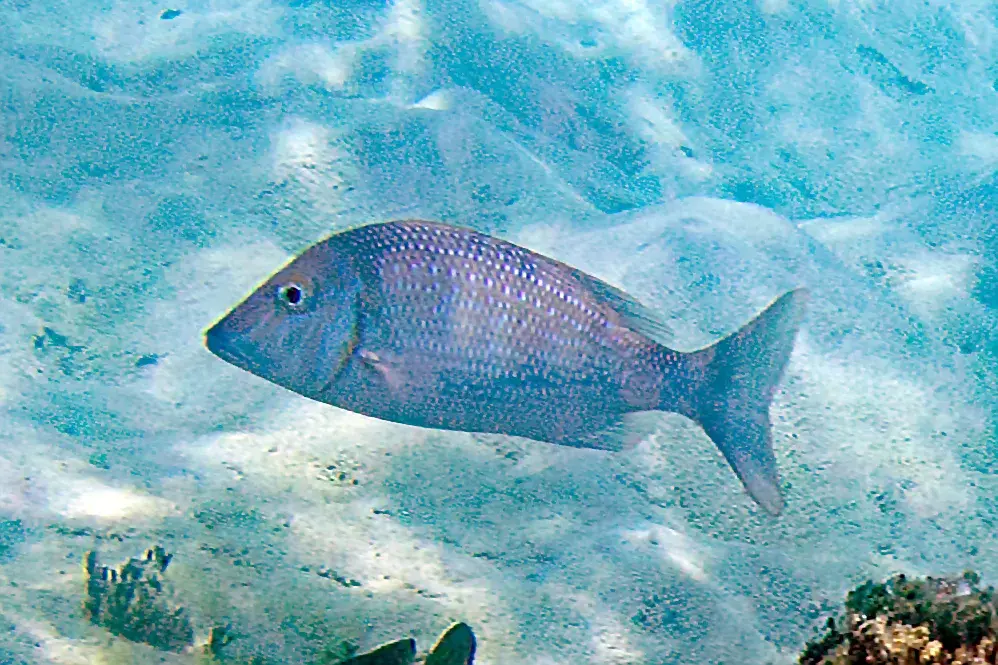
Shaari fishing is often a matter of presenting a small durable bait in the right patch of bottom, then recognising the difference between a fish, current pressure and a sinker moving across uneven ground. More hooks and a larger bait do not automatically create a better chance.
The target is spangled emperor, Lethrinus nebulosus, in Abu Dhabi's coastal waters. This guide offers a cooler-month shore plan for a permitted area. The biology and local planning framework come from the sources below; hook sizes, weights, bait dimensions and session timing are practical starting suggestions, not an account of a local catch or a guarantee of fish at a particular beach.
Identify shaari without relying on colour alone
Spangled emperor commonly show a yellowish or bronze body with pale blue markings on the scales and around the eye. Juveniles can carry additional blotches or stripes. Other emperors and seabream can look similar, so a general local name or blue spot is not sufficient identification for retention.
Use the combination of head shape, scale markings and a reliable illustrated guide. If a fish remains uncertain, resolve its identity before applying a species-specific size or quantity rule. Do not assume that every emperor has the same limits.
The species is widespread in the Indo-West Pacific, including the Arabian Gulf, and uses reef, sand and other coastal habitats. Adults may occur alone or in small groups while juveniles can school. A cluster of small bites does not prove that larger fish occupy exactly the same shallow patch.
Let the diet shape the bait
Spangled emperor eat a range of bottom-associated animals, including molluscs, crustaceans, worms and other prey. That makes a modest prawn piece, squid strip or suitable worm bait a reasonable presentation to compare. It does not mean those shop baits are the dominant natural food at your chosen Abu Dhabi shoreline.
A bait should cover the hook shank attractively while leaving the point and sufficient gap clear. Large bundles can let small fish remove pieces without engaging the hook, and they can spin in the current.
Start with one bait type and a consistent size. If it returns washed out, torn or buried in silt, correct that mechanical problem before changing flavour, adding attractant or concluding that shaari are absent.
Choose a permitted access area first
Experience Abu Dhabi identifies designated shore-fishing areas around Al Bateen and the Corniche, while directing anglers to the Hadaq map for current approved areas. Use these as planning districts, not permission to fish every beach, residential frontage or marina.
Confirm your EAD licence, the exact permitted section and any signs or temporary restrictions before setting up. A scenic mangrove edge or reef reserve is not an alternative merely because the main shore is busy. This plan does not recommend fishing inside a protected area.
Look for secure footing and a clear landing route, then assess the bottom you can reach. A permitted sand-to-rock transition may offer a useful search lane; an inaccessible reef beyond a prohibited boundary is outside the plan regardless of its potential.
Read bottom and current together
A small sinker cast into clean ground can help compare the near lane with a farther patch. A smooth retrieve suggests different substrate from repeated sharp taps or immediate snagging. Treat that information as a rough practical clue, not a detailed seabed survey.
Current can spread scent and move food, but it can also roll a bait into an obstacle. Start when you can maintain control rather than choosing the strongest possible tidal flow. A change in tide is a comparison opportunity, not a fixed guaranteed bite period.
Low light is worth considering where access and local rules allow it. In bright clear water, a smaller bait and a quieter approach can be more sensible than repeatedly casting a large splash into the near edge.
| Bottom or condition | Starting rig | Presentation aim | Change after poor results |
|---|---|---|---|
| Clean sand with modest current | Running sinker | Keep a small bait on a defined patch | Reduce weight if it buries |
| Mixed sand and low rough ground | Short paternoster | Hold bait just above snags | Shorten cast into cleaner ground |
| Bait repeatedly stripped | Smaller firm bait on one hook | Improve point exposure | Change bait texture |
| Sinker rolling constantly | Better holding shape or heavier weight | Keep the target lane repeatable | Move to less current |
| Repeated rock snags | Different casting angle | Retrieve over the clear route | Abandon the lane |
One practical shore outfit
A 2.7–3.3 m medium shore rod with a casting range covering your complete rig, a 4000–5000 reel and roughly 15–20 lb main line make a useful starting outfit for moderate conditions. Fine braid improves bite contact but needs careful handling; mono offers a simpler alternative.
Use an abrasion leader around 1–1.5 m long, initially 20–30 lb where rock contact is possible. Match the strength to the actual ground. A rough leader should be replaced even if it was strong when first tied.
Carry a small selection of size 1 to 1/0 bait hooks, swivels, beads and sinkers. The right hook depends on bait and expected fish size, so inspect gape rather than trusting the number printed on the packet. One well-presented hook is enough for this plan.
Running-sinker rig: a clean-bottom option
Thread the main line through a running sinker or a suitable sliding sinker carrier, add a protective bead and tie to a swivel. Attach a 40–70 cm hooklength and one hook. Make sure the running component can slide freely and will not trap against the bead or knot.
Start around 20–40 g where that holds bottom, increasing only as current and distance require and within the rod rating. A heavier sinker that disappears into soft ground can make the bait harder to find; a lighter one rolling through rocks is equally unhelpful.
Bait with a small prawn section or narrow squid strip, leaving the point exposed. Cast with a smooth action to a chosen landmark. After settling, remove slack until you can recognise a change without towing the sinker.
With a J-hook, wait for a sustained movement, wind down and make a controlled lift. Tiny rapid taps may be small fish or bait movement. If the bait is repeatedly damaged without a proper indication, shorten the hooklength or reduce bait size before making a stronger strike.
Short paternoster: a rougher-ground alternative
Build a single-hook paternoster on a suitable abrasion-resistant rig body: a swivel at the top, a short hook branch above the bottom and a sinker attachment beneath it. A starting hook branch of about 15–25 cm, positioned roughly 30–50 cm above the weight, keeps the bait from lying directly on the substrate.
Use sound knots or rated components and ensure the branch cannot wrap around the sinker on the cast. Check the finished rig under steady tension. Do not leave long loose loops that make tangles more likely.
Lower or cast it into a clear pocket beside rough ground, then keep gentle contact. The bait can move without being dragged along every stone. If the rig wedges consistently, change the landing point; a paternoster is not permission to fish an impassable reef crack.
A small circle hook is another bait-hook choice where suitable and legal. For it, use steady winding pressure as the fish moves away rather than a sharp strike. Do not fish one hook type while applying the hook-setting method intended for the other.
Keep the bait working
Squid is durable but can fold over a point; prawns can be attractive yet easily removed. Compare their mechanical performance in the same lane. A small strip secured neatly is often a better experiment than a much larger bait that obscures the hook.
Retrieve to inspect bait when indications change or after a reasonable quiet interval. Do not reset an exact timer as though fish must bite every ten minutes. Check for silt, weed, tangles and abrasion, then recast accurately.
If repeated catches are very small, reduce feed or scent disturbance, move away from that patch or change depth rather than continuing to hook the same nursery-sized fish. A large hook alone does not guarantee larger fish.
An illustrative cooler-month session
Begin with current permit and area checks, then choose two accessible casting lanes within the authorised section. Use the running rig on the cleaner lane with a small squid strip. Keep cast distance and weight consistent while learning the bite pattern.
After several sound presentations without evidence, compare a prawn piece rather than changing the whole rig. If current starts rolling the weight, change its shape or move to a manageable lane. Do not keep increasing weight until the rod is overloaded.
Use the short paternoster where a low obstruction makes the running bait unsuitable. After repeated snags, leave that lane. Record bottom feel, current direction and bait condition after every meaningful response.
Brief local rules and care
Checked 28 October 2026: EAD requires the appropriate recreational fishing licence, and the emirate's fishing decision makes the licence's site, species, quantity and other conditions binding. Check current shaari size limits, seasonal restrictions and approved areas through EAD/TAMM and the linked official planning tools before fishing. Rules from Dubai, Oman or another emirate must not be substituted.
Use secure footing, keep clear of prohibited infrastructure and treat spines and hooks carefully. Support fish with wet hands and return unwanted or undersized catches promptly under the applicable rules. Keep the main effort on a small bait, sound tackle and a bottom lane you can fish repeatedly.