A new result about small fish and barriers
A study published on 8 October 2026 in the California Fish and Wildlife Journal adds experimental evidence to an important restoration question: how readily can very young steelhead move upstream past a vertical obstacle? Christopher O'Keefe and Darren Ward tested hatchery fish in 28 overnight raceway trials. Passage declined as barriers became higher and improved as fish became larger. Some fish cleared jumps many times their own body length, but results varied substantially among trials.
This is new published research, not a new permission to put barriers in streams. It is also not evidence of a recovered wild steelhead population. The useful conservation development is more specific: managers now have another experiment to consider alongside field studies, current design guidance and the needs of different fish life stages. The journal did not conduct this research or observe the trials.
Why juvenile movement belongs in restoration decisions
NOAA's steelhead species profile explains that steelhead and resident rainbow trout are different life-history forms of Oncorhynchus mykiss. Steelhead hatch in freshwater and migrate to the ocean before returning to spawn. Their conservation therefore depends on suitable habitat and movement opportunities across very different environments. The agency identifies dams, culverts, diversions and altered habitat conditions among the pressures affecting populations.
This life cycle makes an exclusively adult view of passage incomplete. A route that a strong returning adult can negotiate may present a different challenge to a much smaller fish. Equally, the presence of water upstream is not enough if fish cannot reach it when they need to. In assessing habitat restoration, access and habitat quality have to be considered together.
Our interpretation is that projects should state the movement question before choosing a design. Which species and life stages are expected to pass? At what times and under which flows? Is movement upstream, downstream or both? A structure can look minor to a person standing on the bank while changing an important route for a small fish. The right question is functional access, rather than whether the obstacle appears impressive.
Capacity is different from reliable passage
The new experiment included fish measuring 44–152 millimetres in fork length and barriers ranging from 24 to 44 centimetres. The authors reported passage up to 6.6 body lengths. A willow-twig treatment did not produce a detectable effect on passage, and more crowded trials had greater passage success. The substantial variation left unexplained is a reason to avoid turning the highest observed jump into a design standard.
The distinction between a maximum and a dependable route is fundamental. If one fish succeeds, that demonstrates that passage was possible for that individual under those conditions. It does not show that smaller fish, another species or the same fish in a different season would pass. A conservation objective usually concerns opportunities for a population and its range of sizes, rather than an exceptional individual's performance.
There is also a difference between passing eventually and passing without an important delay. A route can be technically negotiable while changing where or when a fish moves. This article does not assign an unmeasured delay or energetic cost to the experiment. It identifies why a manager should ask about those outcomes before assuming that a successful jump answers the entire connectivity question.
The field evidence asks a complementary question
A 2022 PLOS ONE study by Michael Pollock, Shari Witmore and Erich Yokel investigated passage across beaver dams in Sugar Creek, a Scott River tributary in the Klamath system. In displacement trials, tagged juvenile coho and steelhead were detected upstream. The researchers also found much less upstream movement among fish that had not been displaced. Their results highlighted the problem of confusing a lack of motivation to move with an inability to pass.
That field study and the new raceway experiment should be read together without merging their percentages. A natural or restored stream offers several possible routes, changing flows and different reasons for fish to move. A controlled experiment narrows the circumstances to examine particular factors. Those approaches answer related questions, but one is not a universal calibration for the other.
For a reader looking at a restoration proposal, the practical lesson is to ask what was actually measured. Detection upstream can demonstrate movement, while the absence of detection may have several explanations. Study design, the location of detection equipment and the circumstances that encouraged movement all matter. An evaluation needs a defensible connection between its observations and the claim made about the structure.
Habitat creation and connectivity can involve tradeoffs
California Department of Fish and Wildlife's 2024 Fish Bulletin 185 examines low-tech, process-based stream restoration. Its discussion includes fish passage, water temperature, planning and monitoring. The guidance considers the needs of native fish at different life stages and describes design options that may retain passage opportunities. It does not justify a blanket claim that every small dam is harmless or that every pond improves temperature conditions.
This is important because restoration often seeks more than one outcome. Retaining water, encouraging sediment deposition, reconnecting a floodplain and preserving movement can interact. A project should explain which processes it intends to restore and how it will recognise an unacceptable consequence. Stating a tradeoff is part of a useful design discussion; it is not an argument for ignoring either habitat or access.
We would assess a proposal by tracing the intended sequence: an intervention changes water and sediment movement; those changes create particular habitats; fish must be able to reach and use them; monitoring then tests whether the expected response occurred. If one step is assumed rather than examined, a plausible mechanism can be mistaken for a demonstrated benefit.
Current guidance takes priority over an older quotation
Readers should be careful with the regulatory background in scientific papers. Publication can occur after the guidance cited during research has changed. NOAA's West Coast fish-passage page, updated in August 2026, says its consolidated stream-crossing and grade-control guidance supersedes earlier regional documents. The new paper's references to older numerical passage criteria should therefore not be repeated as a statement of current law or a complete project-approval test.
NOAA's July 2026 guidance document provides the current agency reference for stream crossings and grade control. Its existence is separate from whether an individual proposal satisfies all applicable requirements. The paper supplies biological evidence; the current guidance supplies an agency design framework; a site's permissions and consultations address its actual circumstances. None can be substituted for all the others.
For that reason, this article gives no universal allowable barrier height and announces no change to fishing rules. Anyone proposing work should consult the relevant agencies and qualified designers using the current documents. An experiment is valuable input to that conversation. Treating a research headline as an approval would remove precisely the local checks that distinguish a restoration project from an unmanaged obstruction.
How to read the next fish-passage study
A useful assessment begins with the population represented. Hatchery and wild fish, species, size ranges and previous experience may differ. Then consider the hydraulic setting: the depth below a jump, the available routes and the range of flows examined. Finally, ask whether the observation measures attempts, successful passage, delay, habitat use or subsequent survival. These are related outcomes with different evidential requirements.
The journal's interpretation is that replication deserves as much attention as the most striking individual result. If repeated trials give very different outcomes, uncertainty is part of the result. A single favourable trial cannot establish a reliable route, while a single unfavourable trial cannot establish an absolute barrier. Readers should look for the sampling unit and the uncertainty around predictions, not just the largest number in the abstract.
These questions also help compare studies fairly. A finding about fish displaced from an upstream location is not automatically a measure of normal movement by undisturbed residents. A result for one flow is not proof across a season. A comparison becomes stronger when researchers make those boundaries explicit and explain where their design does and does not support generalisation.
A constructive role for anglers
Anglers can help identify possible movement problems and support properly authorised monitoring. Record a suspected obstruction from a safe, lawful position, with a date and location that can be passed to the land manager or responsible agency. Describe what is visible rather than declaring an entire population blocked on the basis of one visit. A report can prompt a professional assessment without pretending to replace one.
Do not build a small dam, breach a structure or remove wood from a channel merely because it appears to impede fish or casting. CDFW's restoration bulletin describes permitting considerations, and the agency's Fisheries Restoration Grant Program guidance points practitioners towards planning and monitoring resources. Those pathways matter whether the proposed intervention seems simple or substantial.
Our practical recommendation is to join coordinated projects with clear permissions, methods and a plan for responding to findings. That makes observations more useful and reduces the risk that well-intended changes create a new problem. It also keeps habitat work accountable to its ecological objectives rather than to the convenience of an individual fishing session.
What this development changes—and what remains open
The October paper strengthens the evidence that very small steelhead can negotiate some vertical obstacles. It also reinforces the need to examine probabilities and conditions rather than assuming that all young fish behave alike. The next management question is whether movement remains adequate for the fish and flows at an actual site, and whether the resulting habitat supports the intended conservation outcome.
Useful future work would link controlled tests with repeated field observations and evaluate more of the conditions relevant to management. A convincing recovery claim would need evidence beyond passage alone. More accessible habitat is a plausible route towards improvement, but population response must still be measured alongside other pressures.
Image and reporting note
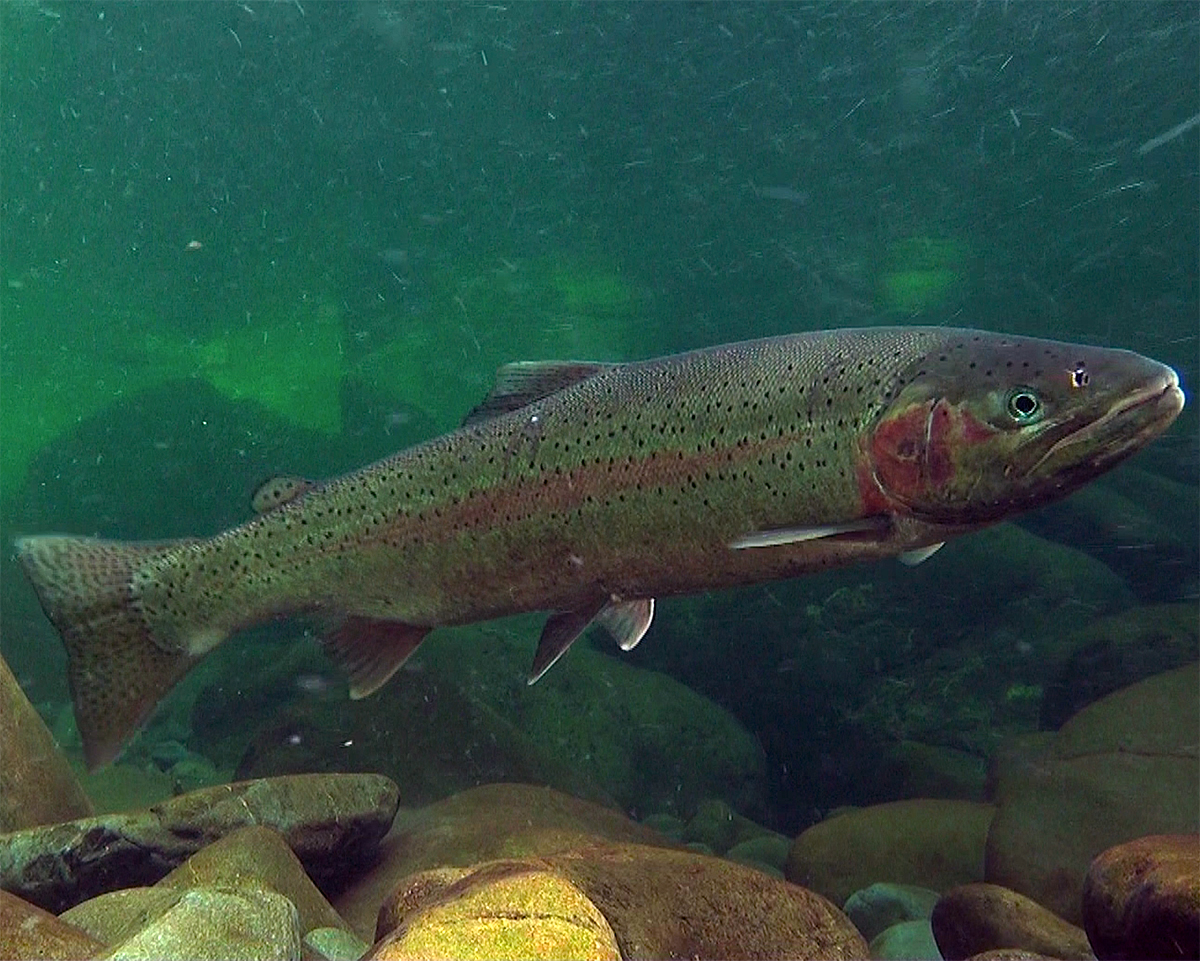
The cover is a USFWS public-domain photograph of an adult steelhead swimming above a rocky riverbed. It shows a representative adult of Oncorhynchus mykiss, not an experimental juvenile or the study site. The original study is by O'Keefe and Ward in the California Fish and Wildlife Journal; authors and CDFW are acknowledged. Sources were checked on 20 October 2026.