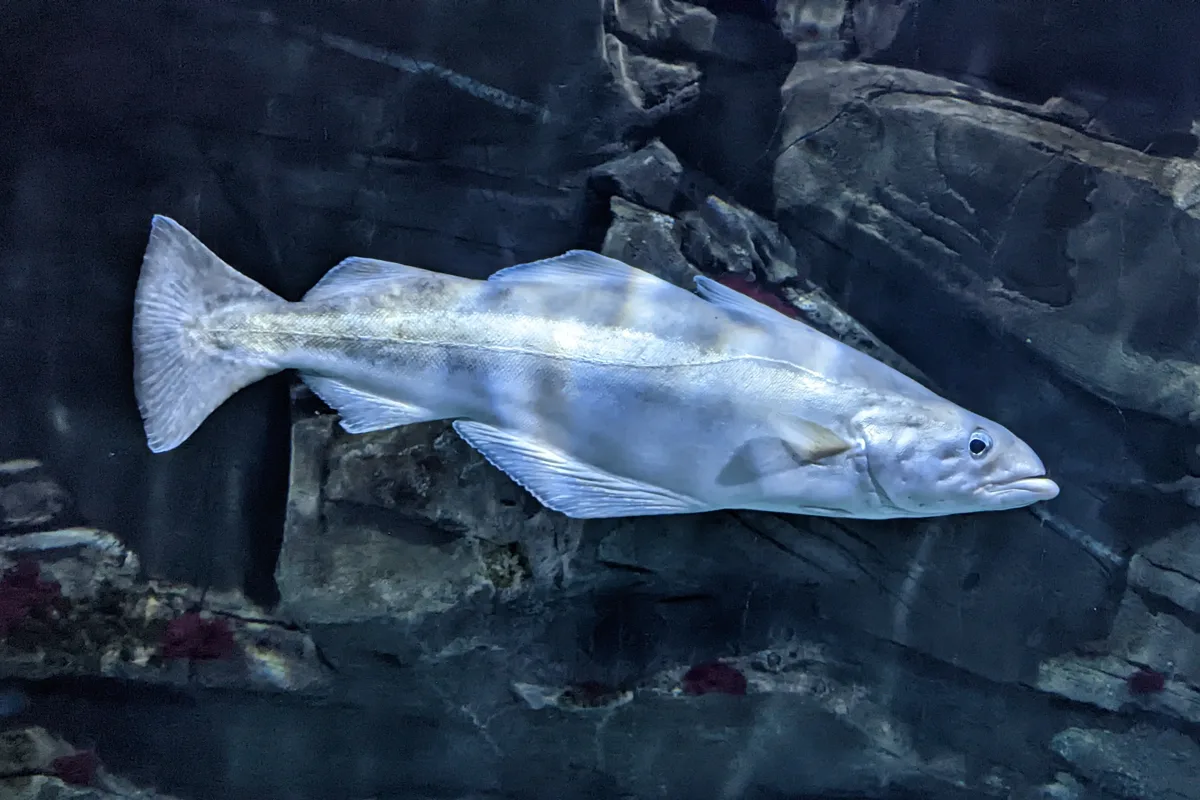
On the reef ground off Kilmore Quay, a pollack lure is useful only while it can swim above the rocks and return without snagging. Start with a steady paddle-tail retrieve and a repeatable depth. If the current carries it away from the boat before it gets down, try a compact metal jig or ask the skipper to change the drift. Each method should give you a clear test of the upper edge of the reef.
Find a workable piece of the Saltee ground
Arrange a licensed charter from Kilmore Quay, County Wexford. The local angling guide identifies varied ground around the Saltee Islands, including boulder and reef as well as softer bottom. The skipper chooses the actual route, safe drift and usable depth for the day. An island name is not a casting mark. Ask for a short pass along the edge of rough ground where there is room to reset in open water. Do not assume that fishing tight to a headland or reef is safe because a chart shows a promising contour.
European pollack, *Pollachius pollachius*, occurs in the northeast Atlantic and around Ireland. It has three dorsal fins, a lower jaw that projects, no chin barbel and a lateral line that curves conspicuously above the pectoral fin. Coalfish tend to have a much straighter lateral line and a less pronounced lower jaw. A cod has a chin barbel. A fish raised through green water can look darker than expected, so use the jaw and lateral line before any retention decision. Pollack form groups near rough ground and feed on small fish. Young pollack often occupy nearshore kelp. The practical clue from a boat is bait along the open face of a reef, where fish can intercept it above the cover.
Summer and autumn are established seasons for Irish pollack, but a late-autumn trip depends on workable sea conditions and the fish present. A mild flow can carry forage along a reef and let you repeat a drift. A stronger stream can push the lure well behind the boat and into a higher ridge, even if the fish are still there. Try a low-light or shaded face if available during the trip, but choose a controllable line angle first. As light changes, compare the upper part of the water before fishing deeper. A sonar trace can show the reef and a group of returns without identifying which fish are there.
| Drift observation | Start with | Adjustment |
|---|---|---|
| Gentle flow along the open reef face | Paddle tail on a jighead | Start high and extend the countdown gradually |
| Jighead sweeps well behind the boat | Compact metal jig | Shorten the drop and reset if it still trails |
| Fish follow up through clear water | Smaller paddle tail at the same depth | Keep the retrieve steady and add one short pause |
| Lure hits structure at the same point | Move to the open side of the drift | Retrieve earlier rather than increasing weight |
Swim a paddle tail along the reef face
A 7–8 ft medium or medium-heavy rod with a 3000–4000 reel, 15–25 lb braid and 1–1.5 m of 20–30 lb mono or fluorocarbon is a practical starting setup. Tie the leader directly to a 15–35 g jighead with a single 3/0–5/0 hook and use a 75–110 mm narrow paddle tail. Thread the body straight so the hook exits centrally. A crooked lure rolls and makes it hard to tell if the weight or the shape is causing the trouble. Try a natural silver or grey back when small fish are visible in clear water, and a pale belly or dark silhouette as an experiment in stain. Use the same size and weight for that comparison.
Make a short cast ahead of the drift and along the reef, only on the skipper's safe side of the boat. Close the bail by hand and use the sounded depth and the boat's drift to choose a cautious first count. Keep the lure above the highest return in the area you can reach. Retrieve with steady turns fast enough to make the tail pulse. Pollack can follow a lure upward. If weight starts to build while the reel is turning, keep winding until the rod loads and sweep smoothly. Then hold a steady bend as the fish turns, keeping it away from the propeller and another angler's line.
If you lose the lure's depth as the line swings out, shorten the cast first. A long cast with a large bow can lift a lure above the fish and then draw it down across the reef as you slow. Do not count until bottom over kelp. Use the depth where a clean lure crosses the face reliably. Once a fish touches, remember the line angle and how many turns you had made before it happened.
Send a slim metal jig down a shorter line
Try a slim 25–50 g metal jig when the paddle tail cannot stay near the chosen level. Keep the same leader. Tie direct to a solid ring with a matched single assist hook around 1/0–3/0 on the upper end. A single upper hook reduces the hardware hanging below the lure. Use a lighter jig when it still falls close to the line, especially in shallower water. Lower or lob it ahead, let it settle under light tension and stop several metres above the reef crest as a starting margin. Wind a few turns, give a short lift, then continue steadily. Add one brief fall only where you can keep the line under control.
A bite on the fall may show as slack or a sharp knock. Wind into it and lift if the weight stays on. If you feel rocks or kelp twice on the same track, bring the lure up earlier and ask the skipper to reset the drift farther out. Extra weight is useful only if it helps you fish a controlled line. The boat should leave the patch if the current defeats both rigs. A fish that comes in hard needs steady pressure and a net ready near the waterline, with space clear around the hooks.
Use the first drift as a measurement even if nobody hooks a fish. Ask the skipper when the ground begins to rise and look at the angle of your line at that moment. A lure well astern may be crossing the crest after the boat has cleared it. When the track repeats, start retrieving earlier or lower the lure closer to the boat. If the metal jig reaches the chosen band on a shorter line, keep the jig for the next pass. If the same weight simply hangs close to the boat while bait is off to the side, the short paddle-tail cast is the better way to reach that lane.
A second useful comparison is the difference between a long fall and a short pause during a retrieve. Give the lure its longer fall at the start, where you know there is clearance. Through the fishable band, make only a short pause and resume winding before it can get into kelp. A bite that comes during the lift gives you something to repeat. A line that stops falling at the same position every pass may be settling into the same snag. Move across the drift a little before changing action. If a fish looks undersized or you intend release, avoid fishing deeper simply because the first shallow pass was quiet.
A worked charter pass
Suppose the skipper finds an open margin with bait showing above a reef crest. On the first pass, swim a 20 g paddle tail high, then try a slightly longer count at the same speed. If two anglers find that their lines swing aft before they can retrieve, shorten the next presentation and try the metal jig. Stop above the crest, wind five turns and repeat without adding depth. If the only contact comes halfway up, test that higher level on the next drift rather than putting the lure lower. After two clean drifts without bait or touches, move along the edge and see whether the next section has a different flow. If a small fish follows or pulls short, try a smaller profile with the original depth and pace before changing area.
Check Inland Fisheries Ireland's current pollack rules before booking. Its 2026 conservation notice sets a three-fish daily bag limit. Wear a PFD, follow the skipper's instructions and keep intended releases shallow and quick.