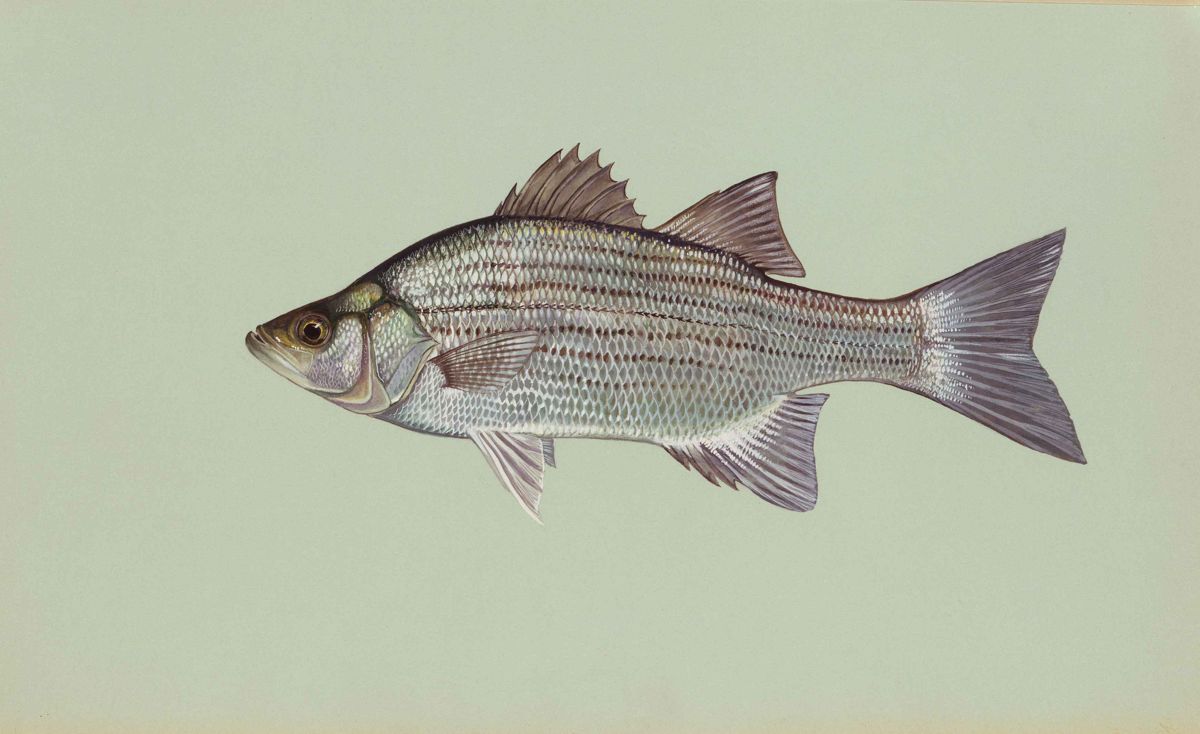
Lake Buchanan rewards an organised search more than loyalty to a particular lure. For white bass, the useful question is where small forage fish are concentrated and whether your lure actually passes through that depth. A promising point with no bait may deserve less time than an unremarkable contour with repeated signs of feeding.
This guide is a practical plan for exploring the reservoir as autumn becomes winter, not a report of today's catches. The tackle sizes, trial depths and time allowances below are starting suggestions. Water level, wind and the position of forage can change the plan within a single session.
Know the fish and the season
White bass, Morone chrysops, are schooling temperate bass, native to parts of central North America and widely established in Texas reservoirs. Their food includes small fish, particularly threadfin and gizzard shad, with insects and crustaceans also eaten. Young fish begin with much smaller invertebrate foods. That progression explains why an adult-fish search can concentrate on baitfish without assuming every white bass eats only shad.
Do not identify a catch simply by its stripes. Young striped bass can look similar. White bass normally have one tooth patch at the back of the tongue, while striped bass have two; consult the linked identification guidance if uncertain, especially before retention. A silvery fish from a feeding school is not automatically a white bass.
The spring tributary migration is a different opportunity from a late-autumn reservoir search. Colorado Bend State Park provides access above the lake for the spring run, but that does not establish a November spawning run. For the coming weeks, begin with reservoir forage and measured depth rather than treating the calendar as evidence that fish have moved upstream.
Choose access and a manageable search area
Buchanan lies on the Colorado River west of Burnet. Its water level fluctuates considerably. The lake profile describes clearer water near the dam and generally more turbid water upstream, with little significant aquatic vegetation. Use those broad characteristics as orientation, then inspect the actual water.
The official access inventory lists public and privately operated facilities. Canyon of the Eagles has a fishing pier but no boat ramp; boat anglers should select a listed ramp appropriate to their craft and confirm present usability with its operator. A ramp symbol does not guarantee enough water for launching today. Shore anglers can begin at an authorised fishing access, but should not assume that adjacent private shoreline is included.
Choose a compact area with two or three different contour shapes rather than crossing the whole reservoir. A point, the side of a creek arm and an adjoining deeper basin provide contrasting tests. These are habitat types to locate on a current map, not claimed secret marks or guaranteed concentrations.
Find forage before choosing a colour
From a boat, inspect the edge of a point and continue into adjacent open water. Look for repeatable bait concentrations on the sounder. A single unidentified mark is weak evidence; several passes showing bait at a consistent level are more useful. Keep away from other anglers and feeding birds rather than driving into the middle of activity.
From the bank, watch for small fish breaking the surface, moving dimples and abrupt changes in shoreline slope. Begin close enough to control the retrieve. Long casts that leave you unable to detect a bite do not necessarily cover water effectively.
| Observation | Working explanation | First presentation | Change if it fails |
|---|---|---|---|
| Bait near the surface | Predators may be feeding above the bottom | Small casting jig through the upper layer | Count down progressively |
| Bait off a point | A contour may concentrate travelling forage | Fan casts across the slope | Search the next contour |
| Bait directly beneath the boat | A vertical presentation can stay in its depth | Compact spoon above the marks | Shorten lifts or move |
| Repeated bottom snags | Lure is spending too long below the useful layer | Lighter jig with an earlier retrieve | Change casting angle |
Do not assume birds prove the species beneath them. Use the first positively identified catch, bait observations and repeated bites to decide whether you have found your target.
Outfit and casting-jig rig
A practical light outfit is a 6½–7-foot medium-light spinning rod, a 2000–2500 reel and 8–10 lb braid joined to roughly 1–1.5 metres of 8–12 lb leader. Straight 6–10 lb monofilament is a workable alternative for modest distances. Select line and drag to suit the rod, not its advertised maximum strength.
For casting, begin with a 1/8–1/4 oz jighead and a 2–3-inch soft plastic. Choose a hook that exits around the middle portion of the body without restricting the tail. Thread the lure on straight: measure the exit point, insert the hook centrally through the nose, bring it out at the mark and slide the head firmly against the lead. A bent body can spiral instead of swimming predictably.
Tie the leader to the jig with a suitable, carefully tightened terminal knot. Pull-test the connection and inspect it after contact with rock. A small knot that slides or cuts itself is not improved by a stronger main line.
Cast across a potential travel route. Close the bail by hand and count the descent while watching the line. Begin high, then increase the count on later casts; the count is a repeatable reference for that lure and conditions, not a universal conversion into feet. Retrieve slowly enough to maintain the chosen level, adding a short lift and pause if a steady swim gets no response.
Vertical-spoon alternative
When fish and bait stay beneath a controllable boat, a compact 1/2–3/4 oz spoon is a useful starting choice. Use the lightest weight that stays near vertical. An appropriate single replacement hook can reduce tangles, but changing hook weight may alter the spoon's action; test it beside the boat.
Lower the lure under control rather than dumping slack line. Stop above the observed fish level, make a short lift of perhaps 15–30 cm, and follow the spoon back down with enough contact to see a sudden slackening or sideways movement. Let it pause. Wide, violent strokes can pull the lure away from a compact group and make the falling line difficult to read.
If the line angles far behind the boat, retrieve and reposition. More weight may help, but it does not fix an uncontrolled drift. Do not drag a spoon through unseen timber merely because the sounder shows fish nearby. Work above the obstruction or choose a clean casting lane.
Bites, colours and practical adjustments
With either lure, a bite may be a tap, extra weight or a descent that stops early. Reel out slack and make a controlled lift rather than a hard overhead strike. Keep pressure through the fight and use a net for fish that should not be lifted on the leader.
Carry a small selection: a pale shad-like plastic, a darker silhouette and a contrasting bright option are enough to test visibility. Clear water may make a restrained presentation worth trying; stained water may justify stronger contrast. There is no verified Buchanan rule that one colour always wins on cloudy days. Change depth and speed before repeatedly changing paint.
If several fish follow without taking, reduce lure size or shorten the pause. If the lure repeatedly returns fouled, raise the working depth. If bites stop after a few catches, search around the original position; a mobile school may have shifted rather than become permanently unwilling to feed.
A worked two-hour search
Begin at a currently usable launch with three nearby contour targets selected. Spend the first fifteen minutes checking the first point and its deeper side. Suppose bait appears several metres down but no surface feeding is visible: start with the casting jig, count it below the surface and compare a steady retrieve with short pauses.
If repeated casts reveal nothing and the sounder remains empty, move to the next feature. If bait becomes concentrated beneath the boat, change to the spoon and hold it just above that level. Record the productive depth, drift direction and lure weight. Repeat the position before exploring farther.
A bank version uses the same logic on a smaller scale. Fish a close fan first, then longer casts at increasing countdowns. Move along permitted access only after testing a different depth or angle. Finish by repeating the most informative presentation, even if that information was a clean no-bite result rather than a catch.
Brief rules and care
Checked 31 October 2026: TPWD lists Buchanan under statewide species regulations; white bass have a 10-inch minimum and a daily bag of 25. Confirm current licence requirements, exceptions and identification before keeping fish. Drain boats and equipment as required and avoid transferring live organisms between waters.
Wear a suitable life jacket afloat, respect rapidly changing wind and keep hands clear of hooks and spines. Support fish during unhooking and return unwanted catches promptly. The aim is a controlled, repeatable search, not a promised limit.