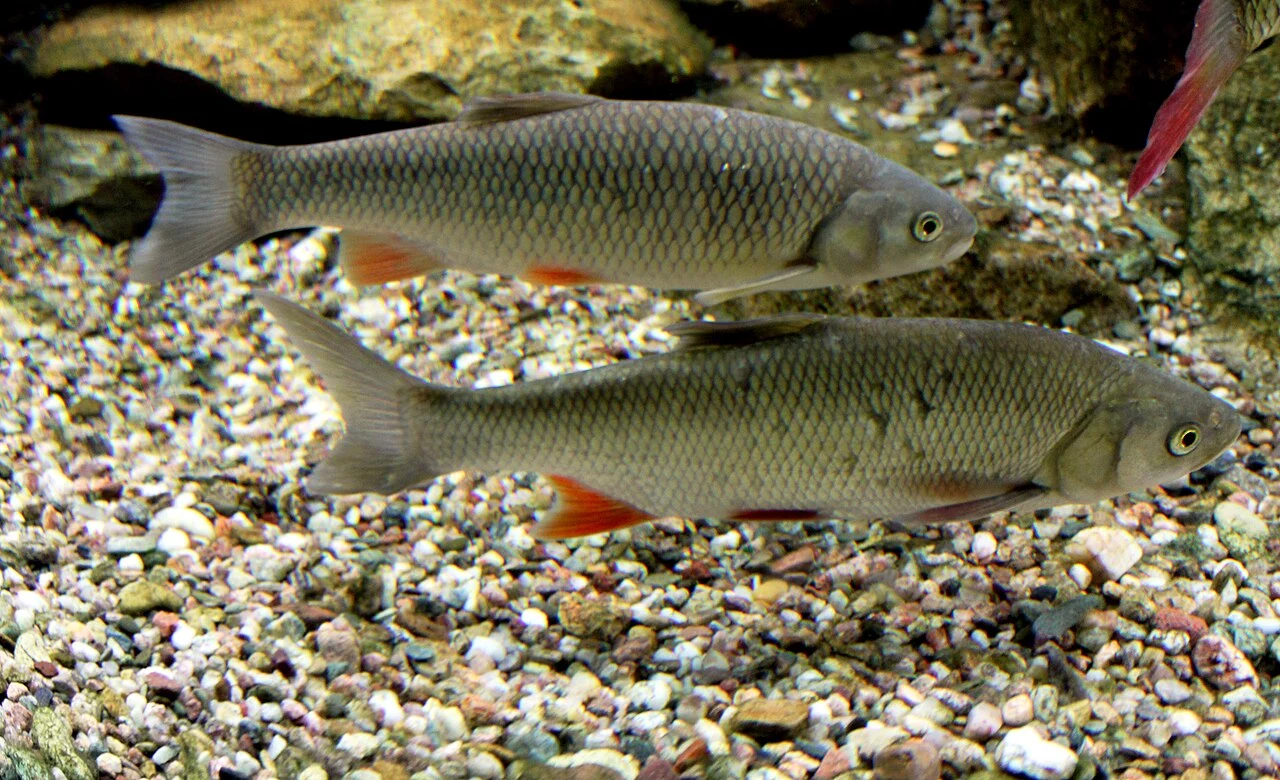
A Loire chub session at Montjean starts with a small piece of water, not the width of the river. Look for a reachable boundary between fast and slow flow, then use a worm to find out whether the fish are near the bed or willing to intercept a drift. A running feeder holds the bait in a short pocket. A stick float gives the worm a longer passage along a clear seam. Choose the position that lets you control either rig from dry, stable ground.
Look for shelter next to food
The Montjean-sur-Loire fishing route in Mauges-sur-Loire includes open banks and a documented pontoon. Check current access and use only a permitted position. The river can rise, cover the lower bank and shift deposits of wood or sand. A marked access point is a place to start looking, not proof that the same edge will be fishable on every visit. Fish from a dry position with room behind you and leave access clear for others.
European chub, *Squalius cephalus*, are widespread in continental Europe and are known in France as chevesne or chevaine. A broad head, fairly large mouth and dark edges to the scales help distinguish them from dace, which have a more slender shape and smaller mouth. Roach often show a more conspicuously coloured eye and different head shape. Fins vary in colour with light and age, so use several features together. Small fish feeding in shallow water can look similar from above.
Chub eat aquatic insects and other invertebrates, plant material and, particularly as they grow, small fish and other larger prey. The boundary between a current tongue and a slack pocket brings food past a fish without making it hold in the strongest flow. A shaded undercut or the downstream edge of a stump can serve the same purpose. If the current is carrying debris, pick a pocket where the line can pass beside the cover. A slow eddy may turn your float back upstream. Fish its outside seam if you cannot keep the hook out of the swirling debris.
On a mild late-autumn morning, try a reachable edge while the light is low, then compare a slightly deeper pocket if the near edge is exposed. Cooler water and higher flow can make the sheltered side more practical. In brighter conditions, watch for movement at the edge of shade. After rain, colour and debris can change within one reach. Start where a worm remains visible or detectable and a sinker holds without lodging. Treat the first bite as a reason to repeat a presentation, not proof of an all-day window.
| River feature | First rig | Test before changing |
|---|---|---|
| Clean seam with a steady downstream lane | Stick float | Add a little depth if the worm runs clean and high |
| Short slack pocket beside faster water | Running feeder | Cast closer and reduce weight if the pocket is small |
| Repeated stops in the same place | Fish above or outside the obstruction | Shorten the drift rather than striking at every stop |
| Both rigs clean and untouched | New seam or depth | Keep bait size fixed for the first comparison |
Let a feeder hold beside the current
Start with a 3–3.6 m light feeder rod, 2500–3500 reel and 6–8 lb mono main line. Run the line through a small feeder link, add a bead and tie to a swivel. Finish with 35–60 cm of 4–6 lb mono and a single size 12–8 hook matched to a short worm section. Begin with an empty or lightly loaded 15–30 g feeder. Add only modest legal feed if useful, and include its weight when checking the rod rating. Where feeding is inappropriate, use a plain running weight of similar mass. Let the feeder or weight settle in the slow lane instead of anchoring it in the fastest part of the river.
Cast slightly upstream or across the slow pocket, close the bail and let the rig settle. Remove just enough slack for a slight bend in the tip. Watch through the first pulse of current. If the tip tightens and springs back each time the feeder rolls, move closer or use a more stable weight where safe. If the tip draws steadily or relaxes suddenly, pick up the line and sweep. Do not strike hard against a light trace. Keep the fish in the open side and lead it into a wet net. A worm torn only at its loose end is a reason to shorten it before changing hook size or trying a new pocket.
Run a stick float on the open seam
A 3.3–3.9 m float rod and 2000–2500 reel with 4–6 lb floating mono are practical starting points. Fix a small stick float top and bottom with silicone sleeves. Add split shot to cock it, grouping the largest shot in the upper part of the rig and using a small dropper shot nearer the hook. Start with a float that carries around 1.5–3 g and a 20–35 cm hooklength of 3–5 lb mono. Tie a size 14–10 single hook and use a short worm. On clean water, check the depth with a plummet and set the bait a little above bottom. If it touches weed repeatedly, shorten the setting before adding more shot.
Lob just upstream of the chosen seam, mend the surface line gently and let the float lead the bait along the edge. A short holdback can lift the hook over a snag or let the bait slow briefly on the sheltered side. Holding too hard pulls the float out of the lane. When it submerges or moves sideways independently of the flow, wind down and lift smoothly. If it dips at the same fixed point every drift, shorten the depth and see whether the signal disappears. Compare worm with a small permitted natural bait only after the depth and line control are repeatable.
To compare the two rigs fairly, fish the float through the open side of the pocket where you held the feeder. A fast drift can carry a worm above fish that are feeding near bottom. Try a small holdback before changing shot or bait. When you ease off, the worm settles again, giving you a short change of speed in the same lane. If the float swings into the stronger current while you hold it, move your position and use a shorter drift. A good short run lets you tell whether the bait was actually over useful water.
If branches make it impossible to run the float, the feeder can test the slower patch without crossing the obstruction. Cast just far enough to reach it and keep the line off the faster surface current as much as possible. Check the worm after a few minutes. If it comes back wrapped around the trace, shorten the hooklength or make a smoother lob. If the bait remains straight and untouched after two well-placed casts, change depth or current angle before adding feed. A different seam is a cleaner comparison than repeatedly casting at the same snag.
One session on the Montjean bank
Suppose the open bank offers a short pocket and a longer, smooth seam outside it. Start with a 20 g feeder and a 45 cm trace in the pocket. The first cast rolls into the fast lane, so cast closer and let the feeder settle without pulling it sideways. After two clean rests without a pull, try the seam with the float. First set the worm above the bed and make two short drifts. Add a few centimetres only if they both come back clean. If the float goes under at the same branch on every pass, reduce the depth or move the casting line. If it travels sideways into clear water, lift and use the net you set out first. Repeat the successful route before moving. If both stations are quiet and clean, walk to a different current change rather than feeding heavily into the empty pocket.
Check the Maine-et-Loire prefecture and fishing federation’s current permit, reserve and method rules. Keep out of rising water and return fish promptly with wet hands.