King mackerel fishing off Pinellas County is a search for moving predators and the bait they follow. A useful late-autumn trip begins with a small, workable search area, tackle that can survive teeth, and a return route that remains comfortable when the wind changes. It does not begin with a promise that kings will be on yesterday's waypoint.
This guide is for recreational boat anglers planning November–December sessions along the Gulf side of Pinellas County and near the outer approaches to Tampa Bay. The tackle dimensions below are editorial starting points, not regulations or reports of present catches. Adapt them to bait size, boat handling and conditions. A local forecast, current access notice and departure-day rule check remain necessary.
Set realistic expectations for the season
NOAA describes king mackerel as coastal pelagic fish whose movements respond to temperature and food. Their broad seasonal movement is northward in summer and southward in winter. That makes late autumn a reasonable period to investigate Florida's Gulf coast, but it does not establish a reliable daily run off a particular beach.
A mild November period with visible bait may justify a short nearshore search. Repeated cooling fronts can change that picture, especially into December. Do not respond to an empty morning by automatically running farther offshore. Reassess the bait, water conditions, fuel reserve and ride home. A different sheltered fishing plan, or a postponed trip, may be the better decision.
Treat a temperature reading as one clue. Compare several nearby areas and look for bait on the sounder or at the surface; a single supposedly perfect temperature is not evidence that feeding kings are present. This is a planning guide, not a forecast of abundance.
Identify the fish before measuring it
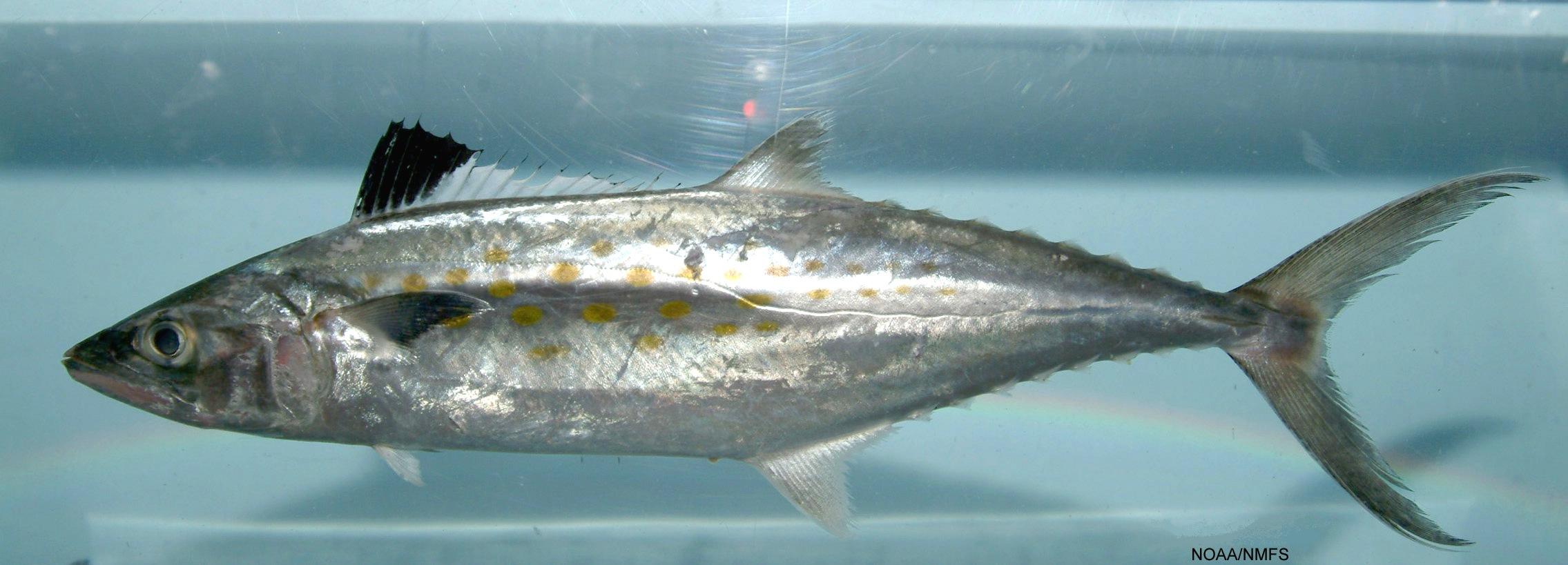
King mackerel, Scomberomorus cavalla, can be confused with Spanish mackerel, particularly when young kings have spots. FWC's useful distinguishing feature is the lateral line: it drops sharply below the second dorsal fin in a king, whereas the line of a Spanish mackerel slopes more gradually. Spanish mackerel also have a dark patch at the front of the first dorsal fin. Do not make the decision from spots or apparent size alone.
Prepare the identification reference and measuring board before fishing. If the identity cannot be established confidently, release the fish promptly rather than applying another species' smaller minimum size. Photographing an uncertain fish does not justify keeping it while seeking an answer later.
Read the Gulf-side rules for this trip
Checked on 22 October 2026, FWC's king-mackerel recreational page lists a minimum of 24 inches fork length, three fish per harvester daily, and a year-round open season for Gulf state waters and Monroe County. Its Atlantic state-water limit, excluding Monroe County, is two fish. Do not transfer that Atlantic figure to this Pinellas plan. FWC lists hook-and-line and spearing as legal gear; the methods here use hook and line.
Fork length is measured to the fork of the tail, not to the longest tail tip. Measure a fish securely and quickly on a suitable board. A bag limit is a ceiling, not a target.
FWC maps place the Gulf state-water boundary nine nautical miles from shore. Plot the actual boundary rather than judging it by how close land looks. This article summarizes the state-water plan; if your route or fishing extends beyond it, check the relevant federal rules and current notices before departing. Do not assume identical provisions everywhere.
A normal saltwater fishing licence, or a specific applicable exemption, is needed for this private-boat plan. Florida's shoreline-only licence does not cover fishing from a vessel. Catch-and-release intentions do not themselves remove the licensing requirement. Charter passengers should confirm their particular coverage with the operator instead of assuming every boat carries the same permissions.
Choose access before choosing a fishing spot
Pick a legal operating ramp with adequate parking, a route you can navigate in daylight, and a realistic alternative if the ramp is congested or closed. For a first attempt, the shortest safe route to suitable open water is usually more useful than a distant launch selected from an old catch report.
If you intend to launch at Fort De Soto, confirm current ramp and dock availability with Pinellas County before towing. Do not assume that an open park means every facility is usable, and do not infer pier access from boat-ramp availability. Carry an alternative launch plan that suits the boat, crew and weather; reassess the sea route if changing ramps significantly increases the distance.
At passes and the Tampa Bay entrance, keep the fishing plan separate from the navigation plan. Stay out of the path of commercial traffic, respect marked restrictions, and do not set a slow trolling spread where you cannot promptly maneuver. A bait school in a busy channel is not an invitation to obstruct it.
Find a workable search pattern
Start with an area that combines signs of bait, enough room to maneuver, and an uncomplicated route back. Baitfish marks around a depth change or the edges of a reef can justify investigation, but kings are not bottom-dwelling reef fish. Work the surrounding water rather than assuming the precise structure coordinate is the target.
Make a broad initial pass while watching the sounder and surface. Note where bait appears in the water column and whether birds are repeatedly working one patch. Birds alone can indicate other predators or bait too small to suit your presentation; use them to narrow the search, not to identify the fish below.
When activity is found, work around its edge. Running straight through a small surface concentration can scatter it and conflict with other boats. After a strike, mark the location and direction of travel, clear the remaining line and make another deliberate pass once the fish is dealt with. Avoid repeatedly circling an empty waypoint simply because it produced one bite.
Assemble a simple outfit
A practical starting outfit is a roughly seven-foot boat rod matched to 20–30-pound line, with a reel holding at least about 250 yards of the chosen line and a smooth, serviceable drag. FWC recommends 20-pound tackle or heavier for larger kings. The exact reel label matters less than reliable drag, sufficient capacity and an outfit the angler can control.
Mono provides useful stretch; braid provides a thinner connection but less shock absorption. With braid, a several-foot mono leader can make handling and sudden loads more manageable. In either case, finish with a suitable bite-resistant trace rather than assuming thick fluorocarbon is immune to mackerel teeth.
For modest live baits, begin with approximately 12–18 inches of 30–50-pound wire and a single strong hook sized to the bait, often around 2/0–4/0. These are starting ranges, not universal specifications. Choose wire connections appropriate to the material: do not tie ordinary line knots in single-strand wire, and do not substitute an improvised crimp for the manufacturer's fitting method.
Inspect every connection under controlled tension before deployment. Keep spare traces ready in a closed organizer. A kink, broken strand or damaged hook point is a reason to replace the rig, not a reason to hope it survives one more fish.
Present live bait without turning it into a lure
FWC lists small schooling fish among suitable live baits. Use legally obtained bait that is lively and appropriately sized, rather than a large weak bait whose movement the tackle overwhelms. Keep the livewell working and avoid overcrowding it.
Start with one bait while checking how it swims beside the boat. A light nose or bridle attachment suited to that bait should let it face forward without spinning. If it rolls, planes onto the surface or is dragged sideways, change the attachment or presentation before letting out more line.
For slow trolling, use only enough boat movement to maintain steerage and a natural presentation. Idle speed varies considerably among boats; the bait's behavior is a better guide than copying a fixed speed. If the vessel cannot travel slowly enough, choose another method in safe open water instead of towing an exhausted bait.
Two rods are plenty for an inexperienced crew. Put one bait closer and one farther back, with enough separation to keep the lines clear during gentle turns. Extra hooks and elaborate stinger rigs add handling hazards; learn a straightforward single-hook presentation before deciding whether more complexity is justified.
Use artificials to search efficiently
A diving plug or suitable spoon can cover water when live bait is unavailable or when locating activity is the main problem. Match rod and leader to the lure's specified load and speed range. Check it beside the boat first: it should track consistently rather than repeatedly breaking the surface or spinning.
Choose lure size to approximate the bait you can actually see, and vary one factor at a time. Change depth, setback or speed, then give the change a fair comparison over the same productive area. Randomly replacing everything after each pass teaches little.
Keep the spread simple and turns wide. Retrieve lines before crossing another boat's stern or moving into a navigation lane. A lure carrying several exposed hooks needs a secure storage point when not fishing; loose plugs on a seat or deck are an avoidable injury.
Plan the weather and the return
Use the NWS Tampa Bay marine resources for the relevant coastal zone, current observations and hazards. A pleasant land forecast is not a substitute for the marine forecast. Consider wind direction as well as speed, wave conditions, visibility and the timing of any frontal change.
The trip's hardest leg may be the return. A comfortable outward run with wind behind the boat can become a wet, slow passage home. Set a turnaround time and retain fuel for a longer route or slower speed. Do not stretch either because the first fish arrived late.
Tidal flow matters especially at entrances and passes. Wind opposing the current can produce uncomfortable steep water. Check the local tide and current information linked from the NWS page, then observe the actual entrance before committing. Keep a sheltered alternative and cancel when the boat, crew or forecast makes the plan unsuitable.
Land fish with teeth in mind
Assign jobs before the first strike: one person controls the boat, one fights the fish, and another clears spare tackle when available. Keep steady pressure, allow the drag to work, and avoid grabbing the running line. Do not tighten the drag abruptly because the fish makes another run near the boat.
For a fish to be released, keep handling and air exposure minimal and use a long dehooking tool to protect hands from teeth. FWC advises cutting the line close to a deeply swallowed hook rather than causing further internal damage. Do not gaff a fish intended for release or lift it by the gill openings.
If retaining a legal fish, have an appropriate landing method, a clear deck and an ice-filled container ready. Keep the fish whole, with its head and fins attached, until ashore so that identification and measurement remain possible; check current landing requirements before retaining fish. Decide how much fish you actually need before the action begins.
Food advice deserves a separate check. The FDA/EPA chart for people who might become or are pregnant or breastfeeding, and children aged 1–11, places king mackerel in its highest-mercury category to avoid. Do not confuse it with other mackerel species on that chart. Check applicable consumption advisories before planning a meal.
A manageable first session
The evening before, confirm licences, current rules, ramp status and weather; prepare two outfits, spare traces, identification references and a usable measuring board. Choose one primary area and one safe alternative rather than drawing an ambitious circuit along the whole coast.
At the launch, test the livewell and communications, agree on the return time and clear the deck. Begin with a short search, deploy a simple spread only after finding worthwhile evidence, and record the conditions associated with each bite. If the weather deteriorates or repeated passes find no bait, revise the plan early.
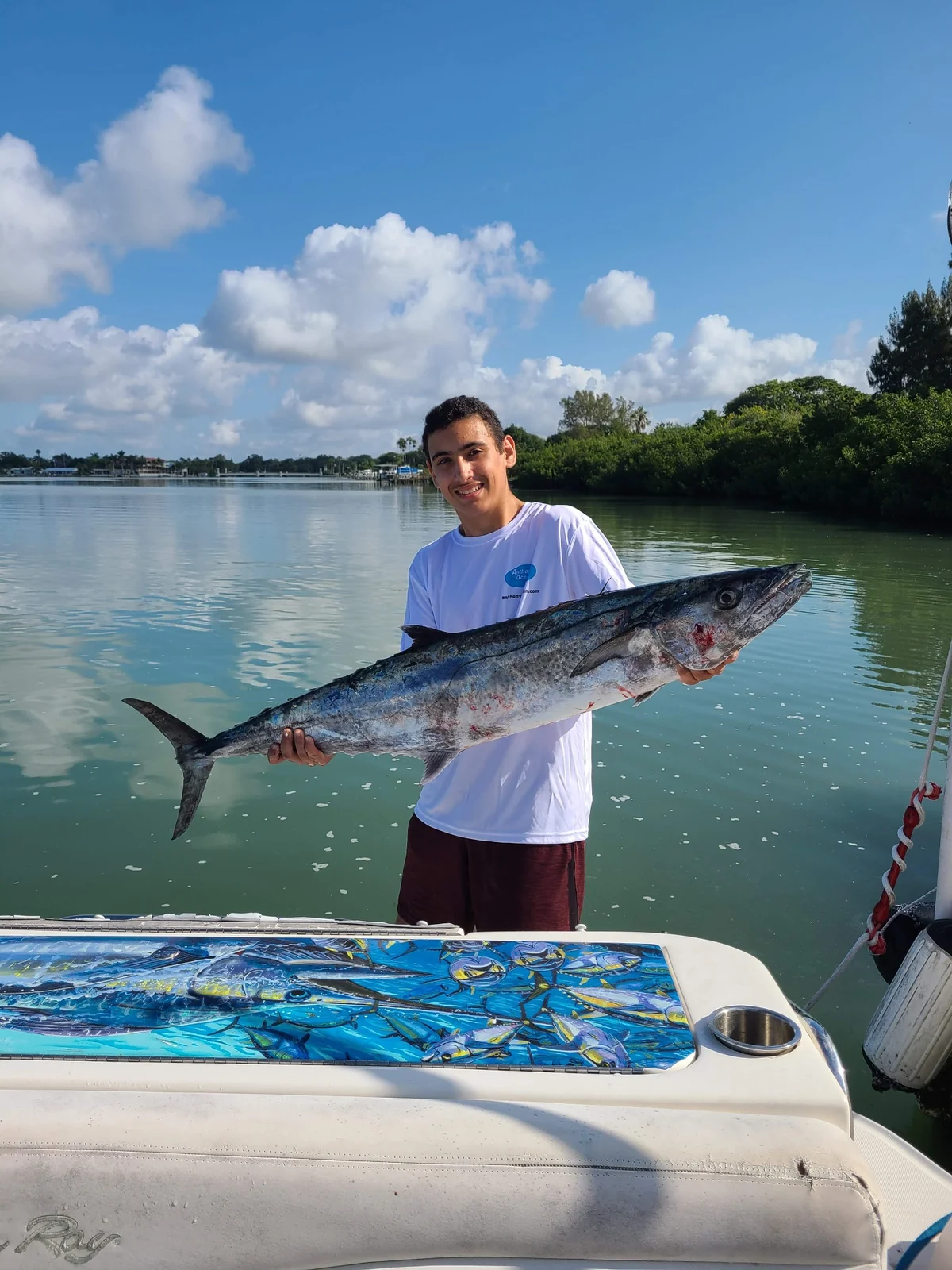
The cover is a king-mackerel catch photograph from the owner’s personal collection, used with permission. Catch location and date are unconfirmed; it is not a current Pinellas catch report or a demonstration of live-release handling. The complete fish and angler are retained in the original composition. Sources and rules were checked on 22 October 2026; check for subsequent changes before fishing.