Follow the bait, with room to change plans
A November or December Spanish mackerel outing in southwest Florida is best planned as a short search for bait and clean, fishable water. It is not a promise that a particular pier or beach will produce every morning. NOAA describes seasonal movement south along Florida's Gulf coast in autumn, while the Florida Fish and Wildlife Conservation Commission identifies cooler water as a driver of that movement. Those patterns explain why the coming weeks deserve attention; they do not establish today's fishing conditions.
This guide is for light-tackle casting from a legally accessible shoreline or a small boat operating in suitable Florida state waters. Think of the coast around Charlotte Harbor, Fort Myers and Naples as a broad planning area, not a list of verified open fishing positions. Check the access manager's current notices before using any pier, ramp, beach or park. Storm damage, repairs and local restrictions can change the practical options.
Identify Spanish mackerel before measuring one
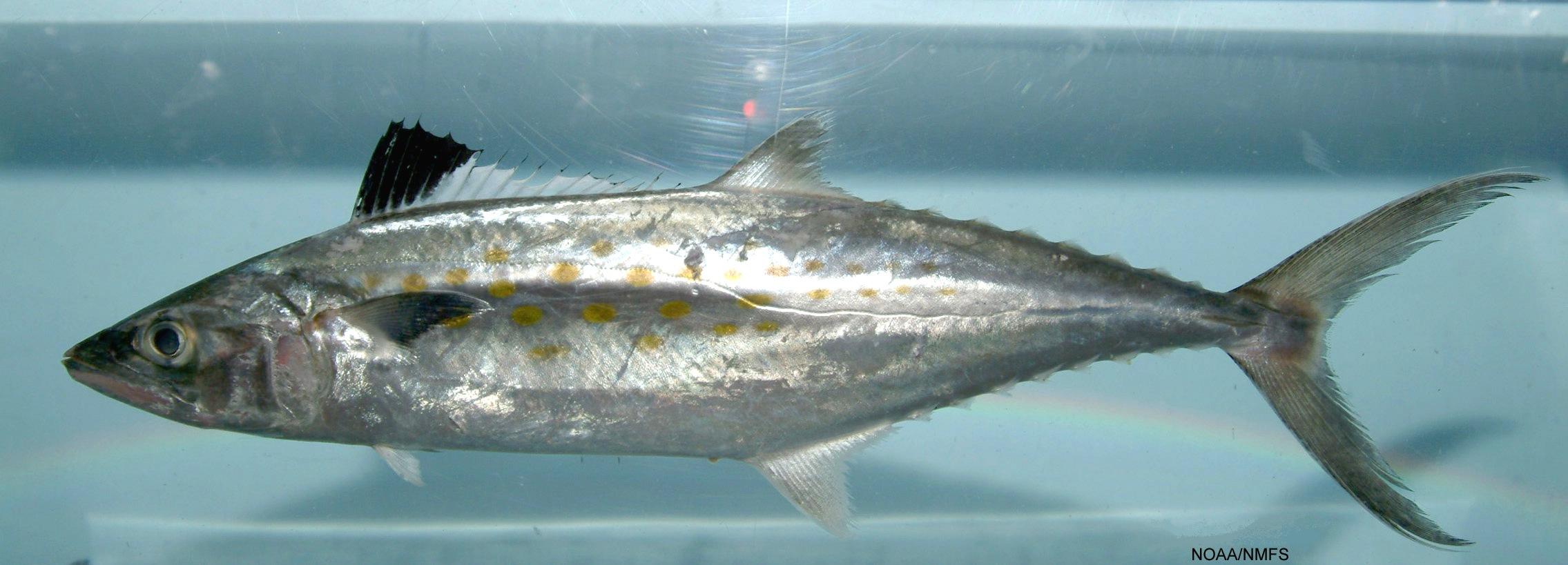
Spanish mackerel are Scomberomorus maculatus. FWC highlights irregular golden spots, a dark patch on the front of the first dorsal fin and a lateral line that descends gradually toward the tail. King mackerel have a much sharper downward bend in that line beneath the second dorsal fin. Cero have a conspicuous yellowish stripe along the flank. Juvenile king mackerel can also show spots, so spots alone are not enough.
Keep an identification reference available offline and compare more than one feature. If the fin is folded, do not guess its colour; examine the fish briefly and carefully while minimizing handling. An uncertain fish should not go into the cooler simply because it is above the Spanish mackerel minimum. The separate king-mackerel guide on this site does not supply interchangeable limits for these two species.
The cover photograph is a NOAA-identified Spanish mackerel specimen. Its whole head, dark first dorsal, spotted flank and forked tail remain visible. It is a historical reference image, not a recent southwest Florida catch or evidence that a particular school is present.
Current rules and the limits of this guide
On 23 October 2026, FWC's recreational Spanish mackerel page lists a minimum of 12 inches fork length, a daily bag limit of 15 per harvester and a year-round season in Florida's Gulf and Atlantic state waters. Fork length is the measurement to the fork in the tail, not the farthest tip. Use an appropriate measuring board and confirm the species before making a retention decision.
Our suggested method is hook and line, which appears among FWC's listed legal gears. The bag limit is a maximum, not a goal. Keep only fish you can use responsibly, and check the current rule again before a trip. The state page links to the full rule and the federal regional regulations; use those if the fishing area or vessel's operation extends beyond this guide's state-water scope.
Resolve the licence requirements for your actual situation before departure. Shore fishing, a private boat and a licensed charter do not automatically have the same arrangements. Confirm any claimed exemption or vessel coverage with FWC or the operator. A parking ticket or pier admission receipt is not by itself proof that the fishing requirement is satisfied.
Choose water you can fish and leave safely
Begin by looking for small baitfish and manageable current edges. An accessible beach beside moving water, a permitted pier or a legal position near a deeper channel edge can provide a starting point. Fish may travel through open water rather than remain beside one piling. Avoid anchoring or casting into a navigation route, and never assume that seeing another boat fishing establishes permission.
Spend a few minutes watching before tying on extra tackle. Bait flicking across the surface, repeated flashes and birds concentrating over one area can justify a closer look. Birds alone are not proof of mackerel, and resting birds are not a feeding sign. Observe the direction of travel and approach from the side, leaving the bait and other anglers room.
From a boat, slow down well before reaching activity. Running through the middle forces everybody to react and may disperse the bait you hoped to fish. Make a quiet drift or hold a safe position outside the activity, casting toward its edge. If you cannot approach without cutting off another boat, choose another patch.
Build one dependable casting outfit
A practical starting outfit is a medium spinning rod around seven feet long, a suitably matched reel and line light enough to cast a small metal lure comfortably. FWC recommends light tackle with 10–15 pound monofilament and a heavier 30–60 pound monofilament leader because of the teeth. That is a useful baseline for a beginner, provided every component fits the rod and lure rating.
As an editorial starting setup, carry compact spoons or metal jigs around a quarter to three-quarters of an ounce, with a short selection of small baitfish-shaped soft plastics. Those weights are options to test against wind and depth, not a claim that one size is optimal everywhere. A lure that is much larger than the visible bait may be less useful than a smaller model you can present cleanly.
Use a strong, neatly tied leader connection and inspect the last section frequently. Heavier monofilament resists abrasion but is not tooth-proof. Repeated cutoffs may justify a short wire bite section appropriate to the lure, accepting that it changes the presentation. Avoid unnecessarily large swivels or snaps beside a tiny lure. Test the finished rig in the water and watch for fouling.
Make the first casts informative
Start with a straight retrieve just below the surface when bait is visibly being pursued. Cast beyond the edge of the activity rather than directly into the densest boil, then bring the lure through it. Keep the rod positioned so you can control the lure and respond to a strike without an exaggerated swing.
If no fish show on top, allow a short, counted sink before retrieving. Repeat the same count for a few casts so you know what changed. Then try a slightly deeper pass. Stop increasing depth if the lure repeatedly contacts bottom or snags. A systematic search teaches more than changing colour, speed and depth simultaneously.
With metal lures, increase speed only while the lure remains under control. A spoon that skips erratically on the surface may need a different rod angle, a slightly slower retrieve or a different weight. With soft plastics, start with a steady swim and small changes in speed. These are controlled comparisons, not rigid recipes.
When a fish strikes, maintain pressure and let the drag work. Check that nearby anglers know where the fish is moving, especially on a pier. Avoid lifting a fish by the line over a high rail; plan a safe landing method before casting from any elevated position. If you cannot land and release a small fish safely, choose a different location.
Treat tide and weather as separate questions
A tide prediction describes water level; it does not guarantee the exact direction or strength of flow at your position. Watch the actual movement of floating material and the angle of your line. If the current makes it impossible to control the lure, reposition or wait. You do not need to fish the strongest flow simply because it appears on a favourite tide chart.
Weather is the first decision, particularly around autumn and winter fronts. Read the current marine forecast for the area and the return route, including wind changes, seas and warnings. A sheltered launch can hide rough conditions outside a pass. Decide your turnaround conditions before launching rather than after the fish begin feeding.
The National Weather Service warns that fronts and thunderstorms can produce rapid wind shifts, and that fog can sharply reduce visibility. If conditions deteriorate, end the fishing phase early. A good bite does not improve the boat's ability to return safely. From shore, avoid exposed rocks, waves crossing the fishing platform and a route that could be cut off.
Solve common problems without chasing every splash
If fish follow but refuse, compare lure length with the bait first. Try a smaller profile or a modest speed change before adding more terminal tackle. Keep one aspect constant so the next result tells you something. If another angler is catching, observe the depth and direction of the presentation without crowding their position.
If the line parts cleanly near the hook, suspect teeth or damaged leader and inspect the rig. If it breaks at a connection, examine the knot and hardware. Do not automatically tighten the drag; that can make another failure more likely. Replace questionable leader material rather than tying a fresh lure to an already weakened end.
If birds move and the surface goes quiet, give the immediate area a few deeper exploratory casts. Then relocate methodically if safe and permitted. Racing after distant activity can spend more time running than fishing. Set a distance limit and keep enough fuel, time and daylight for the original return plan.
Handle a fast, toothy fish carefully
Keep long pliers or a dehooker within reach and keep fingers away from the mouth. Use a soft landing net where appropriate, wet hands before contact and minimize time out of the water for fish being released. NOAA's handling guidance recommends supporting the body, avoiding the eyes and gills, and using tackle capable of ending the fight promptly.
Do not gaff a fish intended for release. When a swallowed hook cannot be removed easily, follow the agency's advice to cut the line close to the hook rather than prolonging damaging attempts. A photograph is optional; safe, prompt handling is not. Leave no cut line, discarded hooks or lure packaging where birds or other wildlife can reach them.
If retaining a legal fish, keep its identity and size verifiable and follow current landing requirements. NOAA specifies landing Spanish mackerel with heads and fins intact. Plan cold storage before fishing, and consult current public fish-consumption guidance for the people who will eat the catch rather than assuming all mackerel have identical advice.
A useful half-day session
Before leaving, check regulations, licence coverage, access, weather and the return route. Rig one casting rod, pack a spare leader and lure, and arrange landing tools where they are immediately reachable. Choose two or three nearby alternatives so a closed pier or unsuitable wind does not push you into an improvised unsafe plan.
At the first position, observe before casting, work a controlled surface-to-midwater sequence and note any definite bait activity. Reassess conditions at a planned interval, not only after a problem develops. Finish with time to land, clean up and leave safely. Record what you actually saw, including a blank session, rather than converting seasonal expectations into a catch report.
This AI-assisted guide separates verified rules and species information from practical editorial starting suggestions. It has no sponsored gear recommendation and claims no firsthand fishing experience. Recheck the linked official sources before using it for a particular outing.