Passage through a ramp is one result, passage through the river is another
In western Czechia, an assessment of the Rolava and its connection to the Ohře shows how several small improvements can make one reach more usable while leaving a larger barrier problem intact. The 2026 study by researchers from the T. G. Masaryk Water Research Institute and colleagues was available in the journal's October coverage and discussed by the regional Czech Anglers Union on October 25. It reports telemetry evidence from restored structures near Nová Role. The work there predates the publication. The study gives readers new evidence about what the restored ramps did, without implying that the structures were rebuilt this October.
Two sills were restored in 2020 near river kilometres 8.8 and 9.2 and a third structure near kilometre 8.4 was subsequently treated. Ramps replaced steep drops. The researchers estimate that work on the three structures opened about ten kilometres of connected channel. Tagged brown trout were observed using the restored reach. A Czech public procurement record for monitoring at two of the structures ties the reported evaluation to specific sites. It gives a way to tell the post-work evidence from the engineering objectives.
Why the denominator matters
The study distinguishes success among fish attempting or reaching a particular pass from overall success along a movement route. Reported efficiency at the monitored passes ranged from 88 to 100 percent, while broader migration success in the analysis ranged from 66 to 90 percent. These are measurements of particular fish and passages under the study conditions. A fish can stop moving, never reach a structure or continue in a direction that does not bring it to the monitored point. Counting it in the wrong denominator changes the apparent result.
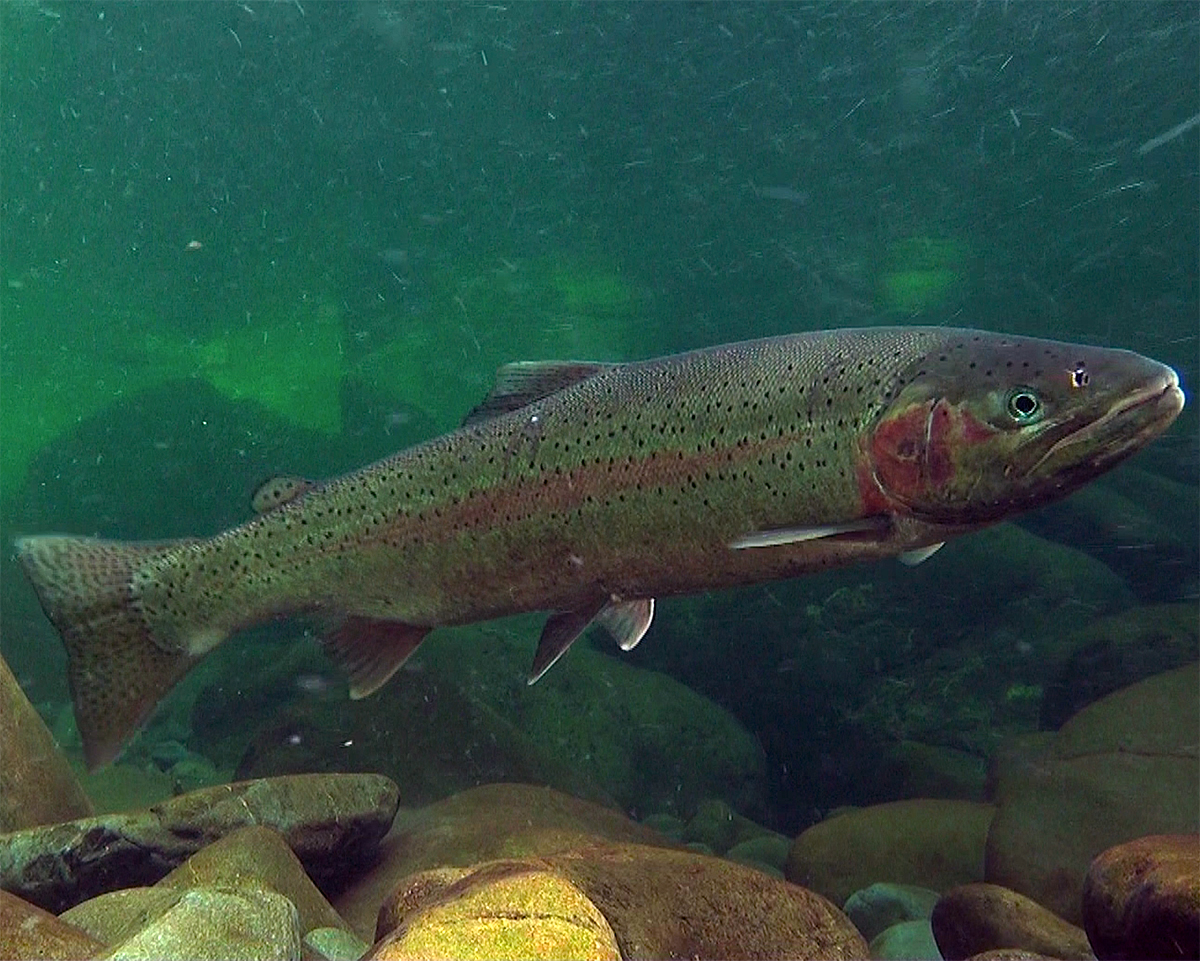
Brown trout, Salmo trutta, were tagged for the movement study. The researchers confirmed that some adults and juveniles crossed the restored barriers. A subset of adults was moved downstream from its original territory, and the study describes a strong tendency for these fish to return toward their original position. That behaviour is useful for assessing whether a motivated trout can negotiate the ramps. It also limits what the percentage can tell us about all trout living in the river. A fish that was released where it was caught may have little reason to travel. That is different from trying and being blocked.
The difference matters for restoration reporting. A ramp can be passable to a motivated adult under an observed flow without proving that every juvenile can pass in low water or that every species responds the same way. A recording at a downstream station documents that a fish reached it. A confirmed recording above a barrier, in the right sequence, supports an actual crossing. The team also used fish surveys below barriers to examine community differences. Those survey results answer a different question from the movement study and provide context about which species were found where.
The route to the Ohře still has bottlenecks
At the scale of the Rolava assessment, researchers identified 41 transverse structures and reported that 25 had a head difference of more than 0.6 metres. The lower river includes two prominent barriers in Karlovy Vary. The study highlights the Rybáře weir at kilometre 1.1 and a structure at Stará Role near kilometre 4.6. The lack of a passage at the lower end can separate otherwise passable upstream habitat from the larger Ohře network. Reconnecting a group of structures near Nová Role therefore does not make the entire lower river continuous.
One useful analogy is to think of a series of doors. Opening three neighbouring doors improves movement between the rooms they connect. If a door farther down the corridor remains closed, an animal approaching from the other side still cannot reach that improved section. The analogy has limits because a stream changes with flow and a barrier may be passable under some conditions but not others. It helps explain why barrier order and location can matter more than a simple count of structures treated.
Reaches also differ naturally. The main Ohře and the Rolava do not provide identical temperatures, gradients and habitats. Fish communities can change upstream for natural reasons as well as because of weirs. The paper reports contrasts in the distribution of brown trout, chub, bullhead, stone loach and other fish. Treat the sampled differences as evidence to interpret alongside the habitat and barriers. It would be a mistake to aim for exactly the same fish mix in every stretch simply because restoration could improve movement between them.
The fishing community has a stake in how success is measured
The Czech Anglers Union's regional discussion emphasizes the remaining lower barriers and the long-term limits of relying on stocking alone. The paper also discusses stocking and reports an increase in brown trout fry in part of the restored reach late in the study. That is an encouraging observation to evaluate with the passage records. It is not enough by itself to isolate what changed across the entire population. The number of adults that spawned, variation in flow, habitat differences and the timing and size of stocked fish can all change what a survey detects.
A useful next step is to keep separate records of restoration work, repeated fry surveys and fish movements. The type and timing of stocking matter when interpreting which young fish were naturally produced. If counts increase at a restored site, the result is more informative when survey effort is stable and comparable reaches are also sampled. If a pass is used by adult brown trout, further work can ask whether smaller fish or other species pass, and whether access still works under a wider range of water conditions. No single metric covers all of those questions.
For visiting anglers, the fishery register gives a way to check a named reach and its current access and conditions. A restored sill does not automatically create a public casting position or change how fishing is regulated. The most useful takeaway from the study is about the river, not about a place to target fish gathered near an obstruction. Follow posted access requirements and the local fishery rules rather than reading them into a study map.
What a two-way connection would add
A pass can be useful even if only some fish use it, but the direction and timing of that use matter. An adult going upstream to reach spawning habitat and a young fish moving downstream to find suitable rearing water represent different stages of the life cycle. An upstream trial with tagged adults answers an important part of that question. It leaves open how younger fish move under ordinary conditions and whether passage persists when discharge differs from the study conditions.
A second question is what happens at the far end of a reopened reach. A fish recorded above a ramp has demonstrated passage at that point. Repeated detections in suitable upstream habitat could show that the opened route is being used for more than a short excursion. To show that recruitment has changed, researchers would need to look for young fish in those habitats over time and consider what was happening to the river in the same years. The most useful follow-up would keep the telemetry and the fish community sampling together so readers can see how much of the restoration story each method tells.
The next evidence to look for
Future reporting can distinguish design or procurement at an untreated barrier, completed construction, a functioning route under multiple flows and a measured response in the fish community. The October evidence is already stronger than a promise that the Nová Role ramps would work: tagged fish passed them. The remaining question is how much usable river can be connected if the lower barriers are addressed and how the wider community responds after that connection is made.