Why start preparing now?
Sheepshead offer a useful winter project for anglers around Tampa Bay: short trips, accessible structure and a fishing method that rewards careful observation. The goal is to put a small crustacean bait beside the food-bearing surface, feel what happens and adjust one thing at a time. A long cast is usually less valuable than accurate positioning and consistent contact with the bait.
Treat late autumn as preparation for a broader winter-to-spring opportunity, not a promise that every piling is already holding fish. FWC identifies late winter and early spring as an important period for sheepshead fishing and describes movement toward nearshore spawning areas. Local temperature, fronts, water quality and access influence individual outings. This is an educational planning guide checked on October 20, 2026, not a live fishing report.
Identify the fish and choose the structure
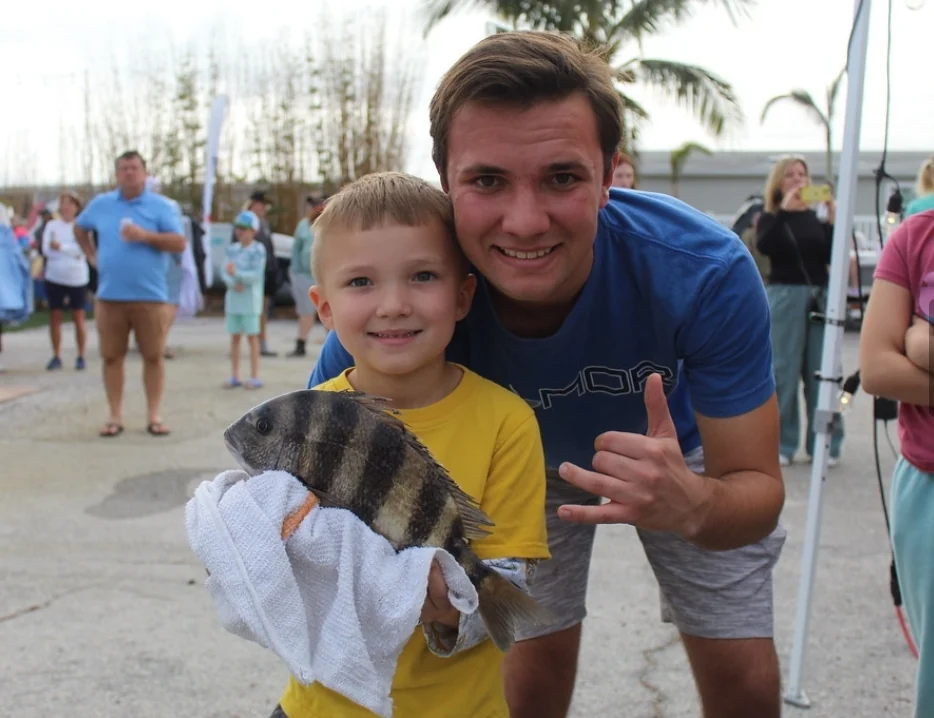
Sheepshead have dark vertical bars and conspicuous teeth adapted to their diet. Young black drum also have bars; their chin barbels help distinguish them. Use the FWC species illustration to verify identification before keeping anything. The opening picture on this article is a general illustration of tackle, not a species-identification image.
Think in terms of edges where food and shelter coincide: shell-covered pilings, seawalls, rocky margins and oyster structure. From public shore, first confirm that fishing is permitted and that there is room to handle a rod without blocking pedestrians. A fishing platform with safe railings is a better learning venue than a precarious seawall. From a boat, choose structure you can approach without entering a navigation channel or interfering with another vessel.
Examine one small patch before moving along an entire shoreline. Which side shelters the bait from the strongest flow? Is the bottom clean enough to lift a rig without repeated snagging? Can you bring a hooked fish into open water? These questions turn an attractive-looking spot into a workable fishing position. Never assume a privately owned dock is available for boarding, tying up or collecting bait.
A practical starting outfit
For sheltered inshore structure, a roughly seven-foot medium or medium-heavy spinning rod and a 2500–4000-size reel are reasonable starting choices. These are suggested ranges, not required specifications. Use the outfit you can hold comfortably and control accurately for a full session. A sensitive tip helps you notice changes; enough power in the lower section helps move a fish away from the structure.
A starting combination is 10–20 lb braid with an approximately 18–30 inch abrasion-resistant leader in the 20–30 lb range. Around especially rough shell, use stronger leader if needed rather than simply tightening the drag. Check the leader after contact with a piling and after each fish. A white, flattened or rough patch is a reason to retie. Light braid is easy to damage against barnacles even when its stated breaking strength seems sufficient.
Carry a small selection of single hooks around size 1 to 1/0, with actual gape matched to the bait. Hook sizing differs between manufacturers. The point and working gap must remain clear once the bait is attached. A compact, strong hook can be more useful than a large hook mostly hidden inside a shrimp. Check the point after a snag; replace a damaged hook rather than trying to compensate with a harder strike.
Two rigs to learn first
A small jighead is the simplest starting rig when it can stay close to the structure. Try approximately 1/8–3/8 oz in light current and shallow water, increasing weight only if the bait cannot reach or remain in the working zone. A jig that falls straight down and lifts cleanly tells you more than a heavy weight buried between rocks. Depth and flow matter more than the number printed on the packet.
A second option is a small sliding sinker above a swivel, followed by a short leader and a single hook. Start with the lightest sinker that gives useful contact. Shortening the leader can reduce tangles and wandering near a piling; lengthening it slightly can help a bait move more naturally in unobstructed water. Learn the first rig before constantly switching to the second. The immediate question is whether the bait is arriving where fish can reach it.
If using a circle hook, leave its gap exposed and wind steadily into sustained pressure rather than making a sharp strike. With a conventional single J hook, a controlled lift after feeling a committed bite is a different action. Match your response to the hook design. Snatching is prohibited, and Florida prohibits taking sheepshead with multiple hooks used with natural bait.
Bait preparation and presentation
FWC recommends small-hook presentations with shrimp, sand fleas or fiddler crabs. Buy bait from a legitimate supplier when learning; that avoids adding collection rules and uncertain identification to the trip. Keep crustacean bait in suitable conditions and replace crushed or repeatedly stripped bait. A small, secure offering often presents more cleanly than an oversized bait wrapped around the hook.
When hooking a shrimp, avoid burying the point in a thick mass of shell and flesh. With a small crab, attach it so the hook remains exposed and the bait stays secure during the drop. Inspect the finished rig in your hand: can the hook gap still work, and will the bait slide across the point? If the answer is unclear, rerig before lowering it.
Avoid treating barnacle scraping as a necessary part of sheepshead fishing. Access permission and collection rules still matter, and oysters have their own restrictions. Buying a modest amount of bait and fishing carefully is an effective way to learn without disturbing a structure or shellfish bed.
Fish one position methodically
Lower the bait beside the selected structure and note when the line stops descending. Lift it just clear of the bottom so you can distinguish the weight from a bite. Keep enough contact to detect an extra load while allowing the bait to move a little. Excess slack delays your response; constant aggressive jigging can pull a small bait away before a fish commits.
Spend several drops learning the same depth and line angle. If every drop snags, move the presentation outward or shorten the time it rests on the bottom. If bait disappears with no felt signal, shorten slack and inspect the hook placement. If the line bows far away, add a little weight or choose a more sheltered side. Make one adjustment, repeat a few drops, then judge whether it helped.
After hooking a fish, apply smooth pressure toward clear water. Keep the rod within its normal working bend and avoid lifting the fish by the rod or leader onto a high platform. A landing net suited to the height of the fishing position prevents many broken leaders and dropped fish. Have the net ready before the first cast, not after discovering a fish cannot be reached.
Tide, wind and a realistic outing
Moving water can deliver food, but the fastest flow is not automatically the easiest or most productive period. A beginner may learn more when the rig can be controlled. Tide tables predict water levels; they do not precisely describe the current at every bridge or canal. Watch actual line angle, floating debris and vessel movement when judging conditions.
Plan around a sheltered location, adequate daylight and a safe return. A cold front can turn an exposed crossing into the most consequential part of a small-boat trip. Check the local marine forecast and water-quality advisories before departure. If a productive piling requires unsafe boat handling, choose another. The fish do not justify anchoring in a channel or holding a boat where wakes can push it into the structure.
For a simple two-hour learning session, spend the first fifteen minutes checking access, conditions and equipment. Work two or three nearby positions with the same basic rig. Record water movement, depth, bait, weight and whether bites were felt or only inferred from missing bait. Finish while there is still light to land, clean up and inspect the tackle. The useful outcome is a repeatable pattern, even if the catch is small.
Current Florida rules to check before keeping fish
As checked on October 20, 2026, FWC lists a 12-inch total-length minimum and an eight-fish daily personal limit for sheepshead. During March and April, a 50-fish vessel limit applies per trip; personal limits still apply. The listed season is year-round, and Florida extends these regulations into federal waters. Biscayne National Park has additional rules and is outside this Tampa Bay guide.
Confirm the current FWC page before fishing. A legal season does not override local access restrictions or other applicable closures. Measure correctly with suitable equipment before deciding to retain a fish. Keeping fewer than the legal maximum is a reasonable choice; a bag limit is not a catch target.
Check your saltwater-license requirements separately. Florida's resident shoreline-only license is limited to eligible shore-based fishing and does not cover fishing from a vessel or shore reached by vessel. Nonresidents generally need the appropriate nonresident saltwater license unless a specific exemption or licensed operation covers them. Verify your own eligibility instead of assuming another angler's exemption applies.
Handle the catch and improve the next trip
Keep pliers, a measuring board and a net within reach. Sheepshead have sharp spines and gill-cover edges; use controlled handling and avoid putting fingers near the teeth. Wet your hands before handling fish intended for release, support the body and minimize time out of the water. Return undersized or unwanted fish promptly. For fish you legally retain, use a suitable cooler and ice, and check relevant consumption advice.
After the trip, remove line scraps and bait packaging, rinse tackle gently and inspect the leader and hook. Write down one adjustment that improved presentation and one problem to solve next time. For example: a shorter leader reduced snagging, but landing from a high railing was awkward. That observation suggests bringing the right net or selecting a lower platform. It is a more useful next step than buying an entire new collection of tackle.