November and December can reward a flexible spotted-seatrout plan in Tampa Bay. The useful question is not which lure always works, but where fish can feed without fighting uncomfortable water conditions. Start with a protected grass-and-sand edge, keep a nearby deeper alternative, and adjust the presentation before committing to a long move. This is a seasonal planning guide, not a report of today's bite or a promise of winter catches.
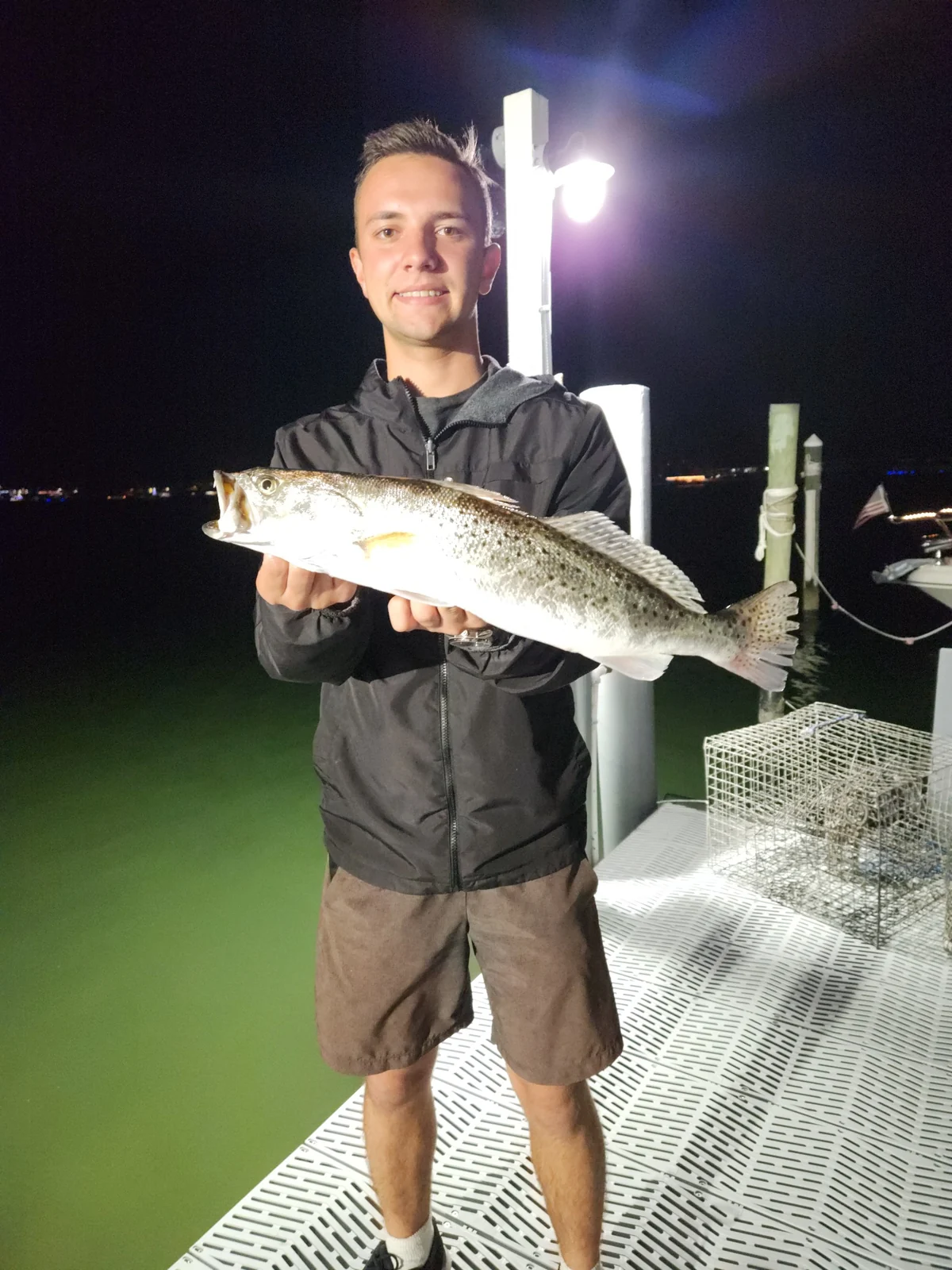
The target is spotted seatrout, Cynoscion nebulosus, also called speckled trout. It is a coastal drum-family fish, not a freshwater trout. Florida's species profile describes a dark upper body, silver belly, distinct dark spots continuing onto the dorsal fins and tail, upper-jaw canine teeth and no chin barbels. Identify the fish before applying its regulations; an unfamiliar trout-like fish is a reason to consult the identification guide, not to guess.
Choose the water before the lure
FWC places spotted seatrout over seagrass and sandy bottoms and notes movement toward deeper, still water in colder months. Its feeding and fishing guidance supports shrimp, small fish, jigs and float presentations. Those are habitat clues, not a guarantee that every deep basin holds fish or every grass flat is productive.
For a first winter outing, choose a manageable stretch with three connected features: a grass edge, one or more sandy openings, and a nearby depth change. Work the shallow-to-deep transition rather than treating the middle of a broad flat as one uniform fishing spot. On a chart, mark the safe approach and exit as carefully as the intended drift. A shallow shortcut that looks efficient at launch can become unusable later.
Use the first drift as a test. Observe clarity, floating grass, bait activity, water depth and the angle at which wind carries the boat. Record whether a bite came beside grass, over bare sand or near a drop. Repeat the productive line from a respectful distance rather than running directly through it. If several controlled presentations produce nothing, try the adjacent depth band before changing colors repeatedly.
A practical tackle kit
These ranges are editorial starting points, not legal requirements or a claim that one outfit suits every angler. A roughly 7-foot medium-light or medium spinning rod, a 2500–3000-size reel and 10–15-pound braid make a workable light-tackle combination. Choose the rod's lure rating to suit the actual jig or plug. A smooth drag matters more than excessive line capacity.
Start with about 2–3 feet of 15–20-pound monofilament or fluorocarbon leader. Inspect it after fish, shell contact and snags; replace rough sections rather than trusting one more cast. Where abrasion requires heavier leader, accept the presentation tradeoff. Stronger leader does not make an unsafe structure, boat position or casting angle safe.
Carry a small selection instead of several nearly identical boxes:
- Three- to four-inch soft plastics in a light baitfish color and one contrasting color.
- Jigheads around 1/16, 1/8 and 1/4 ounce, with hook size matched to the lure.
- One shallow-running or suspending lure appropriate to the depth.
- A float, single hooks for shrimp, spare leader and line cutters.
- A rubber-coated landing net, dehooker and a readable measuring board.
The lightest head that maintains useful contact is a sensible starting choice. Too much weight repeatedly buries the lure in vegetation; too little leaves the angler uncertain about depth. Wind, current, line diameter and lure shape all affect that decision. Test beside the boat or bank before making a long cast.
Method one: controlled soft-plastic fishing
Rig the plastic straight. A twisted body that spins wastes a good presentation and can introduce line twist. Cast beyond the feature, let the lure settle to the chosen level and use short lifts or a restrained swim. Keep enough contact to notice the lure stopping unexpectedly, but avoid hauling it through every patch of grass.
On a deeper edge, begin with a slow retrieve and pauses that are short enough to retain control. Count the initial sink on successive casts so depth becomes repeatable. If the lure collects grass every time, shorten the sink or raise the rod angle. If it never approaches the intended level, increase head weight modestly or shorten the cast.
Treat a single bite as information. Recast through the same depth and angle before moving. When a fish is hooked, maintain steady pressure and use the net rather than swinging it aboard on the leader. Spotted seatrout have delicate mouths and bodies; an excessively tight drag and a dramatic lift can turn a manageable landing into an injury.
Method two: shrimp without excess hardware
A live shrimp on a suitable single hook can be drifted along a grass edge or near a sandy depression. Choose the hook around the bait, keeping the point clear. Avoid adding weight simply because it is in the tackle box. Start with a natural drift, then add only what is needed to reach the intended depth and maintain control.
A float makes sense when it keeps bait above the grass and gives the angler a clear indication of position. Set the distance below the float for the actual water, not yesterday's depth. Shorten it if bait or hook continually fouls; lengthen it carefully when fish appear deeper. A float is less helpful if wind drags the bait unnaturally fast across the target.
An occasional modest pop can be tested, but continuous splashing is not an obligation. Compare a quiet drift with a lightly worked one. With a circle hook, allow the line to tighten and wind steadily instead of making an abrupt strike. Watch the bait closely enough to avoid leaving fish time to swallow it. Natural bait and a treble hook are not a permissible combination for harvesting this species.
Weather and tide planning
Use the National Weather Service Tampa Bay marine page for the appropriate bay or coastal forecast, not only the land forecast for the nearest city. Review wind direction, gusts, expected changes and warnings for the return as well as the departure. A sheltered launch does not establish safe conditions across the open bay. Wear an appropriate life jacket and carry a means of communication protected from water.
Treat a forecast front as a route-planning issue before treating it as a fishing theory. A short trip within a protected sector is easier to adapt than a crossing that becomes exposed when the wind shifts. If the return depends on conditions staying unusually calm, change the route or postpone. There is no universal wind-speed threshold that makes every kayak, skiff and crew safe.
Use tide predictions to assess available depth and access, then compare them with water actually present. Do not assume predicted high water means safe clearance over a flat. Choose a nearby relevant station, check its time setting and leave room for wind-driven differences. A productive drift is disposable; a safe exit is not. Waders should stay within known footing and avoid channels, soft mud and unfamiliar drop-offs.
Rules checked 21 October 2026
FWC's current recreational table lists the Tampa Bay Region as open year-round, with a daily limit of three spotted seatrout per person and a 15–19-inch total-length slot. One fish over 19 inches is allowed per vessel, or per person when fishing from shore; it counts within the bag, not in addition. For-hire captain and crew cannot retain their own bag while on a for-hire trip. Fish must remain whole until landed ashore. Snatching and multiple hooks with natural bait are prohibited.
The management region extends between Fred Howard Park Causeway and the western end of State Road 64, with the inland waters specified in FWC's map. Palma Sola Bay and the Anclote River are excluded. Use the exact boundary description before moving between areas. Do not transfer Indian River Lagoon's November–December closure to Tampa Bay, or apply an old commercial season to a recreational trip. Recheck the current table and any emergency orders before fishing.
A saltwater fishing license is generally required unless an exemption applies. The resident shoreline-only license does not cover fishing from a boat or shore reached by boat. Confirm personal eligibility or charter coverage before departure; a plan to release everything is not a general license exemption.
Access requires a fresh check this season
Fort De Soto can be a useful lower-bay starting point, but access in late 2026 needs specific attention. Pinellas County's repair update dated 7 October describes phased dock construction requiring roughly half the boat ramps to close at a time. The county expects full reopening in late December 2026, weather permitting. That is a project forecast, not confirmation that every ramp is available for a particular trip.
Check the current county repair page, parking requirements and posted restrictions before towing a boat there. Keep an alternative legal launch within the same safe weather sector; a crowded or closed ramp should not force an unplanned bay crossing. Shore anglers must also distinguish a park being open from every pier, walkway or shoreline section being accessible.
Check FWC's current red-tide status as part of this decision. Read the sample dates and locations rather than interpreting a regional map as a guarantee about one cove. Visible distressed fish or an official access or health warning warrants changing the plan. This guide does not assert that Tampa Bay is currently free of blooms.
Land fish gently and protect the flat
Have the tools ready before the first cast. Wet hands, minimize handling, support a fish horizontally and avoid contact with eyes or gills. Use the net to support its body. Keep a released fish in the water whenever practical; if a hook is deeply embedded, cutting the line close is preferable to prolonged damaging extraction. Decide about legal retention promptly rather than extending handling for several photographs.
The winter search should leave the habitat intact. FWC's Tampa Bay boating guide advises knowing the boat's operating depth, using marked channels and anchoring over bare sand. If grounded, stop instead of powering a trench through grass; use a safe non-motorized way back to deeper water. Do not chase a successful drift onto water too shallow for the boat.
A repeatable half-day plan
The evening before, confirm regulations, access, forecast and an alternative. Rig one light jig outfit and one bait or plug option, and put the landing tools where they can be reached. At launch, compare actual wind and water level with the plan. Reduce the day's range immediately if the assumptions no longer fit.
Spend the first part of the session testing one grass-and-sand edge with controlled drifts. Change depth or retrieve before changing three variables at once. If fish are located, repeat the approach quietly; if not, try the nearby protected deeper option. Reserve time for the return and ramp delays. Finish by recording what depth, presentation and conditions produced evidence. That modest record is more useful for the next winter outing than declaring the whole bay good or bad after one morning.
Cover note: Owner’s personal photograph of a spotted seatrout; catch location and date unconfirmed. The photograph is not a demonstration of release handling.