Tampa Bay snook fishing in November and December calls for two separate decisions: whether conditions justify fishing, and whether any fish may be kept. A calendar can answer part of the second question. It cannot tell you that a cold, windy morning will produce a worthwhile or responsible session. Build a short trip around sheltered water, manageable current and a clear landing route, with release equipment ready before the first cast.
This guide concerns common snook, Centropomus undecimalis, around the Tampa Bay management region. It is a planning guide, not a report of present catches. The tackle sizes below are practical starting recommendations rather than legal requirements, and no particular shoreline is promised to hold fish.
November and December are different trips
FWC describes common snook returning toward upper-estuary wintering areas after the warmer-season spawning period. Cooling water can make them less active. That supports looking at protected channels and estuary edges, but it does not justify assuming every creek contains a concentration of fish. Temperature, water quality, access and recent weather still matter.
For a first visit, choose a settled weather window rather than the first sharp cold front. An afternoon session can be easier to manage than a dark, cold launch: you can see the bank, inspect your exit and adjust before daylight runs out. Treat that as a planning preference, not a guarantee that afternoon fishing is better.
If fish appear cold-stressed, stop targeting them. Do not turn a refuge into a repeated casting target simply because fish are visible. Choose another activity when water conditions or fish behaviour make a responsible session doubtful.
Check the region and rules first
As checked on 22 October 2026, FWC lists Tampa Bay snook harvest closures from 1 December through the end of February and from 1 May through 31 August. During an open harvest period the slot is 28–33 inches total length, inclusive, with one fish per person per day. December therefore requires release of snook; November is subject to the open-season limits and any later orders.
The region extends from Fred Howard Park south to State Road 64 and includes the Alafia, Braden, Manatee and Hillsborough river systems. Anclote River waters and Palma Sola Bay belong to other management regions. Check the official map for your exact water.
FWC permits hook-and-line gear only, requires retained snook to remain whole until landed ashore, and excludes captain and crew retention on for-hire trips. Recheck the linked current table before departure; this review is not permission to ignore a subsequent closure.
A fishing licence generally applies even to catch-and-release, subject to the published exemptions. FWC’s current permit page also lists a snook permit when taking or attempting to take snook. Confirm your licence and permit coverage for the actual trip. The resident shoreline-only licence does not cover fishing from a boat or from a shoreline reached by boat. Visitors should not assume a resident exemption applies to them.
Choose access that also allows a safe release
Begin with public access, landowner permission or a properly arranged boat trip. A view of fish under a private dock does not grant access to the dock, seawall or adjoining lawn. Keep casts clear of moored boats, people and working waterfronts. Avoid locations where hooking a fish would force you to climb a barrier or lean over an unsafe edge.
A low bank or small boat is generally simpler for a beginner than a high bridge. Before fishing, identify where a fish could be brought alongside and unhooked. If you cannot support and release it without lifting it by the line, choose a different position. Plan where your companion will stand with the net so a landed fish does not arrive among feet, loose hooks and bags.
For boat trips using Fort De Soto, check the county’s repair page. Its 21 October update describes phased dock work closing about half the ramps at a time and an expected full reopening by late December 2026, weather permitting. That is a forecast, not confirmation that every ramp will be available on your date. Allow for queues and identify another suitable launch before towing a boat there.
Read a small area thoroughly
FWC identifies mangrove edges, seagrass, beaches and structure as common-snook habitat, and describes fish facing moving water to intercept prey. Apply that information by looking for a manageable feeding lane rather than casting blindly across an entire bay.
Choose three features close enough to compare without a long relocation: an outside shoreline corner, an adjacent channel edge and accessible structure with open water beside it. At each, watch the direction of floating debris and the way the surface changes around obstructions. Approach quietly and leave room for a first cast along the near edge before stepping closer.
A useful first pass places the lure beyond the likely holding area and retrieves it through the lane. A second pass changes the angle. A third changes depth or speed. This simple sequence helps distinguish a poor presentation from an unproductive location. It is more informative than changing lure colour after every cast.
Do not sacrifice an exit route to reach one more mangrove pocket. Mud, oysters, sudden depth changes and falling water can turn a short wade into a difficult return. Fish from a stable bank when you cannot confidently assess the bottom.
Assemble one balanced outfit
For open shoreline and moderate structure, a roughly seven-foot medium-heavy spinning rod, a 3000–4000-size reel and 15–20-pound braid make a practical starting combination. Manufacturer ratings vary, so match the rod’s lure rating and line recommendation to the actual rig. The aim is controlled casting and sufficient pressure to guide a fish away from cover.
Start with about two to three feet of 30-pound abrasion-resistant monofilament or fluorocarbon leader. Around rough structure, a heavier leader may be appropriate, but it cannot compensate for a damaged knot or a landing position with no room to manoeuvre. Carry spare leader and inspect the last section after contact with oysters, pilings or a fish.
Set the drag before casting and test the connection with steady pressure. Do not lock it down in an attempt to make light tackle suitable for a heavily obstructed spot. If the outfit cannot control a likely fish there, move to more open water or use suitable heavier tackle.
Pack long pliers, line cutters, a knotless rubber-coated net, a measuring board and eye protection. Keep tools accessible with one hand; a tool buried beneath a tackle box is unavailable when you need it.
Start with a simple lure presentation
A three- to four-inch soft plastic on a single jig hook is a useful search option. Try a quarter-ounce head where depth and current allow; go lighter in shallow, quiet water or heavier only when you cannot maintain a controlled presentation. Select weight for the actual lane, not because a particular size is supposed to be a winter standard.
Cast slightly across the flow, recover slack and let the lure travel into the target area. Retrieve just fast enough to keep its action working, adding short pauses where it can remain clear of the bottom. If it repeatedly buries in debris, shorten the pause or alter the angle before adding weight. If you never know where it is, reduce casting distance.
A small suspending minnow can provide a second presentation in clear water with enough depth to keep its hooks off the bottom. Begin with restrained movements rather than continuous aggressive jerks. Changing to suitable single hooks can simplify unhooking, but check that the replacement does not spoil the lure’s balance.
Keep a short record of weight, retrieve and casting angle. The purpose is to repeat a controlled presentation when it works, rather than build a collection of untested tackle changes.
A bait option without a complicated rig
Where permitted and appropriate, shrimp or small baitfish can be fished on a simple leader with a single non-offset circle hook. A 1/0–3/0 hook is a starting range for smaller baits; choose a size that leaves the point and gap unobstructed. Use only legally obtained bait and check any collection restrictions separately.
Begin without added weight if the bait reaches the intended lane naturally. Add the minimum necessary weight when current otherwise lifts it away from the target. Stay in contact without dragging the bait constantly back toward you. With a circle hook, increase tension by reeling steadily rather than making a sharp strike.
The important comparison is presentation, not bait versus lure loyalty. If the bait cannot be controlled safely near structure, move or return to an artificial. Do not leave a rod unattended while searching through equipment.
Weather, tide and a realistic return plan
Use the NWS Tampa Bay marine page for the relevant forecast, warnings and observations, including the return journey. A sheltered starting point can hide stronger wind across the bay. Set a conservative turnaround time and avoid planning a crossing that depends on the forecast improving.
NOAA distinguishes tidal height from tidal current: high or low water does not automatically identify slack current at your fishing position. Predictions also cannot account perfectly for weather-driven water levels. Use the nearest appropriate tide information to plan access, then observe the flow on arrival.
Wear a properly fitted life jacket on the water, carry communication equipment protected from spray and tell someone your route and return time. For shore sessions, check the way back before settling into a position. Stop when lightning, deteriorating visibility or worsening wind makes continuing unsafe; a sheltered casting lane is not shelter from a storm.
Land promptly and minimise handling
FWC recommends tackle that lands fish promptly, wet hands, minimal handling and a net that supports the body. Keep a release fish in the water when possible. If briefly lifted, support it horizontally with both hands and avoid its sharp gill covers. Do not suspend it from the jaw or use a photograph as a reason to prolong handling.
Use pliers or a dehooker for an accessible hook. For a deeply embedded hook, cut the leader close rather than spending a long time probing. Prepare the camera in advance or skip the photograph. If a fish needs support before swimming away, keep it upright in the water facing the current; do not pump it backwards and forwards. Apparent recovery does not guarantee survival.
A manageable half-day plan
The evening before, confirm licences, rules, access and weather, and prepare one lure outfit plus a small selection of alternatives. Choose a sheltered area with two nearby fallback positions. Decide in advance what weather or access condition will end the outing.
On arrival, spend a few minutes watching flow and checking the landing place. Fish the nearest useful lane first, then change angle and depth methodically. After a deliberate test, move rather than spending the whole session repeatedly casting at one unresponsive fish.
Finish with time to spare for returning safely and rinsing tackle. Record what you actually observed: water clarity, wind, flow direction, presentation and any fish response. A quiet session can still improve the next plan without being described as proof that the season is poor.
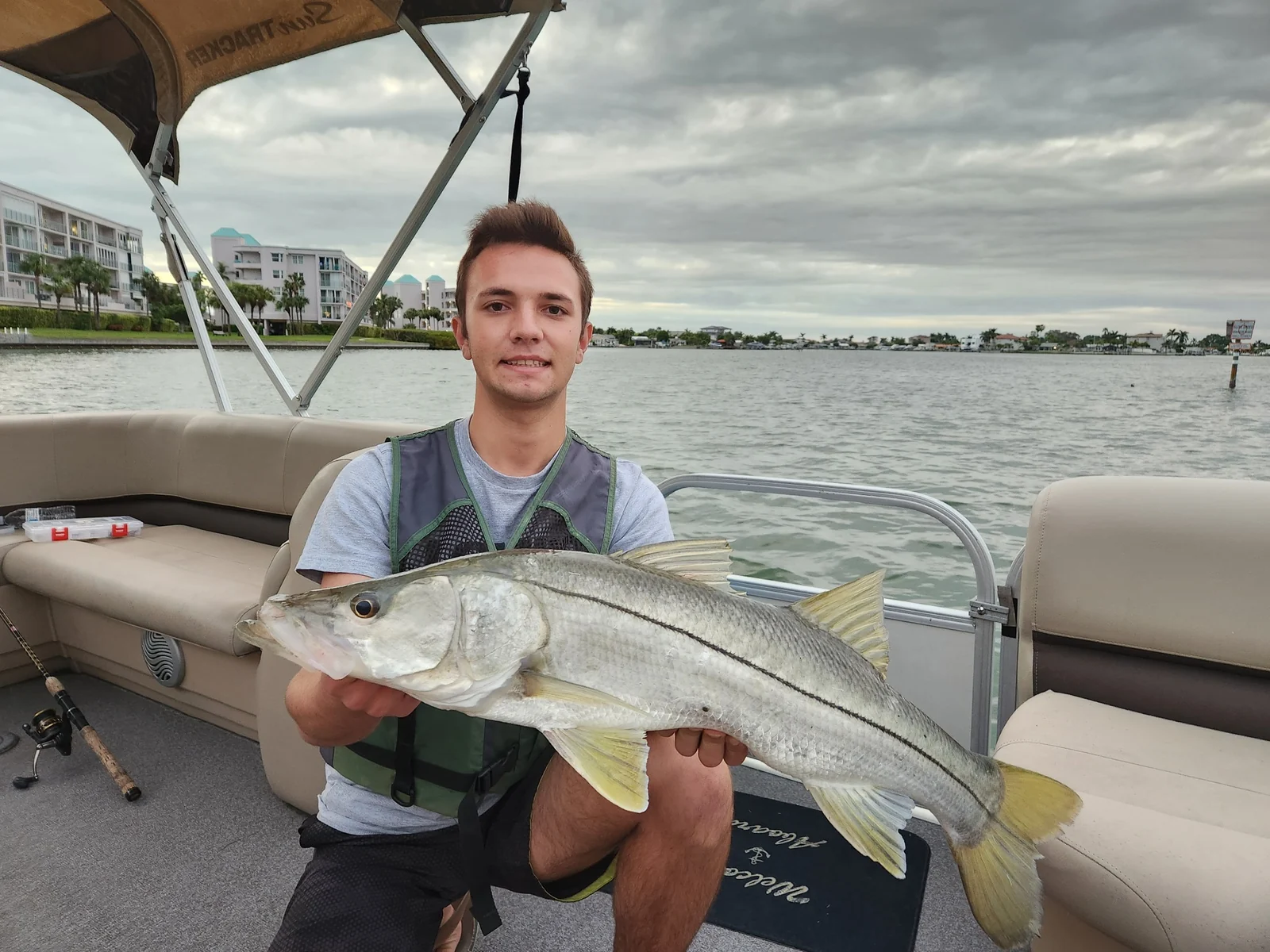
Cover photograph: an owner-authorised personal image of a common snook, shown as a species example. The catch location, date, weight and release outcome are unconfirmed. It is not evidence of a recent Tampa Bay catch or a demonstration of every handling step.