Search one accessible part of the bay
Youghal Bay on the eastern shore of Lough Derg, County Tipperary, is part of the mixed coarse fishery around Dromineer. Use the angling access information to choose a public or permitted bank position and confirm the route before you go. Do not cross private ground or cast through an active mooring. A bank with a sheltered angle and a short, clean retrieve is useful for learning what the lure is doing. The lake is large enough for wind to make one side of a bay far less fishable than another.
European perch are present in Lough Derg. Look for a transition where a few plants or stones give way to open bottom and the water deepens enough for small fish to travel. A perch may sit in a pocket and move a short distance to intercept prey. This is why a cast diagonally along an edge is worth trying before a straight cast into the middle. If the lure must cross a belt of growth on the way in, start it higher and lift it before the belt. A spot with a good-looking outer edge can still be useless if there is no clear retrieve.
Identify perch and choose what to imitate
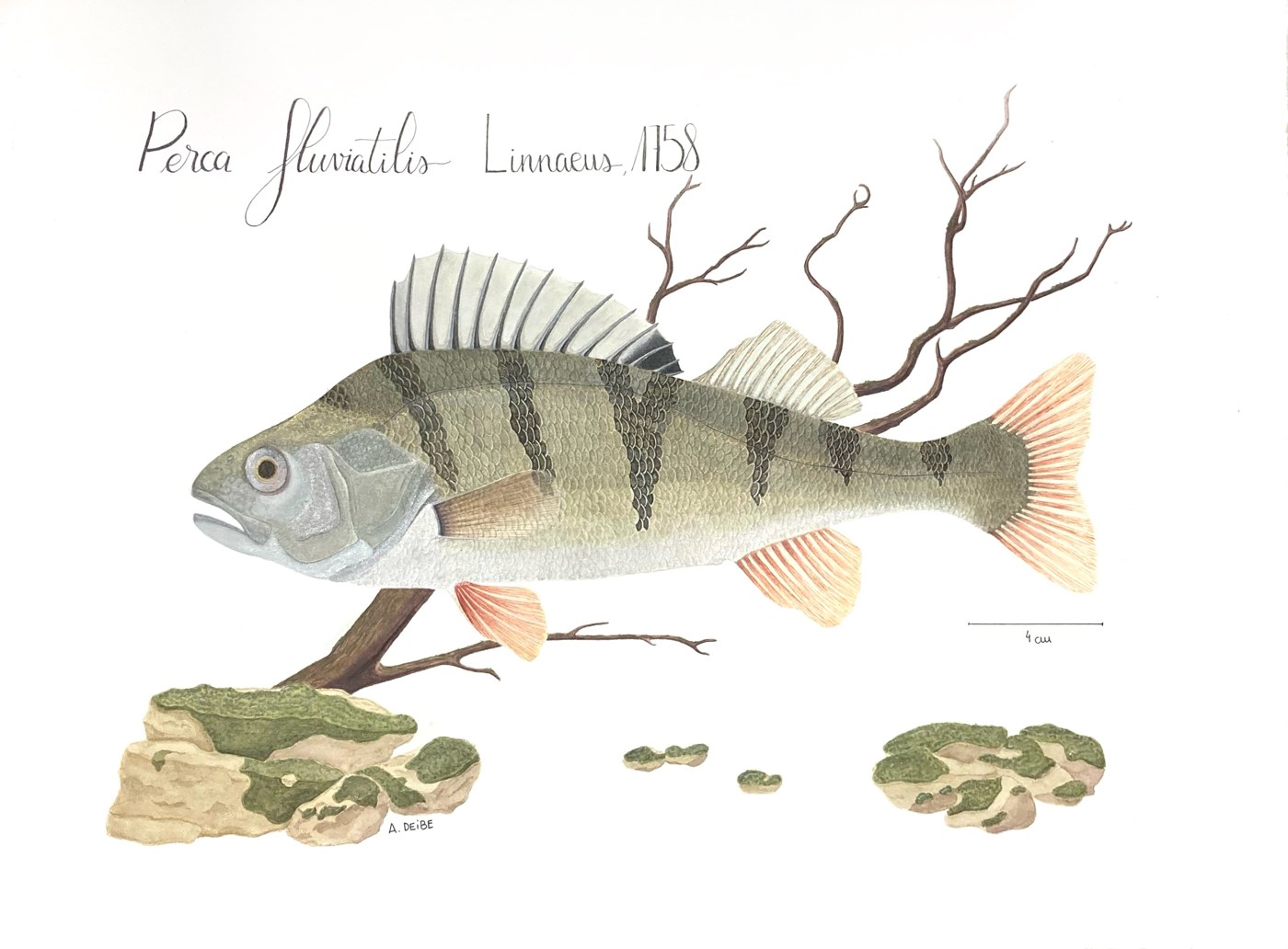
European perch, Perca fluviatilis, is a Eurasian fish introduced to Ireland. Its dark vertical bars, spiny first dorsal fin and reddish lower fins are useful features. Young fish can be pale and the bars can be faint. Ruffe, where present, are smaller-looking, mottled perch relatives with a different dorsal outline and no similar set of strong bars and bright lower fins. Use a combination of features. Large perch will take small fish, while younger ones can rely heavily on aquatic invertebrates. A small bait that suggests a worm or insect can therefore be useful even when there are no visible baitfish.
In cold water, start where the fish can sit near bottom without having to move far to feed. A few signs of bait in a deeper lane are more informative than a date. In late autumn into winter, a calm spell after the wind drops may let you work a useful lane at a depth you could not control earlier. Midday can be a practical time to fish because you can see the bottom and the line. Try lower light if you can still manage the tackle. Do not assume a particular hour is best for every bank or that a spell of cold weather always moves the fish beyond shore range.
Cover the edge with a light jig
Try a 6½ to 7½ ft light spinning rod, a 1000 to 2500 reel, 6 to 10 lb braid and 3 to 5 ft of 5 to 8 lb mono or fluorocarbon leader. For short casts a reel loaded with 5 to 7 lb mono is a simple alternative. A 35 to 65 mm paddletail or grub on a 2 to 5 g head is a useful starting combination. Choose a size 4 to 1 jig hook to fit the body. Feed the point straight through the plastic and check that it exits the centre. If the body sits bent, it may spin or roll and make it hard to distinguish a bite.
Cast obliquely along a clean edge. Let the jig fall briefly on a controlled line, then lift the tip and wind enough to take up slack. Pause just long enough to let the jig settle toward the fish. A short count on the first cast and a longer one on the next compare two depths without needing to know the exact drop. Try olive, brown or a muted baitfish finish in clear water. A darker outline or bright accent is worth comparing if visibility is poor. Change colour after you know you can fish the lure cleanly.
A tap on the fall, premature slack or a line moving sideways can be a bite. Tighten and sweep smoothly. If the lure repeatedly hangs on the same plant edge, start the retrieve sooner or lift before it reaches that point. If the deeper count always brings back vegetation, the fish may still be reachable just above it. A heavier head improves contact in open water but sinks into cover faster.
Stay above a snag with a drop shot
Tie a size 6 to 2 single drop-shot hook to the leader with a knot that leaves a long tag. Feed the tag back through the eye if needed so the hook stands out point up. Attach a 3 to 8 g clip-on weight about 25 to 50 cm below the hook. Nose-hook a 35 to 60 mm soft worm or narrow baitfish, leaving most of the body free. Use 5 to 8 lb leader in clear water and keep the presentation short around debris. Where pike are repeatedly taking the lure or cutting traces, leave the lane or choose an appropriate bite-resistant setup rather than persisting with fine line.
Cast across the open side of the edge and wait for the weight to touch down. Keep a gentle curve in the rod and quiver the bait in place. Move the weight a short distance every few pauses. At a shallow cast angle, the bait sits lower above bottom than the measured gap between hook and weight suggests. Increase the gap a little or cast shorter if the lure fouls. A fish may pull steadily or simply add weight. Wind into contact and lift instead of snapping the light hook free.
| What you encounter | First choice | What to change |
|---|---|---|
| Clean edge and moving baitfish | Jig with a short count | Compare a slightly lower pass |
| Hits repeat at one point | Drop shot held in place | Pause longer at that spot |
| Weed comes back on the hook | Shorter cast and higher bait | Move the weight to a clean pocket |
| Wind takes control of the line | Shorter cast from shelter | Change position before adding weight |
A useful first session
Start with a 3 g jig, a 50 mm plastic and a 6 lb leader. Work a near-parallel lane before testing one across the bay. If both are quiet, change the count while keeping the angle and retrieve steady. When you feel a hit at one point or see small fish holding there, switch to a 5 g drop shot with the hook 35 cm above the weight. Let it sit for several short movements. If the weight wedges repeatedly, shorten the cast and recover it earlier rather than dragging it through the obstruction. If a second well-controlled lane is quiet, move to a new permitted position with a different combination of shelter and depth. A short record of angle, count and contact helps you repeat the effective part of the session.
Interpret a bite before adding weight
A perch may touch the tail of a jig without taking the hook. If it happens several times at the same point and the lure comes back undamaged, try holding a shorter bait on the drop shot before reaching for a heavier jig. When the line repeatedly catches floating debris, check the tip and the leader before treating the pulse as a bite. A small group of perch can move along an edge. After a catch, repeat the cast once and then test a nearby angle if the next pass is quiet. If the small hook opens or the leader feels rough, replace it and reduce drag a little before returning to the same spot.
Local rules and handling
Follow Inland Fisheries Ireland's coarse fish and access rules, including the ban on using live fish as bait and the restrictions on retaining coarse fish. This plan uses artificial lures and prompt release. Keep the spiny dorsal away from your hand, use wet mesh and return the fish quickly.