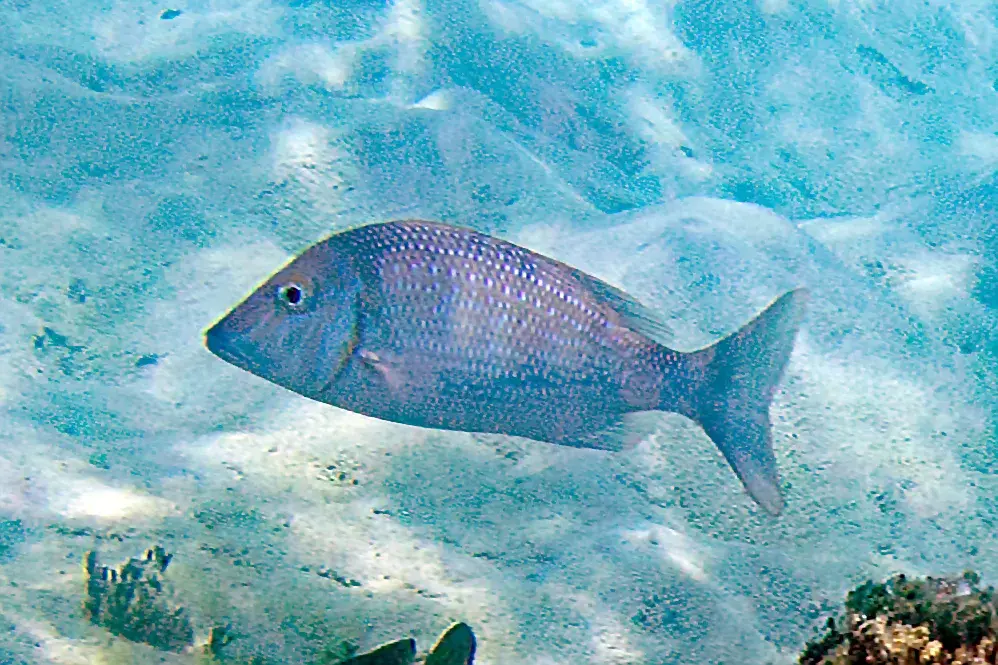
A good shallow-reef drop for orange-spotted grouper ends with the line still clear of the rocks. Give the bait enough weight to reach the edge, then lift it slightly so a fish can find it without the hook lying in a crack. If the boat moves too fast to keep that geometry, change the drift before you reach for more lead. A short trip on a licensed Abu Dhabi charter gives you a way to work these changes with someone who knows the access boundaries.
Pick a legal departure and a fishable edge
Al Bateen is one of the documented Abu Dhabi fishing charter departure areas. Ask the operator to confirm the meeting berth, authorisations and an eligible shallow reef or rock-and-sand edge within the trip's range. A departure point is not a fishing mark. The skipper should choose the actual water with the current protected-area and local limits in hand. Ask for a place with clear water under the boat and a distinct bottom edge, so you can see the change on the sounder and learn to keep your bait on the open side.
Orange-spotted grouper, *Epinephelus coioides*, is called hamour locally. The name hamour can be used broadly for groupers, so identify the fish before making any decision about keeping it. Look for a robust body and rounded tail, numerous small orange to reddish-brown spots over the head, body and fins, and faint irregular dark bars. A related species such as the Malabar grouper can resemble it closely. Spot colour changes with size and lighting, and similar species have been confused in the fisheries literature. If the skipper cannot confirm the identification promptly, return the fish.
The orange-spotted grouper ranges across parts of the Indian and western Pacific oceans. It uses coastal reefs and rocky ground, including turbid habitat, and the species also occurs in estuaries. Fish, shrimp, crabs and cephalopods feature in its diet. A narrow gap between a raised rock and sand is worth a test because it offers shelter beside a prey route. A strip of fish or squid gives a scent trail and can stay in place beside the edge. A small soft plastic covers more of the bottom change when the boat can move slowly along it.
For a first session, test a charted shallow band such as 5–12 m where the skipper confirms it is permitted and appropriate for release. That is a working range to simplify depth and drift control, not a statement that the species only lives at that depth. Cool-season mornings can offer workable conditions, but a tide turn on a windy day can still give poor boat control. Watch the line angle. A slight flow moving a bait past the lip is useful, whereas wind against tide can leave the boat slewing across it. During clear, bright conditions give shaded sides a test. In turbid water use an easier-to-track profile without assuming a particular colour triggers a bite.
| What is happening at the edge | First approach | Adjustment |
|---|---|---|
| Boat can hold near-vertical on open sand | Single-hook running sinker | Lift a hand span after contact and pause |
| Boat can drift parallel to scattered rock | Compact weedless paddle tail | Start on sand, then swim above the lip |
| Line sweeps into holes or under the boat | Reset the drift from the open side | Shorten scope before adding sinker weight |
| Bait comes back nipped but no steady weight | Shorten the strip | Keep the circle hook gap exposed |
Keep a natural bait close without dragging it
A 6–7 ft medium-heavy boat rod with a 4000–6000 reel, 25–40 lb braid and 1.5–2 m of 35–50 lb abrasion-resistant leader is a starting outfit. Slide a 25–60 g sinker and bead onto the leader, tie on a sturdy swivel and add a 40–60 cm trace of 35–50 lb mono or fluorocarbon. Finish with an inline circle hook around 2/0–4/0. Hook a short piece of permitted squid or fish through one end and leave the point and gap clear. Take the heavier sinker only if current demands it. If the line still makes a long arc, the extra weight is only carrying it farther into the snag zone.
Lower on the open side of a reef lip, follow the drop under light tension and stop as soon as the weight touches. Lift 20–40 cm, then hold the rod low enough to reel if a fish takes. Put the bait back down to confirm depth only after you have drifted clear of the snag. Light taps may be small fish. If weight builds and the line steadily moves, reel down to load the circle hook and keep winding. A sharp strike tends to pull the bait away. Maintain pressure as the fish turns, then adjust the drag in open water if needed. Keep the rod angle moderate and have the net ready rather than trying to lift the fish with the rod.
Swim the plastic past the high side
A 75–105 mm paddle tail on a 12–25 g weighted offset hook around 3/0–5/0 is a starting alternative. Thread the nose onto the keeper, turn the hook and reinsert the point just under the surface so the lure sits straight. Tie it directly to about 1.5–2 m of the same abrasion leader. Use the lighter end on shallow protected water and check that the hook gap is big enough for the body to collapse. A slim jighead with an exposed hook can also work on clean sand if you keep it away from the rocks.
Make a short cast ahead of a slow drift along the open side. Count down over sand on a test cast to learn when bottom arrives. On the next cast, wind a beat sooner and keep the lure just above the edge with slow, short turns. Pause only long enough for it to dip without resting in a crevice. If you see the line stop on the fall or feel sustained weight, wind down and sweep firmly to clear the soft plastic from the hook point. Try a silver-brown or translucent plastic in clear water and cream or a dark silhouette in stain. Keep depth and pace fixed for that comparison. Change the direction of the drift if repeated snags make a clean comparison impossible.
Before making a second pass, compare the direction of the line with the direction the boat is moving. A crosswind can push the bow one way while the lure trails another, so your cast may reach a rock even if the boat stays over sand. Make a short pass with one line until you know which side stays open. When the boat turns back, wind the bait all the way up. A bait towing through the turn often crosses the reef at exactly the angle you were trying to avoid. If the fish are holding close to one irregular block, a clean vertical drop on its open face is more repeatable than a long cast across the whole edge.
One shallow drift from Al Bateen
Suppose the skipper finds a permitted sand edge in 8 m with scattered higher returns and a light flow. Start from the sand side with a 35 g sinker, a 3/0 inline circle and a short squid strip. Touch once, lift about a hand span and hold for ten seconds. Repeat after a clean reset. If two drops come back with frayed leader, the boat is taking the trace across the edge. Shorten the drop and ask to reset parallel to the rocks. Retie after abrasion rather than lowering the same trace into another strong bite.
If the next two drops stay clean but get no attention, try the weighted plastic along the same seam. Suppose it ticks the bottom early on the first cast. Start the second retrieve sooner and finish it before the lure passes under the boat. If there is still no sign of life, look for a different lip or current angle. Fish that show only on the sounder could be something else. Given the fishery's documented pressure, keep the session shallow, avoid repeatedly targeting a single tight holding spot, and handle any catch quickly.
Confirm current licences, boundaries, seasonal rules, minimum sizes and retention limits with Environment Agency – Abu Dhabi and the federal ministry before fishing. Environment Agency – Abu Dhabi lists an individual licence requirement for charter guests. Confirm the current requirement with the regulator and your operator. Wear a PFD, keep a wet net ready and follow the skipper's release instructions.